
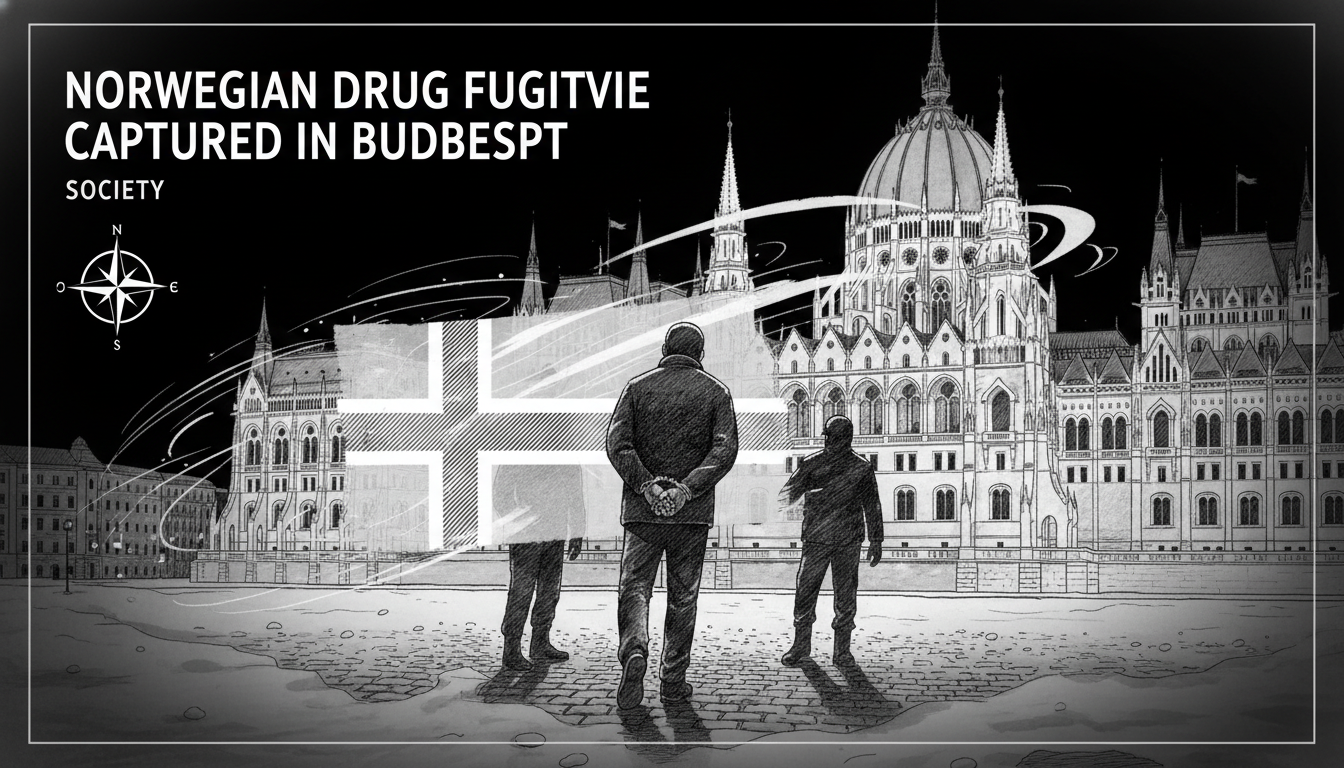
Norwegian police have captured a convicted drug trafficker in Budapest after an international manhunt spanning several months. The arrest underscores the tightening net around fugitives in Europe. The individual, who fled Norway after receiving a substantial prison sentence in 2024, was located and detained by Hungarian authorities on January 7th. He now awaits extradition to serve his term in a Norwegian prison.
From Norwegian Court to Hungarian Cell
The case began in a Norwegian courtroom last year. The defendant was found guilty on narcotics charges and handed a significant prison sentence. Rather than report to serve his time, he disappeared abroad. Norwegian authorities immediately issued national and international arrest warrants. The trail eventually led investigators to Hungary. Police in Oslo received critical intelligence during the Christmas period indicating the fugitive was in Budapest. This triggered a formal cooperation request with the Hungarian National Police.
Oslo Police District confirmed the arrest in a statement. "After being sentenced to a longer prison term in a narcotics case in 2024, the convict fled abroad," they wrote. "He has been nationally and internationally wanted."
The joint operation culminated in a successful arrest in the Hungarian capital. The man is currently held in a Hungarian detention facility. The legal process for his transfer to Norway is now underway. Norway's strict drug laws prescribe severe penalties for trafficking and distribution. This arrest signals that fleeing the country does not erase the sentence.
The Mechanics of a European Manhunt
This arrest was not a matter of chance. It resulted from structured international police cooperation under frameworks like the European Arrest Warrant (EAW). The EAW system, operational since 2004, streamlines extradition between EU member states. It removes much of the political bureaucracy that once hindered such processes. Once a warrant is issued, law enforcement agencies across the Schengen Area are obligated to act on it.
"The effectiveness of this system relies on real-time information sharing and mutual trust between police forces," says a legal expert familiar with Nordic extradition cases. "The fact that intelligence was acted upon so swiftly between Christmas and the early New Year shows this machinery works around the clock."
Norway, while not an EU member, is part of the Schengen Agreement and participates fully in the EAW system through its association agreements. Its extradition treaty with Hungary is similarly robust. These agreements ensure that a sentence passed in Oslo is recognized as valid in Budapest. The primary focus for Hungarian authorities is verifying the legality of the Norwegian warrant and confirming the identity of the individual. Formal challenges from the fugitive's legal counsel can cause delays, but they rarely prevent the eventual transfer.
A Stark Warning to Fugitives
The arrest sends a clear message to others contemplating a similar escape. Europe's internal borders are open for travel but are increasingly sealed for those running from justice. Police databases are interconnected, and airline passenger information is routinely screened. While a fugitive might evade capture for weeks or months, the long-term prospects of remaining free in Europe are poor. The resources available to international police networks are formidable.
This case also highlights the serious view Norway takes on drug crimes. Penalties for large-scale trafficking or importation are among the harshest in Scandinavia. The country's policy focuses on supply disruption and deterrence. Courts impose lengthy sentences to reflect the societal harm caused by narcotics. Allowing a convicted trafficker to avoid prison would undermine the entire judicial principle. The police and prosecuting authority thus dedicate considerable effort to tracking down those who flee.
What Happens Next in the Extradition Process
The man now enters a procedural phase governed by Hungarian law and international treaty. Hungarian courts will review the Norwegian arrest warrant and the supporting documentation. They must ensure the request complies with legal standards and that no fundamental human rights issues would be violated by the extradition. The process typically takes several weeks, though it can extend if the fugitive mounts a legal challenge.
Once Hungarian authorities grant the extradition, Norwegian police will arrange for his escorted transport back to Norway. He will be delivered directly to the correctional service to begin serving the original 2024 sentence. There is no new trial; he returns solely for the purpose of incarceration. The cost of the international operation and transport is generally borne by the requesting state, in this case, Norway.
"This is a textbook example of international cooperation functioning as intended," the Oslo Police statement concluded. "He is now imprisoned in Hungary awaiting extradition to Norway to serve his narcotics sentence."
The successful capture closes a frustrating chapter for Norwegian prosecutors. It also reinforces a fundamental rule of the modern European justice landscape: a national border is not a shield. A crime sentenced in one country becomes a liability across the continent. For this fugitive, the journey that started with a conviction in Norway will end where it began—in a Norwegian prison cell.