
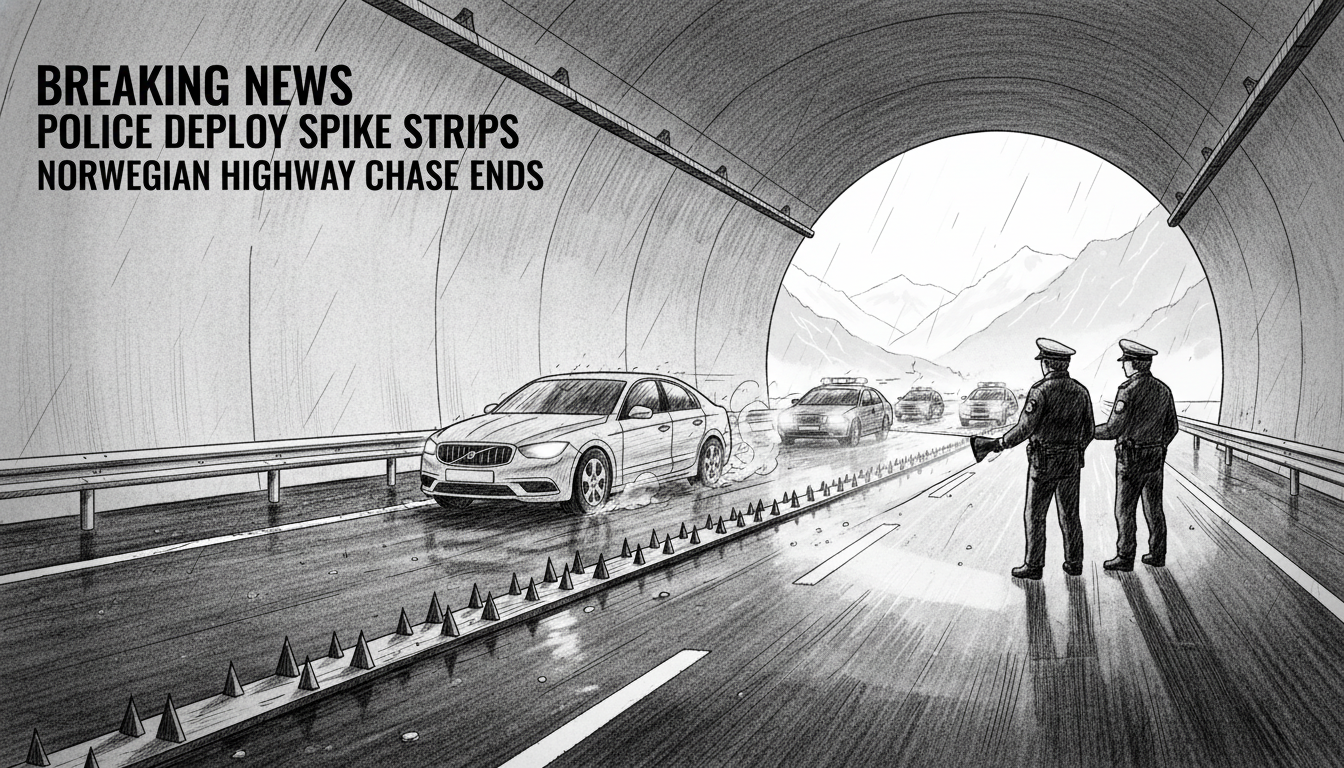
Norwegian police deployed spike strips to stop a driver who refused to pull over during a routine traffic check on the E6 highway near Lillestrøm. The dramatic pursuit occurred during overnight hours and concluded in the Eidsvoll Tunnel after the vehicle drove over the spike mat placed by officers.
Operational commander Atle Vesttorp confirmed the driver now faces multiple charges. These include failing to stop for police control, driving without a valid license, and serious speeding violations. Emergency police units recorded the vehicle traveling at 179 kilometers per hour in a 110 km/h zone.
This incident highlights ongoing challenges in Norwegian traffic enforcement despite the country's generally strong road safety record. Norway maintains some of Europe's strictest traffic regulations, particularly regarding speeding and license requirements. The E6 highway serves as a critical transportation artery connecting Oslo to northern regions, making such high-speed pursuits particularly dangerous.
Norwegian police procedures authorize spike strip deployment when drivers pose immediate public safety risks. The Øst police district, responsible for this region, has dealt with similar incidents previously. Their operational protocols emphasize minimizing risk to other motorists while apprehending fleeing vehicles.
Police vehicles followed the driver through multiple municipalities before the successful spike strip deployment. The location choice outside the Eidsvoll Tunnel demonstrates tactical planning to contain the situation. Tunnel incidents present unique dangers, as stopped vehicles can create hazardous conditions and complicate emergency response.
The legal consequences for the driver could be substantial under Norwegian law. Driving without a valid license typically carries severe penalties, including potential imprisonment for repeat offenders. Combined with the speeding violation and failure to comply with police orders, this case will likely result in significant legal action.
Norwegian authorities continue to prioritize road safety through both enforcement and public education campaigns. Recent years have seen increased focus on highway monitoring and rapid response capabilities. This incident serves as a reminder that even in a country known for orderly driving, dangerous situations can develop rapidly.
International readers should understand that Norway's traffic enforcement operates with substantial authority and technical resources. The country's extensive highway network, including challenging Arctic routes, requires sophisticated policing methods. This professional response demonstrates Norway's commitment to maintaining its reputation for safe roads.
What happens next for the driver involves Norway's structured legal process. The police have filed formal charges, and the case will proceed through the judicial system. Norwegian courts typically handle such traffic violations with seriousness, particularly when public safety was endangered.