
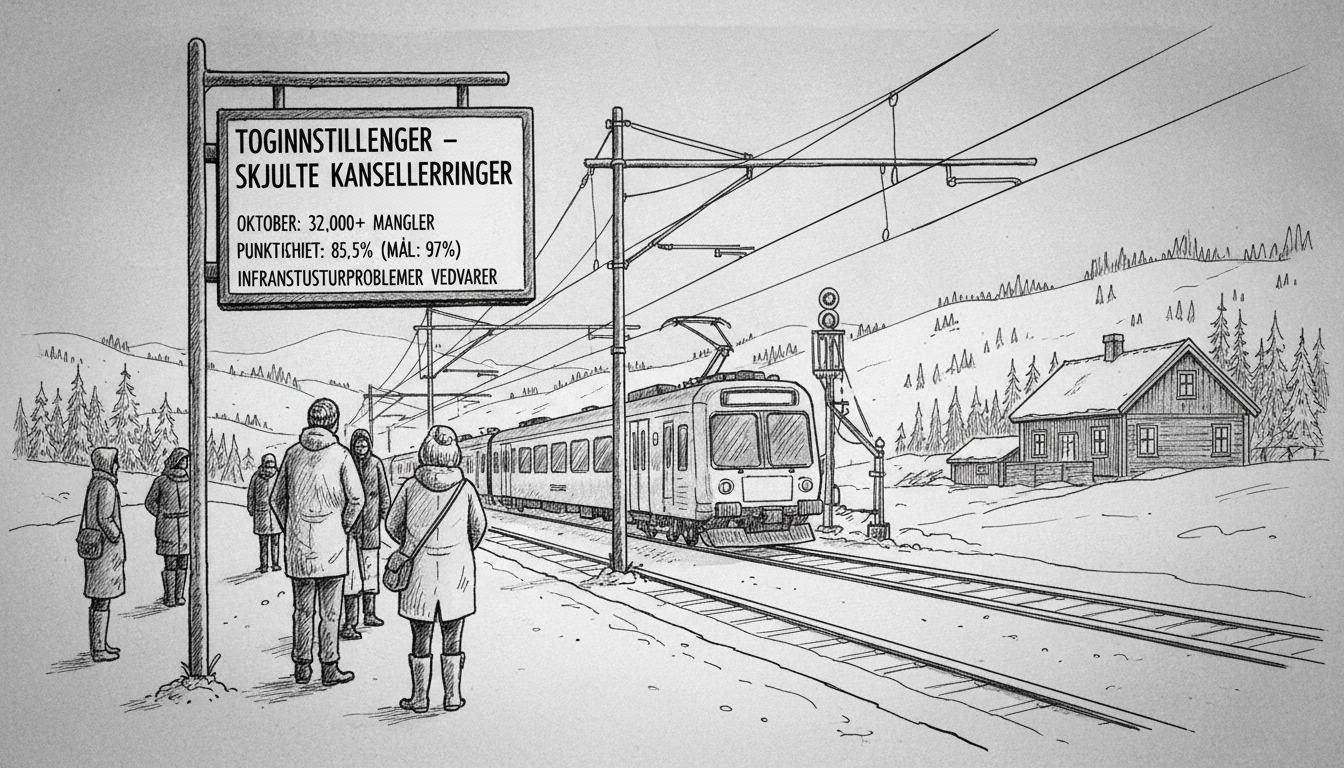
Norwegian train passengers face growing frustration as new data reveals thousands of cancellations never appear in official statistics. Delays, cancellations, and bus replacements have become familiar terms for commuters across the country.
Rail infrastructure company Bane Nor maintains two statistics tracking whether trains run on schedule. But planned cancellations for maintenance work don't count toward punctuality measurements. So far this year, over 32,000 planned cancellations for track work remain unrecorded in official reliability figures.
Anne Kirkhusmo, Bane Nor's press officer, explained the discrepancy. "Trains completely or partially canceled due to planned railway work aren't included in punctuality statistics because they're not part of the planned route offering," she said in a statement.
These planned cancellations come on top of unplanned service disruptions that occur unexpectedly. Kirkhusmo acknowledged the problem affects passenger trust. "We're obviously concerned that people should experience having trust that the train runs when it should," she said.
Current reliability figures paint a concerning picture. The national target stands at 97 percent reliability, but this year's average reaches only 93.9 percent. October's performance dropped dramatically to 85.5 percent reliability.
Punctuality during Oslo rush hours tells an even worse story. Only 63.4 percent of trains arrived on time in October, far below the 85 percent target.
Marius Holm, communications director for train operator Vy, expressed frustration with the situation. "We're frustrated that Norway's infrastructure has many occurring faults that force us to cancel trains unexpectedly," he said. "It's not satisfactory, and we understand very well that customers aren't happy with the service as it's been this autumn."
For October, only 78 percent of national passenger trains ran as scheduled by mid-month. The year-to-date figure reaches 87.1 percent, still below the 90 percent punctuality target.
The railway's challenges extend beyond statistics. Since a quick clay landslide at Nesvatnet in Levanger in late August, no trains have run north of the landslide area. Half of the Trønder Line and Nordland Line remain without train service.
Rikke Lind, managing director of SJ Norway, emphasized the broader implications. "Train is part of our infrastructure and part of our emergency preparedness," she said. "That we don't have a train service to rely on is bad for Norway and bad for individual customers."
Lind apologized directly to passengers for over 5,000 full and partial cancellations this year. "Way too many. To customers I just want to say sorry. This isn't how we want it," she stated.
The Railway Directorate plans to introduce "passenger punctuality" measurements starting next year. This new approach will count delayed passengers rather than just delayed trains.
Jan Frederik Geiner, division director at the Railway Directorate, explained the shift. "We believe it will help us implement measures more targeted where most passengers are affected by delays," he said. The system will use sensors and machine learning to track passenger impacts.
With approximately 250,000 daily train passengers in Eastern Norway alone, the reliability crisis affects a substantial portion of the population. The situation highlights how infrastructure challenges can disrupt daily life despite Norway's reputation for efficiency.