
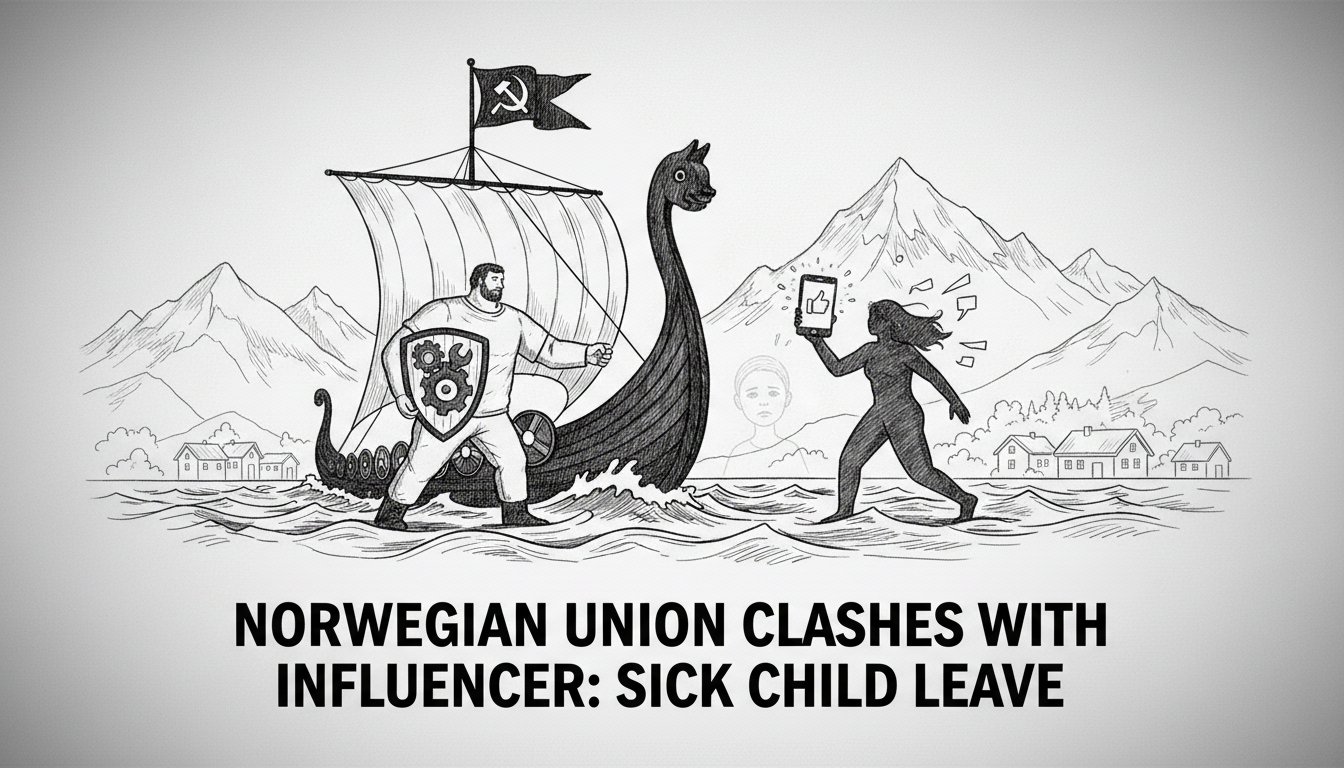
A public debate has erupted in Norway over parental responsibilities and workplace rights when children fall ill. The discussion pits a major labor union against social media influencers and touches on deep questions about Norway's welfare model. At the heart of the matter is whether parents should lose pay to care for a sick child.
Maren Oddvang, leader of the children and upbringing section within Fagforbundet, Norway's largest trade union with over 400,000 members, stated the union's position clearly. 'Parents should not lose wages for taking care of sick children,' Oddvang said. She argued that caring for sick children is not solely a parental responsibility. 'When employees are in a life phase with small children, employers must expect a certain amount of sick leave. It is then the employer's responsibility to facilitate this,' she added.
This statement came in response to commentary from small-child mother and influencer Malin Beathe Nyborg Olsen. In a viral video, Olsen criticized parents who break the 48-hour rule after a stomach virus in kindergarten. She suggested it was sometimes better for parents to 'give up their salary to take care of their children.'
The union leader strongly disagrees with that premise. Oddvang points to Norway's existing legal framework. Norwegian parents have a statutory right to care leave, typically ten days per year for one to two children. Most collective bargaining agreements also include life-phase policies for accommodation. The problem arises when those ten days are exhausted. Parents often must use their own sick days or, in the worst case, their vacation days. 'Some children are often sick,' Oddvang noted, highlighting the practical challenge.
The issue has tangible consequences beyond the home. Kindergarten staff are directly affected when sick children are sent in. Statistics show this occupational group has double the sick leave rate of the rest of the workforce. 'But just as important: It is not good for a child to be in kindergarten or school when they are not well,' Oddvang emphasized.
From the employer's side, Nina Melsom, Director of Working Life at the Confederation of Norwegian Enterprise (NHO), said most employers are flexible. 'In cases where there is a need for more than the ten days, our experience is that it is resolved well at the individual workplace,' Melsom wrote. Solutions can include additional leave, vacation days, remote work agreements, or using one's own network.
The core of this debate reveals a tension in Norwegian society. Norway prides itself on a robust welfare state and strong worker protections. The system of care leave is a cornerstone of this. Yet, the reality for many families, especially those with children prone to illness, is that ten days may not suffice. The union's stance pushes the responsibility onto employers to create more flexible, permanent solutions within the work-life framework. The influencer's view, while controversial, points to a parental guilt and pressure that the system does not fully alleviate. This is not just about sick days. It is a test of how Norway's famed work-life balance functions under real strain. The outcome will depend on continued dialogue between unions, employer organizations, and the government in Oslo.