
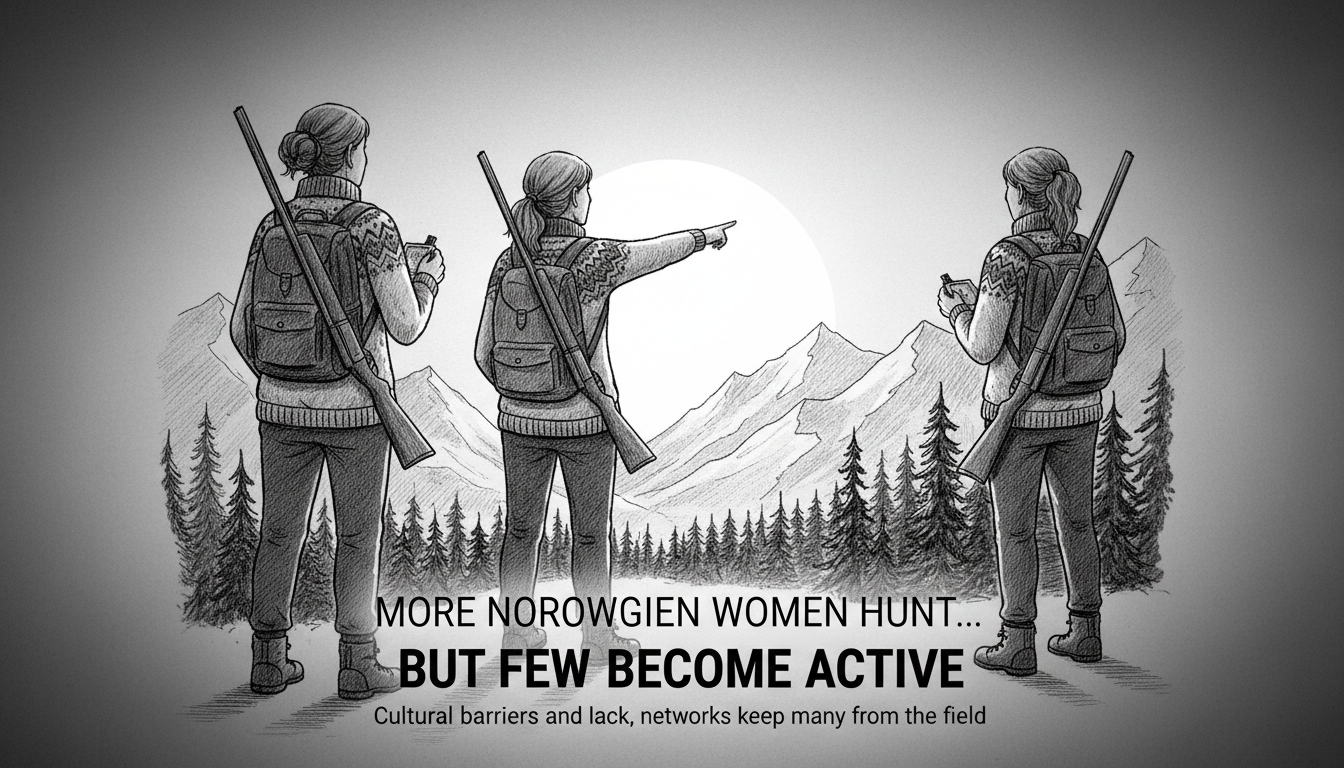
Three women move quietly between birch trees and willow thickets on an early autumn morning. They carry rifles and wear orange safety hats. The fog hangs low over Totenbygda Kolbu but breaks up toward the hillside.
These women represent a growing movement in Norwegian hunting. Statistics show more women than ever are passing the hunter's exam. Yet many never actually go hunting.
Data from Norway's official statistics bureau reveals a historic shift. Never before have so many women obtained hunting licenses. But the numbers of active hunters tell a different story.
Among those who actually go hunting, women remain a small minority. The 2023/2024 hunting report recorded 119,000 active male hunters compared to just 11,000 women.
"Many take the hunter's exam, but far from all get started. That's a shame," said Anne Sophie Marthinsen Fløgum, a 46-year-old hunting leader.
Research shows women's motivations for hunting differ from men's. Women are more motivated by dogs, food, and social community than men typically are.
"Hunting gives me an adrenaline rush - it goes from zero to one hundred. But the most important thing for me is working with my dog, Molte," smiled Marte Marie Taralrud, 32.
After hours in the forest, the women gather around a campfire. The smell of coffee and cheese sandwiches fills the crisp air. They discuss why so few women become active hunters despite passing the exam.
"Historically, hunting has been male-dominated, especially elk hunting. Team spots are almost inherited, making it difficult for outsiders without networks to join - particularly women," noted Gunn-Marie Evensen, 44.
The Norwegian Hunting and Fishing Association (NJFF) recognizes these barriers. Their communications chief, Line Lillebø Osfoss, is a hunter herself. She understands the challenges women face.
"Basic training with weapon handling and being at a shooting range - there's so much around this that might feel foreign and creates an extra barrier for women compared to men," she explained.
Osfoss said about half of those who pass the hunter's exam never actually go hunting in their first three years.
This prompted NJFF to launch a women's initiative in the mid-2000s. They organized special courses, shooting weekends, and hunts for women.
"It worked; many more women found a way into hunting communities. Many wanted safe environments where everyone could feel equally 'stupid'," Osfoss said.
Anna Synnøve Røstad Nordgård from Trøndelag identifies with this experience. The 41-year-old started hunting as an adult.
"It felt like a huge step the first time I went to the shooting range alone after the course. I contacted Trondheim Hunting and Fishing Association and asked if someone could be my mentor. That made it much easier," she recalled.
Nordgård describes the feeling of mastery when everything finally clicks.
"I want to manage it myself. The sense of achievement from going out alone, doing all the preparation, and making my own decisions means a lot," she said.
When asked how to get more women into hunting, Nordgård points to early recruitment and more female instructors.
"NJFF already does good work, but I miss more female instructors. And I believe starting early helps. Bring your daughters, not just your sons," she suggested.
Around the campfire during lunch break, the three hunters offer a simple explanation: networks, safety, and that first step.
"I think many women are afraid of making fools of themselves," said Gunn-Marie.
The solution, they believe, lies in targeted women's activities, mentors, and visible female instructors.
No game was caught on the hillside that day. But for the women around the fire, that wasn't the point. They wanted to convey something more important.
"Stop evaluating. Just do it! If there's anything we can help with, we're happy to do so," said Gunn-Marie.
"Absolutely. Just get in touch. That threshold is low," Anne Sophie added with a smile.
Analysis: The hunting statistics reveal a familiar pattern across many traditionally male-dominated activities. While formal barriers have been removed, cultural and social obstacles remain. The inheritance of hunting spots within families creates invisible gates that keep newcomers out. This isn't unique to Norway - similar patterns appear in many countries where traditions run deep.
FAQ
What is the hunter's exam in Norway?
The hunter's exam is a mandatory certification required for hunting in Norway. It covers wildlife knowledge, hunting ethics, safety procedures, and marksmanship.
Why do fewer women become active hunters after passing the exam?
Experts point to several factors including lack of networks in male-dominated hunting communities, discomfort with firearms, and fewer female mentors and instructors.
What organizations help women get into hunting?
The Norwegian Hunting and Fishing Association runs women-specific programs including courses, shooting weekends, and mentorship opportunities to lower barriers for female hunters.