
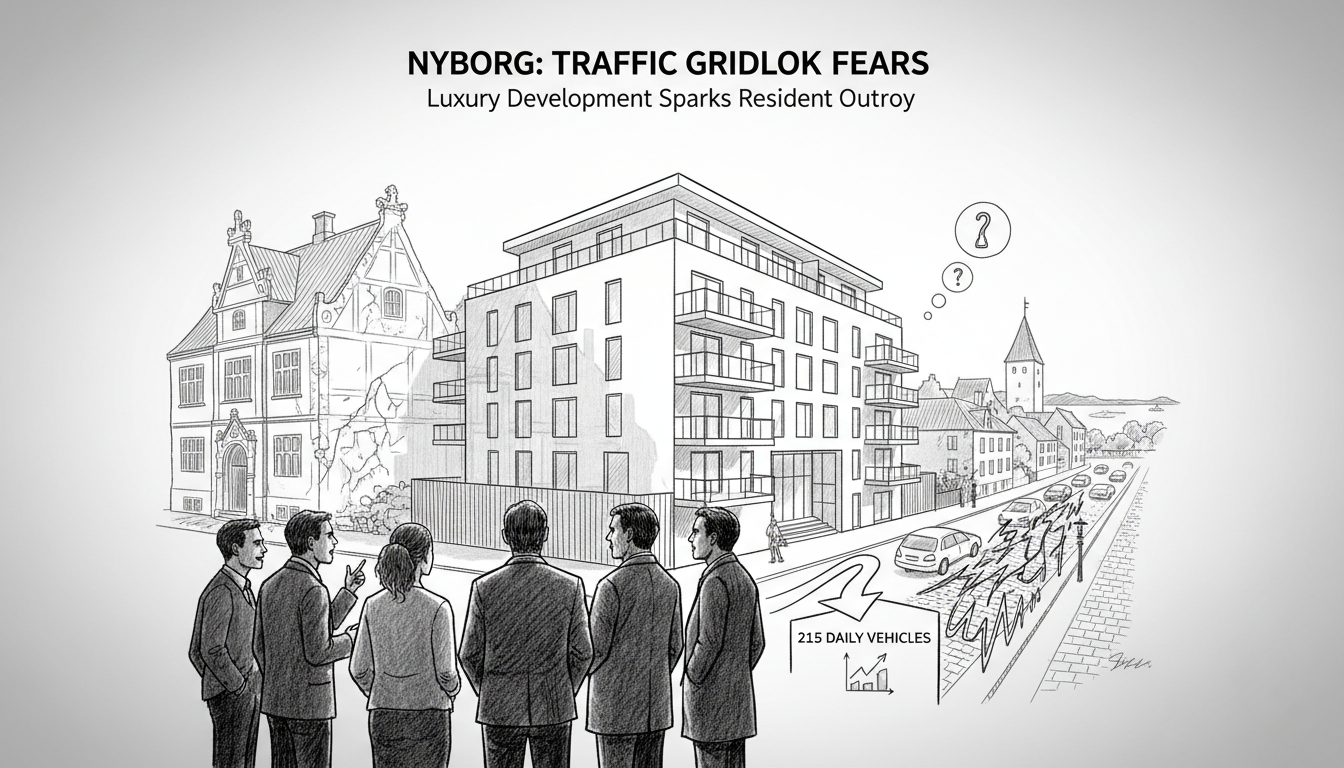
Louise Mathiasen stands confused near Nyborg Fjord as she reads an unpublished traffic report. The document examines what would happen if two new residential blocks were built just steps from her home on Sølystvej.
The proposed development would replace a historic 19th-century property with 66 exclusive apartments. This has divided opinions in the coastal town on Funen, Denmark.
Louise focuses on practical concerns rather than architectural preservation debates. She worries about the report's conclusion that traffic would increase by 215 vehicles daily while still claiming traffic flow would remain smooth.
'But 215 extra cars - that's crazy,' Louise says, gesturing toward the narrow Sølystvej road. 'How can they conclude this won't become a problem?'
She points to existing dangerous situations with hard braking and vehicles struggling to navigate turns. The report itself acknowledges Sølystvej's poor visibility and recommends reducing speed limits to 30 km/h.
Finn Jørgensen, another neighbor, shares her skepticism. 'I don't think the report describes the real world,' he states.
Many residents currently park with wheels on sidewalks to allow traffic passage. Finn worries added vehicles might lead to complete parking restrictions near their properties.
The controversy extends beyond traffic concerns. The distinctive main building dates back to 1895 and holds cultural significance for Nyborg residents.
Nyborg Municipality previously classified the structure as 'worth preserving.' The current property owner, Bøg Madsen Properties, faced multiple rejections when seeking permission to demolish the vacant building.
The political landscape shifted earlier this year. Both the Liberal Party and a majority of Social Democrats now support the scaled-down project, reduced from original plans for 75 apartments across seven stories to 66 units in six-story buildings.
Suzette Frovin, a local council candidate, remains firmly opposed. 'For us, the absolute most important thing is how we treat the town's identity and history,' she explains.
Having read the traffic report and living in the neighborhood herself, Frovin questions its conclusions. 'Honestly, I have great difficulty seeing how we can manage traffic with so many extra cars daily,' she says.
Kaj Refslund, the Liberal Party group chairman, acknowledges existing traffic challenges in the Sølyst area. He calls residents' concerns 'completely understandable' and promises comprehensive traffic planning with resident consultation.
Municipal authorities plan to organize a public meeting when the new local plan proposal enters public consultation, likely next spring.
Finn Jørgensen remains skeptical about public consultation effectiveness. 'There are two parties on the council that will realize this project with devil's force and power,' he says. 'Unfortunately, I'm pretty sure we'll end up holding the short straw.'
The development debate highlights common tensions between preservation and progress in Danish communities, where traffic impacts often become central to planning discussions.