
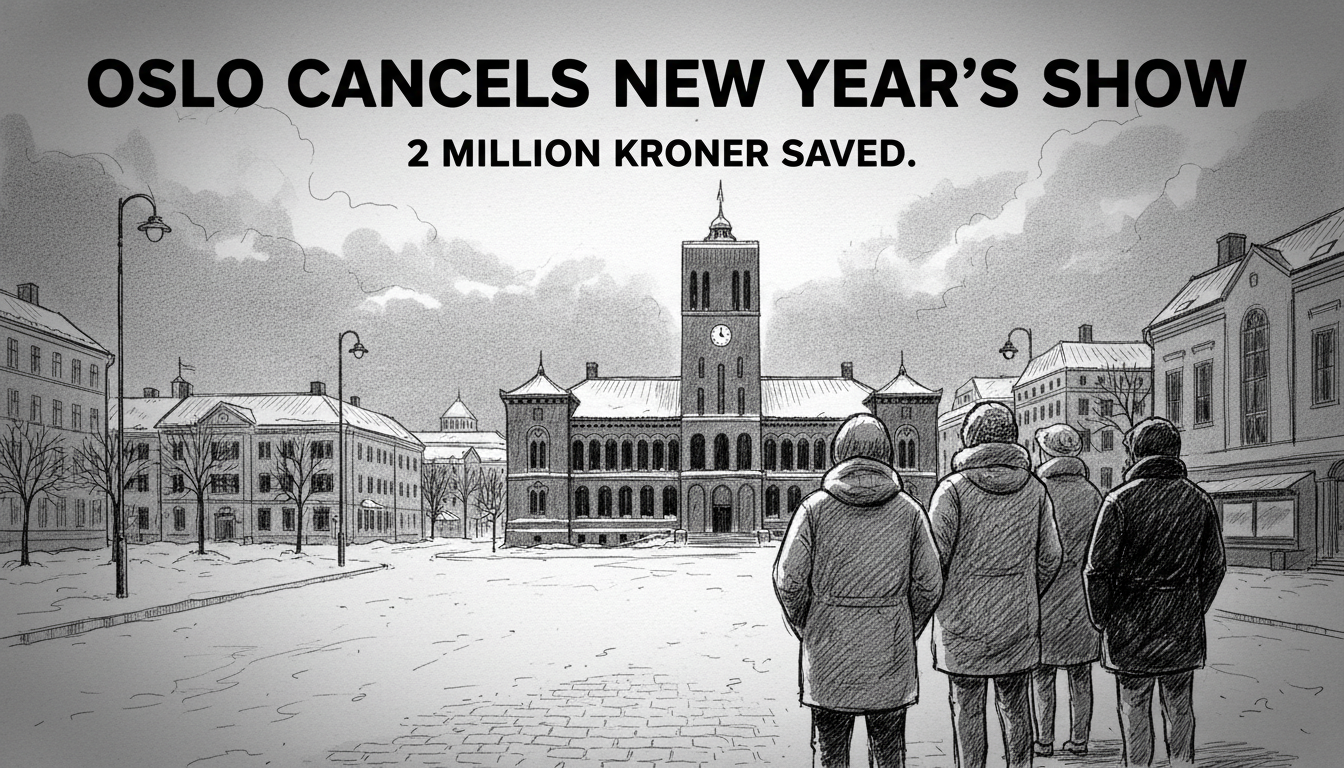
Oslo's City Hall Square will remain dark and quiet this New Year's Eve. City Council Leader Eirik Lae Solberg has confirmed the complete cancellation of the official municipal celebration. This marks a definitive end to a tradition that has faced escalating costs and public ridicule. The decision follows last year's poorly received light show, which cost taxpayers nearly two million Norwegian kroner. Solberg stated the municipality must prioritize severe budget cuts over celebratory displays.
From Fireworks to Fiasco: A Six-Year Retreat
The cancellation is the final step in a gradual retreat from large-scale public festivities. Oslo ceased its traditional fireworks display six years ago, citing environmental and safety concerns. The move aligned with a growing Scandinavian trend away from private and public pyrotechnics. Municipalities across Norway have increasingly promoted silent or light-based alternatives. Oslo attempted this transition with its 2022 laser and light show on Rådhusplassen. Public and critical reception, however, was devastatingly negative. Citizens and commentators labeled the event 'pathetic,' 'a scam,' and 'a hopeless waste of money.' That widespread criticism now serves as the primary justification for ending the experiment entirely. 'It unfortunately was not as good as we had hoped,' Solberg acknowledged in his statement, underlining the political embarrassment.
The Weight of Municipal Budgets
The core driver of this decision is fiscal pressure, not just public opinion. Oslo, like many Norwegian municipalities, faces tightening budgets amid rising costs for core services like healthcare, education, and infrastructure. Funding a celebratory event deemed non-essential becomes politically untenable. 'The City Council therefore does not prioritize spending money on fireworks or laser shows on New Year's Eve, in a situation where the municipality must save a lot of money,' Solberg wrote. This language frames the cancellation as a responsible austerity measure rather than merely a reaction to failure. It shifts the narrative from one of artistic or technical shortcomings to one of prudent financial stewardship. The saved funds, approximately two million kroner, will be redirected within a complex city budget facing significant constraints.
Expert Analysis: The End of a Public Mandate?
Political and cultural analysts see this move as indicative of a broader shift. 'This decision reflects a reevaluation of the municipality's role in providing collective celebration,' says Dr. Kari Noreng, a sociologist at the University of Oslo who studies public festivals. 'When an event fails to meet public expectation and carries a high cost, its social mandate evaporates. The criticism last year was so potent it removed any political will to try again.' Noreng points out that the failure of the light show created a perfect storm. It allowed officials to cancel an expensive line item while appearing responsive to public sentiment. The environmental argument against fireworks, once the primary motive for change, has now been overtaken by economic pragmatism. The debate is no longer about finding a suitable replacement, but about whether the city should fund any replacement at all.
A Scandinavian Trend Towards Quiet Celebrations
Oslo's path mirrors developments in other Nordic capitals. Copenhagen has significantly scaled back its official fireworks display, focusing instead on a concert and encouraging citizen-organized, decentralized events. Stockholm has also increased restrictions on private fireworks use within city limits, promoting public viewing areas for those who still wish to see them. The push is driven by a combination of animal welfare concerns, environmental impact from particulate matter, and the strain on emergency services. Norway's own Directorate for Civil Protection (DSB) annually advises caution with private fireworks. Oslo's cancellation represents the logical extreme of this trend: if the public alternative is too costly and unpopular, and private use is discouraged, the result is a quieter, more subdued transition into the new year. The responsibility for celebration is effectively privatized, returned to households and private gatherings.
Public Reaction and What Comes Next
Initial public reaction to the cancellation is mixed. Some citizens applaud the cost-saving measure, agreeing that public funds are better spent elsewhere. 'It's the right decision,' commented one Oslo resident online. 'Last year's show was an embarrassment. If you can't do it properly, don't waste our money.' Others lament the loss of a potential communal focal point. 'It's sad that a city of Oslo's stature can't manage a dignified public celebration,' countered another. 'It feels like a retreat from creating shared public joy.' City Council Leader Solberg did not offer a blueprint for future years, leaving the long-term status of an official Oslo New Year's event in doubt. Instead of planning another municipal event, he issued an appeal to the city's residents. His statement concluded by encouraging Oslo's citizens to 'celebrate the new year together with neighbors and friends in their local areas,' effectively decentralizing the celebration.
The Future of Festivity in the Capital
The cancellation sets a precedent that may be difficult to reverse. Reinstating a costly municipal celebration in future years would require both a dramatic improvement in city finances and a compelling new concept that guarantees public approval. Neither is certain. This move may signal a more permanent change in how Oslo marks major occasions, with a greater emphasis on supporting district-level or privately organized events rather than staging a single, costly central spectacle. The darkened Rådhusplassen this December 31st symbolizes a pragmatic, if somber, approach to governance. It prioritizes fiscal health and responsive leadership over symbolic spectacle. As other world cities invest in ever-more elaborate displays, Oslo has chosen a different path, one defined by restraint and a direct, if painful, response to public feedback. The question for future city councils will be whether the collective desire for a central, shared celebration will eventually re-emerge, strong enough to justify the expense and risk.