
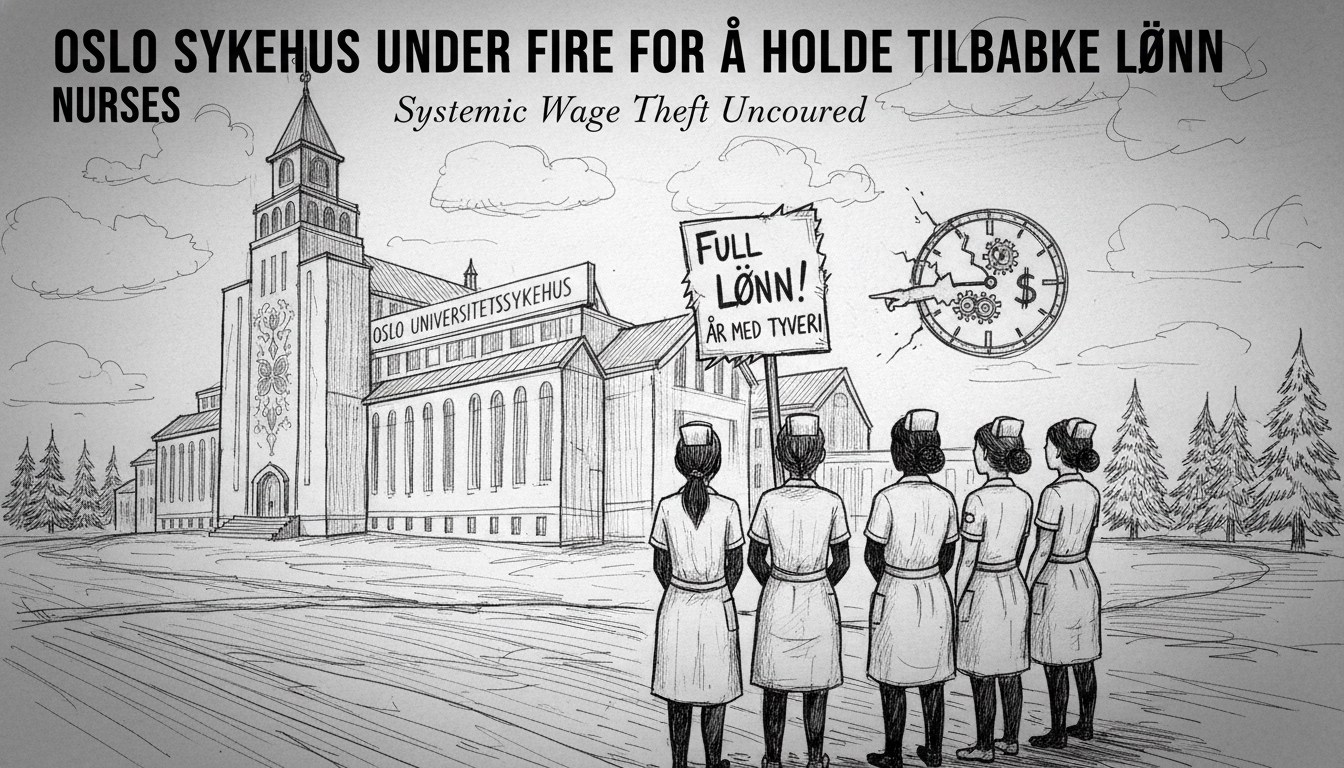
Hundreds of nurses at Oslo University Hospital have been underpaid for up to eight years due to errors in the Gat shift scheduling system. The hospital now offers to repay wages for only four of those years, sparking a major labor dispute. The Norwegian Nurses Association demands full repayment and has engaged legal counsel. This case exposes systemic payroll failures within Norway's largest public employer and tests the limits of national statute of limitations laws.
The error stems from incorrect registrations of so-called 'long shifts' worked on weekends. Nurses working these day shifts on Saturdays and Sundays were entitled to a special supplement of approximately 115 kroner per hour, totaling around 345 kroner per shift. For a nurse working both weekend days, the missing pay nears 700 kroner weekly. The mistake went undetected across roughly 20 different hospital sections.
Therese Heggedal, the enterprise trust representative for the Norwegian Nurses Association at the hospital, expressed deep disappointment. 'We are disappointed they will not pay more. We want them to pay out everything they owe,' Heggedal said in an interview. She argued the error was nearly impossible for individual nurses to spot within the complex scheduling system.
Hospital management cited the statute of limitations as their rationale. HR Director Susanne Flølo stated the hospital follows the general three-year limitation period for wage claims. 'In cases where incorrect payment occurs, OUS adheres to the Limitation Act,' Flølo explained. The hospital extended repayment to four years because a related error was discovered in the third quarter, resetting the clock. Initial mapping suggests 400 to 500 employees are affected 'to some degree,' with amounts ranging from 150 kroner per year upwards over the last four years.
This dispute carries significant implications for Norway's public sector labor relations. Oslo University Hospital employs over 25,000 people, making it one of the world's largest hospitals. The nurses' union points to Paragraph 10 of the Limitation Act, which allows for repayment of missing wages for up to ten years under certain conditions. Their legal team is now examining this avenue.
The conflict reveals a tension between administrative efficiency and worker rights. Hospital management argues employees working shifts know they should receive evening supplements and have full overview of their working hours and paid wages. 'Errors are discovered continuously, by both employees, union representatives and employer, and the errors are solved at the individual workplace,' Flølo stated. The union counters that the system's complexity makes individual oversight unrealistic.
This is not an isolated incident. The hospital referenced a similar case from one year ago, suggesting the error pattern should have been detected earlier. The union says it was unaware the problem spanned multiple departments. The outcome will set a precedent for how large public institutions handle historical payroll errors and their responsibility to affected staff. With nursing shortages a persistent challenge in the Nordic welfare state, fair compensation is a critical retention tool. The hospital's final decision on repayment will be closely watched by unions across Norway's public health sector.