
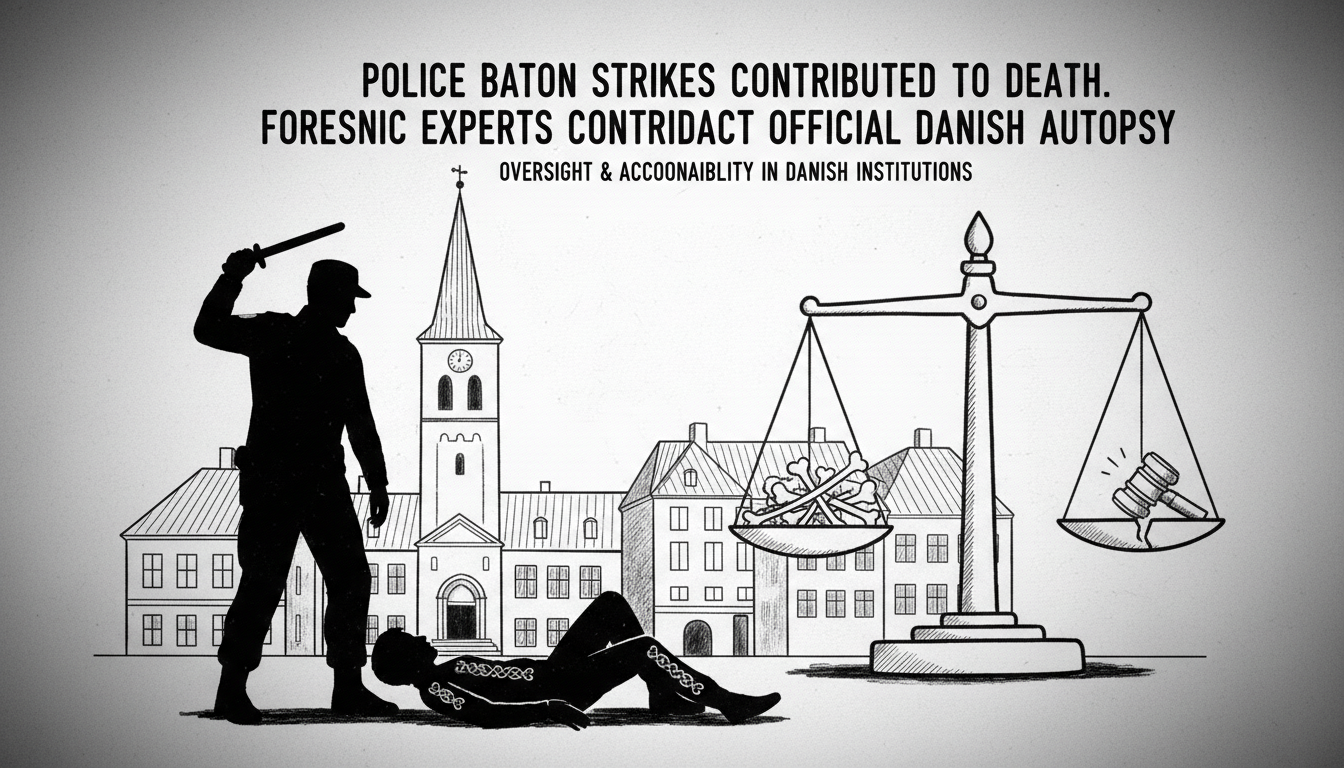
A controversial death following a police arrest in a small Danish town has exposed deep divisions within the Danish forensic community. Newly revealed documents show three independent forensic experts believe extensive baton strikes were a contributing factor in the death of a 29-year-old Polish man, a conclusion starkly at odds with the official autopsy report that omitted these injuries. The case raises profound questions about police accountability and the integrity of official investigations in Denmark's welfare state.
The incident occurred on a bicycle path in Tjæreborg, a town in western Jutland. Witnesses described a violent arrest where officers delivered at least twenty baton strikes to Lukasz Makala. He lost consciousness during the arrest and died in a hospital two days later without regaining awareness. A personal examination conducted before his death documented numerous lesions from severe, blunt force trauma. These injuries were noted in an initial autopsy report but were absent from the final, conclusive document.
The Independent Police Complaints Authority, known as DUP, investigated the case for eighteen months before the regional public prosecutor closed it. The prosecutor concluded the officers committed no criminal act, citing a heart attack triggered by drug intoxication and hyperactivity as the cause of death. The final autopsy report, prepared by the state forensic pathologist, did not assess whether the baton strikes influenced the fatal outcome.
Three emeritus professors of forensic medicine have reviewed all medical documents. They unanimously assert the blunt force trauma was a key factor. Professor Sidsel Rogde, with four decades of experience, called the omission of these injuries from the final conclusion a significant flaw. She stated the extensive damage to musculature and subcutaneous tissue formed a crucial part of the clinical picture leading to his death.
Professor Torleiv Ole Rognum from Oslo's Rikshospitalet detailed significant traumatic injuries to the face, torso, and limbs. He argued the collective muscle destruction and substantial blood loss should have been included in the total assessment of death. Professor Jørgen Lange Thomsen, former head of the Institute of Forensic Medicine at the University of Southern Denmark, was most direct. He wrote an assessment for the bereaved family stating the mechanism of death was triggered by the many blunt traumas from the arrest, including baton strikes, which led to high potassium levels, kidney failure, subsequent heart failure, and death.
The state forensic pathologist responsible for the final report, Peter Mygind Leth, dismissed the experts' critique as unqualified. He maintained there is no basis to believe police baton strikes caused the death, calling that notion far-fetched. He reiterated two solid explanations existed: a heart attack and the influence of amphetamines combined with hyperactive behavior. When asked about the documented bleeding in deep skeletal muscle, he suggested it likely occurred during the hospital admission.
This case touches core elements of Danish society news and Copenhagen integration debates, as it involves a European citizen and questions about equal treatment under Danish law. It directly intersects with Denmark social policy on police oversight and the Danish welfare system's promise of institutional fairness. The handling of such incidents can impact public trust, a cornerstone of Denmark immigration policy and community cohesion.
The director of DUP and the public prosecutor both deferred to the statement from the Danish Medico-Legal Council, the supreme medical authority in legal matters. The Council's statement pointed to hyperactivity and a high level of amphetamine as potential triggers for the heart attack but did not mention blunt force injuries as part of the cause. The prosecutor stated that without the highest medical assessment citing blunt force trauma, there was no basis for establishing criminal liability against the officers.
For international observers, this case presents a complex picture. Denmark is often praised for its transparent institutions and high trust levels. Yet this incident shows that even robust systems can face challenges when internal expert opinions clash. The family of Lukasz Makala continues to seek answers, having organized a memorial run in his Polish hometown. The documentary that brought the case back to light has forced a renewed public examination of a closed investigation, testing the mechanisms designed to ensure police accountability in a nation proud of its social contract.