
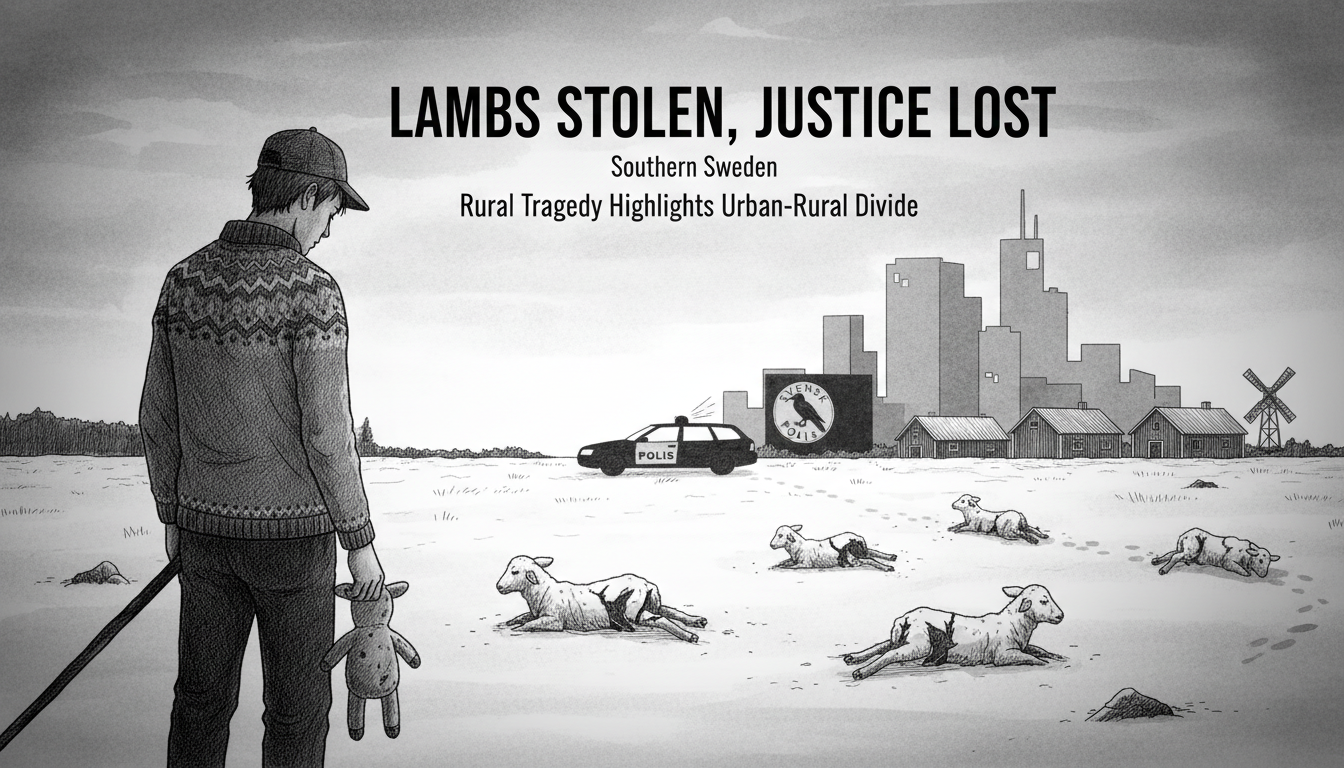
Axel Håkansson, a 15-year-old shepherd from Näsum in southern Sweden, started his morning last April with a sickening discovery. Several of his lambs were gone. Security camera footage from his farm showed a van on the property overnight. Weeks later, divers found pieces of Axel's lambs on the seafloor near Bromölla. Now, police have closed the investigation, a decision that has left the young farmer and his community deeply frustrated.
Authorities reviewed the surveillance footage but did not visit the farm or speak directly with Axel. A police spokesperson stated the video evidence was insufficient. "You cannot see who is in the vehicle on the films," the spokesperson said. "And you cannot see on the film that they actually take any sheep."
Axel's reaction was one of profound disappointment. "It's terrible," he said. He believes police should take this type of crime more seriously. "It's not just me who has experienced this. If you don't put any energy into it, it will just continue," Axel added, highlighting a fear of recurring rural crime.
This case touches on a broader tension in Swedish society between urban and rural experiences. For international readers, Sweden is often associated with safety and efficiency. Yet, stories like Axel's reveal a different reality for those in the countryside, where response to property and livestock crime can feel slow and under-prioritized. This incident near the scenic region of Skåne, known for its agriculture, points to a potential gap in policing resources or focus.
The closure of the investigation without a farm visit is particularly striking. It suggests a reliance on digital evidence alone, which can fail to capture the full context of a rural crime scene. For a young person like Axel, invested in animal husbandry and the traditional Swedish connection to the land, this outcome can feel like a dismissal of his livelihood. Similar incidents of livestock theft have been reported in other Nordic countries, often linked to illegal slaughter operations, raising questions about broader food chain security.
What happens next for Axel? He is left without justice or compensation for his loss. The case also leaves unanswered questions for other farmers in Skåne and beyond. Will there be increased patrols? Is there a pattern of such thefts? Without investigative momentum, these questions linger. The incident serves as a sobering reminder that even in societies with strong institutions, the application of justice can be uneven, depending on where you live and the nature of the crime. For expats and international observers, it's a nuanced lesson in Swedish society trends, showing that systemic challenges exist even in the most well-regarded nations.
The personal story here is paramount. Axel's experience is not just a police report. It's about the violation of a family's work, the welfare of animals, and the security of a rural lifestyle. As Sweden continues to balance its modern identity with its agricultural roots, how the system supports young farmers like Axel will be a telling indicator of societal priorities.