
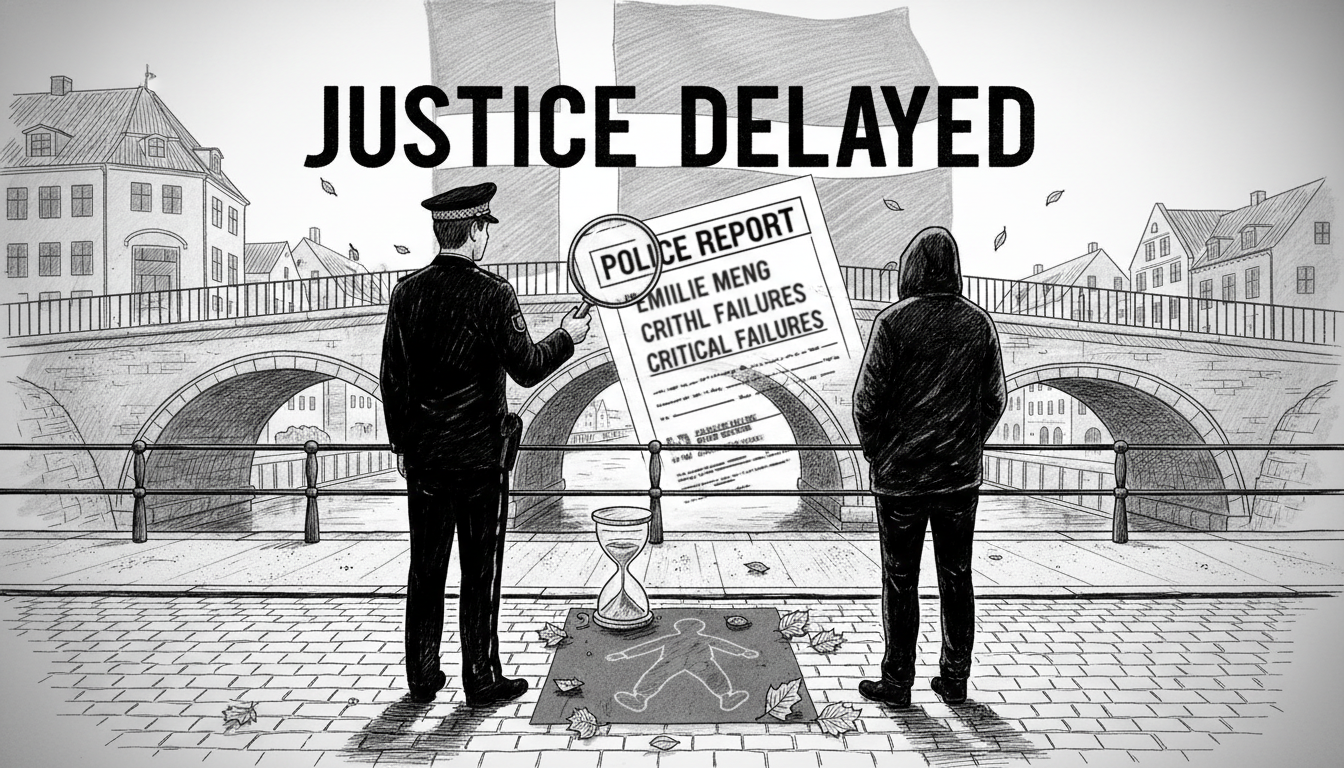
A comprehensive report on the police investigation into the murder of Emilie Meng has concluded that serious errors were made, delaying justice for seven years. The report, released by South Zealand and Lolland-Falster Police, states that too much time passed before a sufficiently organized homicide investigation was initiated. It criticizes the failure to secure and review video surveillance from a larger area around the disappearance site over a longer period. The police district itself assessed that it lacked a robust concept for quickly and correctly securing a large volume of video footage at the time. This case, which deeply shocked Denmark, highlights systemic challenges within law enforcement procedures and their profound human cost.
Emilie Meng disappeared after a night out in July 2016. Her body was found half a year later. The investigation initially received resources typical for a homicide case, but these were scaled down as the case remained unsolved. The report notes that insufficient resources were allocated in the first half of 2018. While the investigation was no longer in an 'acute phase,' the temporal extension of any investigation inherently makes it more difficult, the report states. The perpetrator, Philip Westh, was not arrested until spring 2023, during the investigation into the disappearance of a 13-year-old girl. He was later convicted and sentenced to life in prison for the murder of Meng, rape, attempted rape, deprivation of liberty, and gross violence against two other victims.
In a statement, Police Director Lene Frank acknowledged the shortcomings. 'I naturally wish that we, particularly out of consideration for both the relatives and the victims of the perpetrator's subsequent crimes, had been able to arrest the perpetrator much faster,' Frank said. She described the murder as a so-called 'remote killing,' which can be very difficult to solve if the case lacks good technical evidence. Frank stated that there were not many leads pointing to the perpetrator but conceded that more clues leading to him could have been found. 'Very skilled police work was carried out during the investigation, but the evaluation also shows that in some areas we could and should have done better,' she added.
The case has led to concrete changes in Danish policing. Frank confirmed that both the local police district and the national police force have drawn extensive lessons from this investigation. Notably, comprehensive national standards for homicide investigations were introduced, addressing some of the improvement potentials identified. These standards aim to prevent similar investigative delays and resource shortfalls in future cases. This reform is a direct institutional response to a tragedy that exposed procedural weaknesses.
From a broader perspective on Danish society and its welfare system, this case touches on the public's fundamental trust in state institutions to provide security and justice. The prolonged failure to solve a high-profile murder challenges the perception of Denmark's efficient and reliable public sector. For international observers and residents, it serves as a reminder that even in nations renowned for social stability and robust welfare, systemic failures can occur with devastating consequences. The integration of thorough oversight and continuous protocol evaluation remains critical for all public services, including law enforcement. The report's release, while painful, demonstrates a commitment to transparency and improvement within the Danish justice system, a necessary step for maintaining public confidence.