
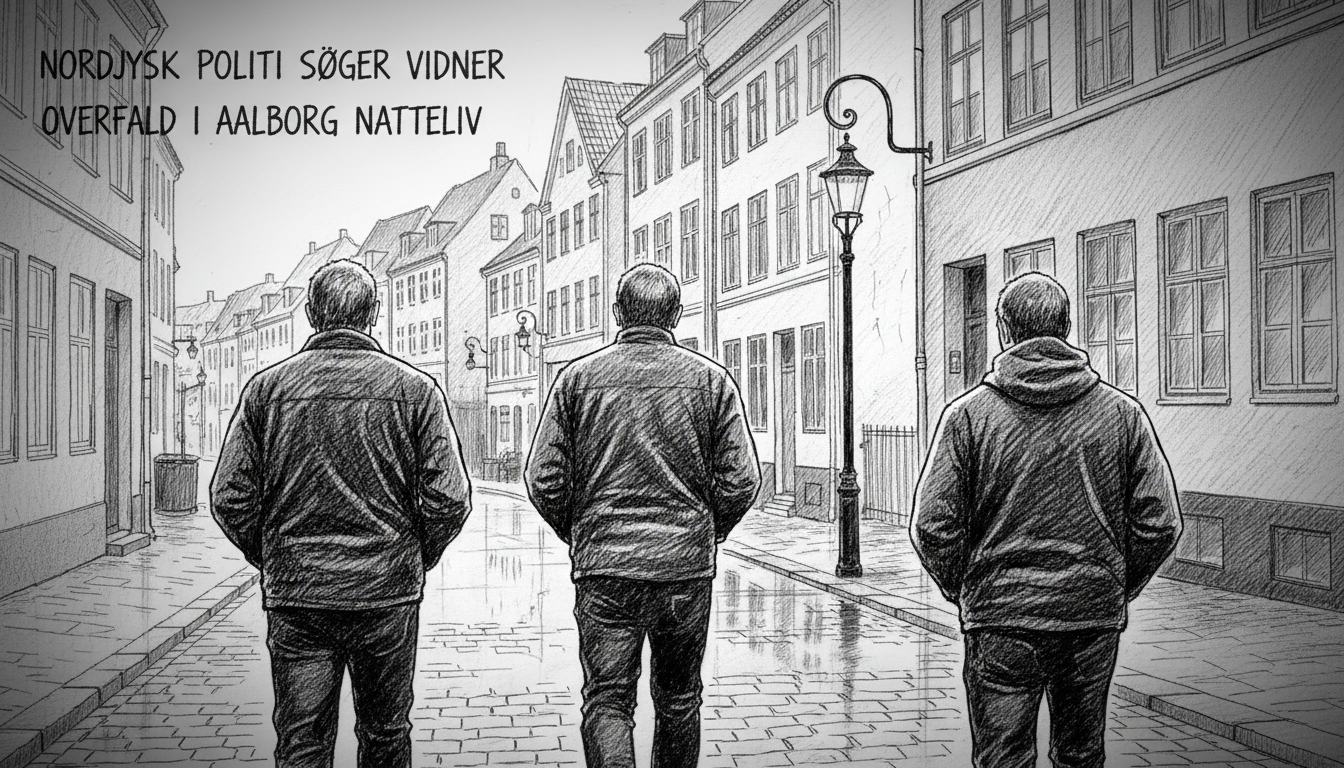
Police in North Jutland are asking for the public's help to identify three men wanted for a violent assault. The incident occurred in the early hours of a Sunday morning on the first floor of Heidis Bier Bar in Jomfru Ane Gade, Aalborg's most famous party street. Authorities have released detailed descriptions and surveillance images after two months of investigation failed to yield arrests. This case highlights ongoing challenges with safety in Danish nightlife areas and the reliance on community cooperation in policing.
The three suspects are all described as light-skinned men. The first is 180-190 cm tall with a muscular build and red or brown hair, last seen wearing a black long-sleeved shirt and blue cowboy pants. The second is also 180-190 cm and muscular with dark hair, wearing a dark polo shirt with a V-neck, dark pants, and white shoes with black markings, likely Nike Air Jordans. The third is 170-175 cm with an average build and dark hair, dressed in a white T-shirt, black pants, and white shoes with a black Nike logo. Police Commissioner Mads Elstrup stated that violence in public spaces is completely unacceptable. He emphasized that guests in Jomfru Ane Gade should be able to enjoy a happy evening in the city without being subjected to violence. The police are now publicizing descriptions and a series of surveillance images of the suspected men in the hope that the public can help identify them.
This incident occurs against a broader backdrop of integration and social policy discussions in Denmark. Nightlife districts like Jomfru Ane Gade often become focal points for debates about public order, alcohol-related violence, and community safety. For international readers, it is important to understand that Danish policing heavily emphasizes preventive measures and community engagement. Municipal social centers and local partnerships often work alongside police to address root causes of social tension. However, when incidents occur, the system relies on public trust and cooperation, as seen in this appeal.
Statistics from recent integration reports show mixed results in urban areas. While major cities like Copenhagen see generally positive trends in employment and education for immigrant backgrounds, sporadic incidents in nightlife can fuel public perception challenges. The direct appeal from North Jutland Police reflects a standard procedural step but also underscores a practical reality. Without new leads, cases can grow cold, even in areas with significant CCTV coverage. The community's response to this appeal will be a small test of social cohesion. Anyone with information is urged to contact North Jutland Police at 114.
From my perspective covering Danish society, each public appeal like this serves two functions. It seeks practical help for an investigation, and it reinforces a social contract. The message is clear: maintaining safe public spaces is a shared responsibility. The effectiveness of this approach depends on consistent trust between residents and authorities, a trust built daily in community centers and local dialogue forums across Danish municipalities. The outcome of this specific case remains to be seen, but the process itself is deeply embedded in the Danish model of welfare and social policy, where security is viewed as a collective endeavor.