
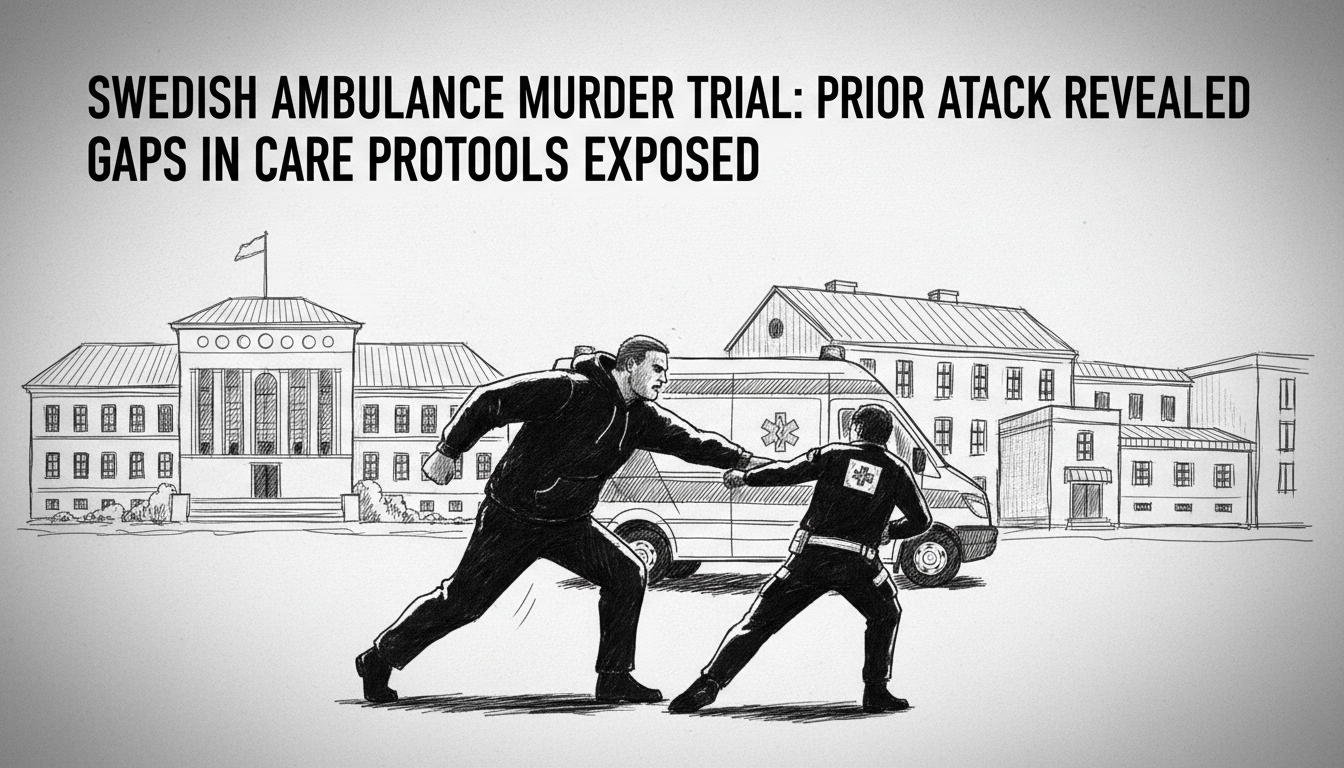
A Swedish court heard this week that the man accused of murdering ambulance nurse Helena Löfgren had violently attacked another paramedic just three days earlier. The 26-year-old defendant admitted to assaulting a male colleague with a baseball bat at the same address. This testimony reveals a critical sequence of events preceding the fatal stabbing and raises urgent questions about patient risk assessment and psychiatric care protocols in Sweden.
The male paramedic gave an emotional account in court. He described arriving at a residence in Hudiksvall after the defendant's mother alerted emergency services about her son's suicidal thoughts. The paramedic stated his intention was purely to provide help. He told the court, 'All my intention was to help him. I said to my colleague that I feel sorry for this boy, he has had a tough life.'
Instead, the situation escalated rapidly. The defendant became angry and demanded the paramedics leave. When they tried to persuade him to accept help, he grew more enraged. The paramedic testified, 'He suddenly becomes aggressive and throws himself at me, pushing me into the doorframe. Then he comes back with the baseball bat.' A swing aimed at the paramedic's head was blocked with his arms. The paramedic managed to wrestle the bat away and escape the apartment after a further blow to his head and neck.
The defendant, who stated he was under the influence of alcohol at the time, apologized in court. 'I want to say right away and apologize. It might not mean much, but I want to highlight that I feel remorse,' he said. Following this assault, the man was taken to the Hudiksvall psychiatric clinic for a two-day treatment period. He was released the day before he called an ambulance and then stabbed nurse Helena Löfgren to death upon its arrival.
This tragic case immediately connects to broader debates in Swedish politics concerning healthcare worker safety and mental health service capacity. The Swedish government has faced repeated calls from unions to strengthen legal protections for emergency personnel. Previous Riksdag decisions have aimed to increase penalties for assaults on public servants, but frontline workers argue enforcement and preventative measures remain inadequate.
The sequence of events—a violent assault, a brief involuntary psychiatric hold, and a subsequent deadly attack—will likely prompt official reviews. Analysts expect scrutiny of the coordination between law enforcement, social services, and psychiatric care units. The case underscores a painful reality where well-intentioned public servants face extreme danger in the course of their duties. It also highlights systemic challenges in managing individuals in acute crisis, a policy area that consistently demands attention from Stockholm politicians. The outcome of this trial and its implications for future government policy in Sweden will be watched closely by healthcare professionals nationwide.