
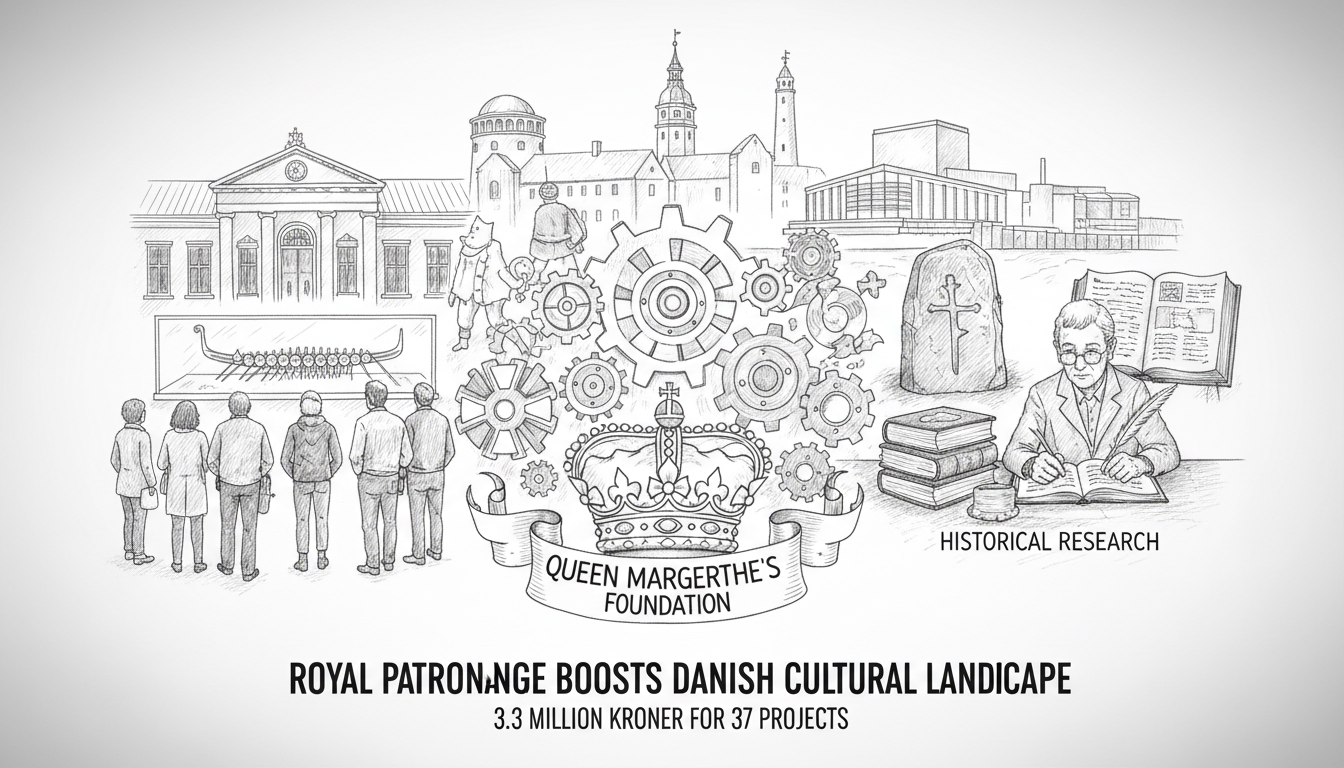
Queen Margrethe has approved funding for 37 cultural and scientific projects through her charitable foundation. The Queen Margrethe and Prince Henrik Fund allocated over 3.3 million Danish kroner in its latest round of grants. This funding supports a diverse range of initiatives, from a scholarly book about narwhals to the restoration of a historic ship and a new opera production. The foundation's board, which includes the Queen, Chief of the Royal Household Kim Kristensen, and pianist Nikolaj Koppen, made these decisions at a recent meeting.
A substantial grant of 250,000 kroner went to the National Museum of Denmark. This money is designated for a project documenting 40 village churches on the island of Funen. The project will produce detailed descriptions and publications about these historic religious buildings. Other museums also received notable support. Vejle Museums obtained 100,000 kroner for an exhibition about 17th-century wars. Museum Jorn received 40,000 kroner for a textile art exhibition, while Museum Skanderborg got 50,000 kroner for a book about the Fregerslev Viking.
This funding mechanism reflects a particular aspect of Danish society news, where royal patronage continues to play a role in cultural preservation. The foundation explicitly supports cultural, scientific, and social purposes. These grants arrive at a time when public debate often focuses on Denmark immigration policy and the allocation of resources within the Danish welfare system. While the state provides broad cultural support, these targeted royal grants can spotlight specific heritage projects that might otherwise struggle for funding.
From my perspective covering Copenhagen integration and broader social policy, such cultural investments hold deeper significance. They preserve national narratives and shared heritage, which can be crucial for social cohesion. In a nation continually negotiating its identity, understanding historical artifacts and artistic expressions provides common ground. The choice to fund a book about narwhals, for instance, connects to Denmark's Arctic interests and scientific heritage. The opera production support maintains a traditional art form in the modern cultural landscape.
Statistics on integration often highlight education and employment, but cultural participation is a less-measured yet vital component. Projects like the church documentation on Funen or the Viking research in Skanderborg create tangible links to place and history. For new residents engaging with Danish society, these resources offer pathways to understanding local context. Municipalities and social centers frequently use such cultural assets in their community programming. The direct funding from the Queen's foundation bypasses slower bureaucratic channels, allowing quicker support for niche but valuable work.
The straightforward allocation of funds shows a clear priority for preserving Denmark's material and intellectual history. There is no complex policy jargon here, just direct patronage for specific projects. This approach has both strengths and limitations. It is efficient and targeted but operates on a relatively small scale compared to state cultural budgets. The real impact lies in the symbolic endorsement and the survival of projects that document Denmark's evolving story, from its Viking past to its contemporary artistic expressions.