
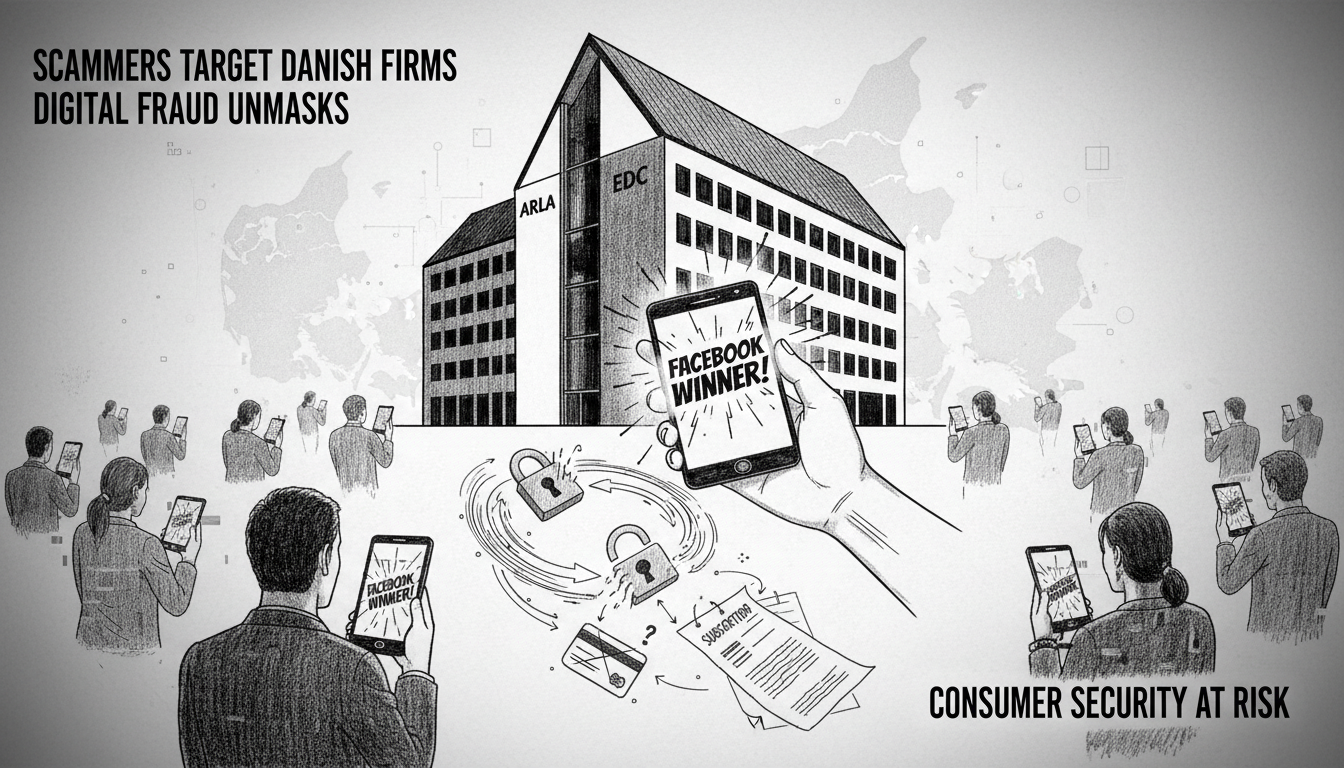
Danish consumers and major corporations face a growing wave of sophisticated online fraud. Scammers are exploiting popular Facebook competitions run by household names like dairy giant Arla and electronics retailer EDC. The fraud involves creating fake winner notification pages to harvest personal and financial data. This new threat highlights the evolving digital risks for Denmark's consumer economy.
Fact-checking investigations have identified at least 350 fraudulent winner pages. The scammers move with alarming speed. They often set up these fake pages the same day a legitimate competition launches on Facebook. Participants are contacted and told they have won a prize. To claim it, they must enter sensitive account details. The promised prize never arrives. Instead, victims find themselves enrolled in a costly, mysterious subscription with a Cypriot company. One example shows a user being charged 68 euros, roughly 500 Danish kroner, every two weeks. The service provided for this fee remains entirely unclear.
This scam directly impacts prominent Danish businesses. Companies like Arla and EDC invest in social media engagement to build brand loyalty in a competitive market. Their reputations are indirectly tarnished when their marketing campaigns are used as bait for fraud. This creates a trust issue between Danish brands and their customers. It also raises questions about consumer protection in cross-border digital commerce within the European single market.
The economic implications are twofold. First, there is a direct financial loss for Danish consumers, draining disposable income from the local economy. Second, it forces companies to allocate more resources to cybersecurity and fraud prevention, potentially increasing operational costs. For a trade-focused nation like Denmark, where consumer confidence drives domestic spending, such scams can have a subtle but real dampening effect. Companies headquartered in Copenhagen's business districts and the wider Øresund region must now factor in these reputational and financial risks to their digital marketing strategies.
From a regulatory perspective, this situation tests the limits of current consumer protection frameworks. The cross-border nature of the fraud, with subscriptions linked to a Cypriot entity, complicates legal recourse for Danish authorities. It underscores a gap in the digital enforcement capabilities of national consumer agencies. The Danish government and the EU may face increased pressure to strengthen collaborative enforcement mechanisms against such international online fraud schemes.
Honest analysis suggests this is more than a simple phishing scam. It is a calculated business model exploiting the trust in well-known Danish brands and the informal nature of social media interactions. The fact that scammers can operationalize hundreds of fake sites so quickly points to a professionalized, profit-driven operation. For international readers, this story serves as a cautionary tale about the vulnerabilities present even in digitally advanced societies like Denmark's. It also shows how global criminal enterprises specifically target prosperous, high-trust economies where consumers are active online.