
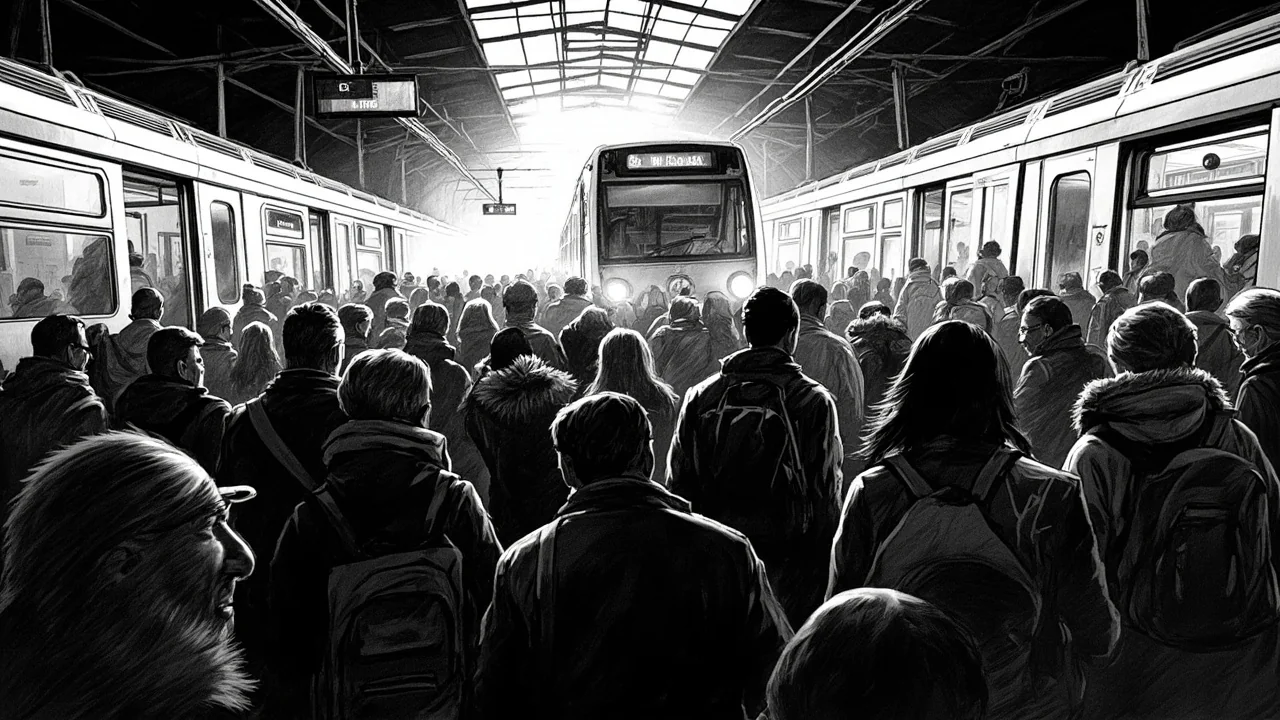
Sweden's Stockholm metro system faced major disruptions on the Red Line during Monday's morning rush, creating crowded conditions and significant delays for thousands of commuters. Technical faults on the tracks between Zinkensdamm and Mariatorget caused irregular service and cancellations on lines 13 and 14, forcing passengers onto shuttle trains and alternative routes. The disruption highlights the fragile balance of a city increasingly dependent on its aging public transport network.
For regular riders like Erik Lundström, a teacher commuting from Fruängen to Kungsträdgården, the morning started with confusion. "The train just stopped at Zinkensdamm," he told me, checking his phone for updates. "The announcement said we all had to get off. No explanation, just that there was a 'technical fault.' Now I'm packed into a shuttle with people pressed against the doors." This scene repeated across stations on the affected stretch, with SL, Stockholm's public transport authority, warning of potential crowding and advising passengers to allow extra time.
A City Grinding to a Halt
The Red Line serves as a critical artery connecting southern suburbs like Fruängen and Mörby Centrum to the city center. Monday's disruption created a domino effect. Trains from Fruängen terminated early at Zinkensdamm, while a shuttle service ferried passengers between Mariatorget and Slussen. Between Slussen and T-Centralen, commuters were directed to the Green Line, adding pressure to an already busy alternative route. "The extra trains we usually put on during rush hour are cancelled," SL stated on their website, acknowledging the reduced capacity.
At Mariatorget station, the atmosphere was one of resigned frustration. Anna Forsberg, a nurse heading to Karolinska University Hospital, sighed as she checked the time. "This happens too often," she said. "You build your life around this schedule—childcare, work shifts—and then it falls apart. Today, I'll be late for my patients." Her sentiment echoes a growing concern among Stockholmers: reliability. While the city's metro is generally efficient, these intermittent breakdowns chip away at public trust and disrupt the precise timing that defines Swedish daily life.
The Strain on Stockholm's Social Fabric
These disruptions are more than mere inconveniences. They expose the stress points in a growing city. Stockholm's population has increased steadily, with immigration and internal migration putting continuous pressure on infrastructure. The metro, parts of which are over 60 years old, must serve more people than ever before. When it fails, the social contract of urban living—predictability, efficiency, shared space—feels broken.
"Public transport is the backbone of Stockholm's identity," says Lars Magnusson, an urban sociologist I spoke with. "It enables the famous work-life balance, reduces car dependency, and shapes how people interact with their city. A breakdown isn't just a technical issue; it's a cultural disruption. People feel it personally." He points to the concept of 'folkhemmet,' or the people's home, where societal systems should function smoothly for collective benefit. A crowded, delayed train contradicts this ideal.
Navigating the Aftermath
By late morning, SL reported that technicians were on-site working to resolve the fault. Normal service was gradually restored, but the ripple effects lasted for hours. For tourists, the disruption was a confusing introduction to Swedish efficiency. A group of Italian visitors at Slussen, maps in hand, looked bewildered by the announcements. "We wanted to go to the Old Town," one said. "But which line is working?"
For locals, the response was typically pragmatic but weary. Many switched to buses, causing congestion on key routes like Hornsgatan. Others turned to electric scooters or bikes, if the distance allowed. Some simply gave up and decided to work from home, a silent testament to how hybrid work patterns have become a backup plan for infrastructure failure. The incident sparked immediate discussion on social media, with the hashtag #röddalinjen trending as users shared photos of packed platforms and voiced their complaints.
Looking Beyond the Technical Fault
While SL attributed Monday's chaos to a specific technical fault, the event invites broader questions about resilience and investment. Stockholm is proud of its sustainable transport model, but maintaining it requires constant upkeep and modernization. The Red Line disruption follows other recent incidents, including signal problems and door faults, suggesting a pattern rather than an isolated event.
"We invest billions in new extensions, like the Blue Line to Barkarby," Magnusson notes. "But we must also invest equally in maintaining the core system that millions rely on every day. It's less glamorous, but more critical." This tension between expansion and maintenance is a challenge for cities worldwide, but in Stockholm, where public transport usage is among the highest in Europe, the stakes are particularly high.
Furthermore, these events test the famous Swedish 'lagom'—the idea of just the right amount. There was nothing 'lagom' about the overcrowded shuttle trains this morning. They were, by all accounts, excessively full and stressful. This deviation from the norm is psychologically jarring in a culture that values order and personal space.
The Commuter's Resilience
As the day progressed, the system slowly returned to normal. But the memory of the disrupted morning lingers. It serves as a reminder of urban vulnerability. For all the talk of smart cities and future mobility, the reality for most Stockholmers remains a metal train on a steel track, vulnerable to the wear and tear of decades of use.
The true story of Monday isn't just about a faulty signal or a broken rail. It's about thousands of individual plans—a job interview, a doctor's appointment, a school pickup—that were suddenly thrown into disarray. It's about the quiet sigh of the commuter, the quick recalculations, the shared looks of understanding on a crowded platform. Stockholm's metro is more than a transport network; it's the rhythm of the city. When it skips a beat, everyone feels it.
Will this incident lead to louder calls for accelerated maintenance schedules or different investment priorities? Perhaps. For now, commuters will check the SL app a little more carefully tomorrow morning, building a small buffer of time into their meticulously planned days. The trust has been dented, but not broken. The real test will be how the city learns from this stumble on the Red Line, ensuring that the system supporting Swedish society trends toward greater reliability, not less.