
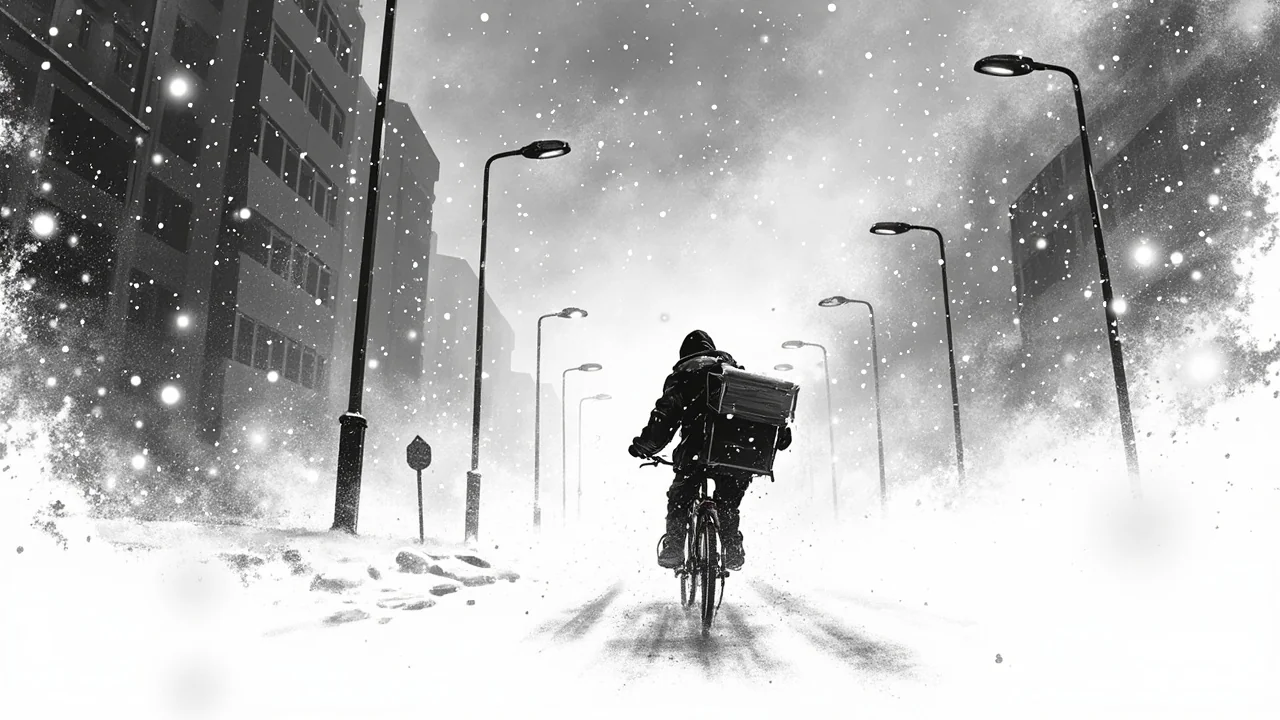
Swedish newspaper carrier Samuel Ekome became an unlikely local hero after completing his delivery route through a sudden and severe Gothenburg snowstorm. While the city slowed to a crawl under three decimeters of snow, Ekome’s dedication sparked a wave of admiration and a conversation about the quiet resilience found in everyday Swedish life.
The snow began falling heavily and unexpectedly one Wednesday morning in Gothenburg. A yellow warning was in place, but the intensity of the storm caught most residents off guard. Schools closed. Public transport, for the most part, ground to a halt. Snowplows worked tirelessly, and tracked vehicles were called in to assist home care services and nursing homes. For many, it was a day to stay indoors.
The Unseen Morning Shift
While the city slept, Samuel Ekome began his workday at 1:00 AM as usual. He had no idea the weather would turn so drastically. "When I started work, I didn't know it was going to start snowing so much," Ekome said. His routine, which normally sees all papers delivered within five hours, was about to be fundamentally challenged. The familiar streets of his Gothenburg route vanished under a thick, unbroken blanket of white.
Faced with impossible driving conditions, Ekome made a simple, determined decision. He would not turn back. "It was so much snow that I had to walk with the moped," he explained. For hours, he pushed his vehicle through the deep snow, ensuring every newspaper reached its destination. This wasn't a dramatic, single moment of heroism but a slow, grinding exercise in perseverance, performed in the dark, silent hours before dawn.
A City Slows Down
The contrast between Ekome's actions and the stalled city around him was stark. The snowstorm highlighted the vulnerability of modern urban systems. Public transport networks, so often a point of pride in Swedish cities, were paralyzed. The logistical machine of a major metropolis like Gothenburg was momentarily fragile. In this context, the simple, physical act of delivering newspapers took on a different weight. It represented a thread of normalcy, a promise kept despite the chaos.
This resilience is a deeply ingrained part of Swedish cultural identity, often summed up by the word "försiktighetsprincip" or the principle of caution, but also by a strong sense of duty. There's an unspoken social contract in the Nordic region: you do your job, you contribute, and you don't let the community down because of minor—or major—inconveniences. Ekome embodied this ethos perfectly. He had a job to do, and he found a way to do it.
Community Praise and Viral Recognition
The reaction to his effort was swift and heartfelt. It was snowplow operator Linus Lycke who helped bring Ekome’s story to wider attention, encapsulating the public mood. "What a warrior. It's completely insane. He deserves a raise," Lycke said. This sentiment spread quickly through local conversations and social media, transforming the newspaper carrier from an anonymous figure into a celebrated local symbol.
This public acclaim speaks to a collective desire to recognize ordinary dedication. In an age of digital headlines and global crises, the story of a man walking his moped through a snowstorm to deliver papers resonates because it is tangible, honest, and pure. It’s about showing up. The praise from a fellow essential worker, Lycke, added a layer of authentic, blue-collar solidarity. It wasn't corporate recognition but peer-to-peer respect, which in Swedish culture often carries more weight.
The Everyday Work Ethic
Ekome himself is a veteran of his trade, having worked as a newspaper carrier for many years and stating he enjoys the profession. His story is not one of seeking glory but of professional pride. The pre-dawn shift is a world unknown to most, populated by people who ensure the city is ready for its waking hours—the delivery drivers, cleaners, and bakers. Their work is foundational yet frequently invisible until something, like a massive snowfall, disrupts it.
This incident invites reflection on how society values such essential, yet often low-profile, roles. The call for a raise, while partly made in jest, touches on a real discussion about the compensation for physically demanding, anti-social hour jobs that keep daily life functioning. Ekome’s commitment highlights the dignity in this work, a dignity that sometimes gets overlooked in economic evaluations.
More Than Just Papers
Ultimately, the delivered newspaper is a symbol. In an increasingly digital world, the physical paper represents a touchpoint, a ritual, especially for older generations who might rely on it as a primary source of information and a part of their daily structure. By battling the storm, Ekome was delivering more than newsprint; he was delivering routine, connection, and a sense of continuity to his customers. For elderly residents, possibly unable to venture out, that paper landing on the doorstep was a signal that the world was still turning.
This human element is what makes the story quintessentially Swedish. It’s understated. There's no grandstanding. Ekome didn't proclaim his effort; it was witnessed and shared by others. The community’s response was to immediately affirm and elevate that effort, creating a positive feedback loop of appreciation. It’s a small-scale model of the social trust that underpins Nordic societies.
A Lasting Impression
As the snow in Gothenburg inevitably melts, the memory of Samuel Ekome’s snowy route will linger. His story is a winter folktale for the modern age, a reminder that community is built on millions of small, reliable actions. It reinforces a cultural preference for practical solutions over complaints, for perseverance over surrender.
In Sweden, where weather is a constant and often formidable companion, the ability to adapt and carry on is a national trait. Samuel Ekome, pushing his moped through the silent, snow-clogged streets of Gothenburg, became a perfect embodiment of this spirit. His story leaves us with a simple question: In our own communities, who are the quiet heroes showing up, regardless of the weather, and how often do we remember to thank them?