
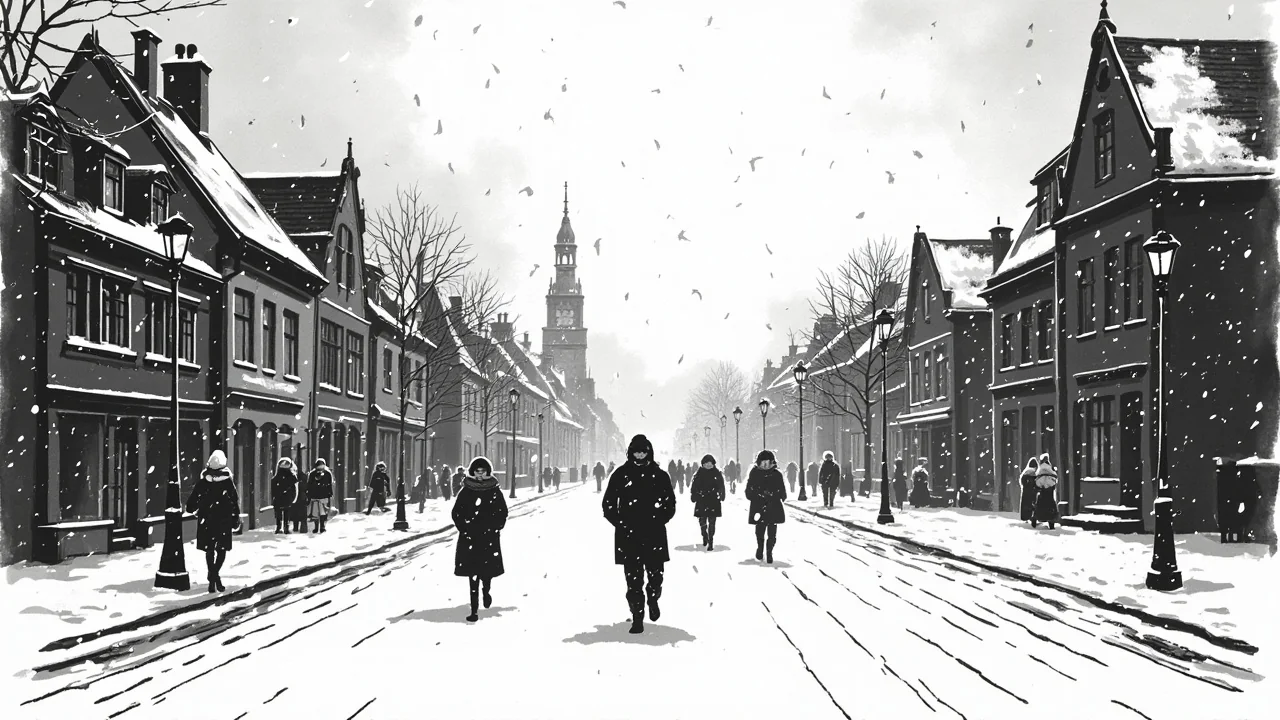
Sweden's Meteorological and Hydrological Institute (SMHI) has issued a new yellow warning for significant snowfall across southern and central parts of the country. The alert covers a wide swath from western Svealand to eastern Svealand, northeastern Östergötland, and southern Gästrikland. Major cities including Stockholm, Uppsala, Norrköping, and Örebro are bracing for intermittent heavy snow throughout Wednesday, with total accumulations expected to reach 5 to 15 centimeters. A separate yellow warning for sudden ice formation remains in effect for parts of Götaland, from Skåne and Blekinge north to Halland and the Gothenburg region.
For Stockholmers, the morning began with a familiar, heavy silence. The dense snowfall muffled the usual city sounds. Commuters at Slussen scrambled onto packed buses, their faces illuminated by phone screens displaying cancelled train notifications. Parents on Södermalm wrestled with strollers through growing drifts, while delivery cyclists navigated the slush with cautious determination. This is not the picturesque, gentle snow of a Christmas card. It is a wet, persistent fall that clings to everything and turns pavements into treacherous slides.
A Capital Slowing Down
The city's infrastructure is being tested. According to traffic management centers, road conditions are deteriorating rapidly, especially on secondary streets and bridges. Major arteries like Essingeleden are experiencing significant delays. Public transport is facing severe disruptions. Several pendeltåg (commuter train) lines have reported delays due to ice on the tracks and points freezing. Many local bus routes, particularly in the suburbs, are running behind schedule or taking alternative, longer routes to avoid problematic hills.
“We’re prioritizing the main bus lines and tram networks,” said a spokesperson for Stockholm’s public transport authority. “But we urge everyone to check their journey in real-time before heading out. Allow extra time, a lot of extra time.” The advice is being heeded. Offices in the city center report lower attendance, with many opting to work remotely. School principals have sent out messages reminding parents to dress children in proper winter gear—waterproof pants, sturdy boots, and reflective vests are essential.
The Double Threat of Ice and Snow
While the snow garners headlines, the concurrent warning for sudden ice formation, or plötslig ishalka, is perhaps the more insidious danger. This phenomenon occurs when rain or wet snow falls on frozen ground, instantly creating a near-invisible, glass-smooth layer of ice. It is a major cause of traffic accidents and pedestrian falls during Swedish winters. The warning for Götaland, including the often-milder west coast, is particularly notable. Regions like Skåne and Halland are less accustomed to such severe winter hazards, and their road maintenance strategies differ from those in the snowbelt of central Sweden.
“A yellow warning for ice in these areas should be taken very seriously,” explained a meteorologist familiar with the forecast. “The ground temperatures are low after recent cold spells. When precipitation arrives, it doesn’t take much to create extremely slippery conditions. This is when we see a spike in emergency room visits for fractures and sprains.” The warning underscores a challenging aspect of Swedish winter: the danger can shift form rapidly, from deep snow one hour to sheer ice the next.
Life Adapts to the Winter Rhythm
Beyond the traffic reports and official warnings, a cultural adaptation unfolds. In neighborhoods like Vasastan and Östermalm, corner grocery stores (kvartersbutiker) see a run on milk, bread, and fika ingredients. The concept of mys—that uniquely Swedish brand of cozy contentment—becomes a survival strategy. Candles are lit earlier in the afternoon as the light fades. The snow alters the social rhythm, forcing a slower pace and, often, more impromptu home gatherings.
For newcomers to Sweden, especially those from warmer climates, such a weather event is a profound experience. “I come from a place where 15 degrees Celsius is considered cold,” said Anya, a software developer from Spain living in Kungsholmen. “This much snow is unbelievable. My Swedish colleagues just put on their långkalsonger (long underwear) and get on with it. For me, it’s a major expedition just to get to the supermarket. But it’s also magical, in a way. The city becomes so quiet and beautiful.”
Her sentiment highlights a dual reality. The snow brings disruption and risk, but it also transforms the urban landscape into something serene and visually striking. The rooftops of Gamla Stan, dusted white, look like a storybook illustration. The skeletal trees in Humlegården park become intricate sculptures of ice and snow.
The Economic and Practical Toll
The economic impact of such a snowfall is immediate and multifaceted. Retail footfall in city centers drops, while online delivery services become overwhelmed. Small businesses, like cafes reliant on walk-in traffic, feel the pinch. Conversely, hardware stores see increased sales of ice scrapers, snow shovels, and salt. The cost to municipalities is substantial. Deploying snowplows, spreading gravel and salt, and managing overtime for sanitation workers represents a significant line item in the winter budget.
There is also a hidden cost in lost productivity due to extended commutes and school closures. While many can work remotely, sectors like construction, hospitality, and logistics face direct stoppages. Delivery times for goods lengthen. The snow exposes the interconnectedness of modern life and how vulnerable its rhythms are to the weather.
Looking at the Forecast and Beyond
SMHI’s warnings are based on sophisticated modeling, but Swedish weather, particularly in the southern and central zones where maritime and continental systems meet, can be unpredictable. The forecast of 5-15 cm is a range that speaks to this uncertainty. Topography and local microclimates play a huge role. A neighborhood on a hill might receive 15 cm, while an area near open water gets a rain-snow mix.
The question on many minds is whether this is a brief interlude or the start of a sustained snowy period. While this particular system will pass, the broader seasonal forecasts suggest a winter with variable conditions. Climate change adds a complex layer to this, not necessarily meaning milder winters everywhere, but often more volatile and extreme precipitation events—whether as rain or snow.
For now, the focus is on the immediate. The advice from authorities is consistent and clear: travel only if necessary, dress appropriately, drive with extreme caution, and keep an eye on the elderly and vulnerable neighbors. The Swedish approach to winter is not one of defiance, but of pragmatic respect. Society does not shut down; it adjusts, recalibrates, and continues, albeit at a different, more careful speed.
As the snow continues to fall over Sergels Torg and the blue and yellow trams push slowly through the white streets, the scene is a powerful reminder. In Sweden, winter is not just a season in the calendar. It is an active participant in daily life, a force that commands attention, preparation, and a certain resilient grace. The coming days will show how well the balance between modern urban life and ancient weather has been struck this time.