
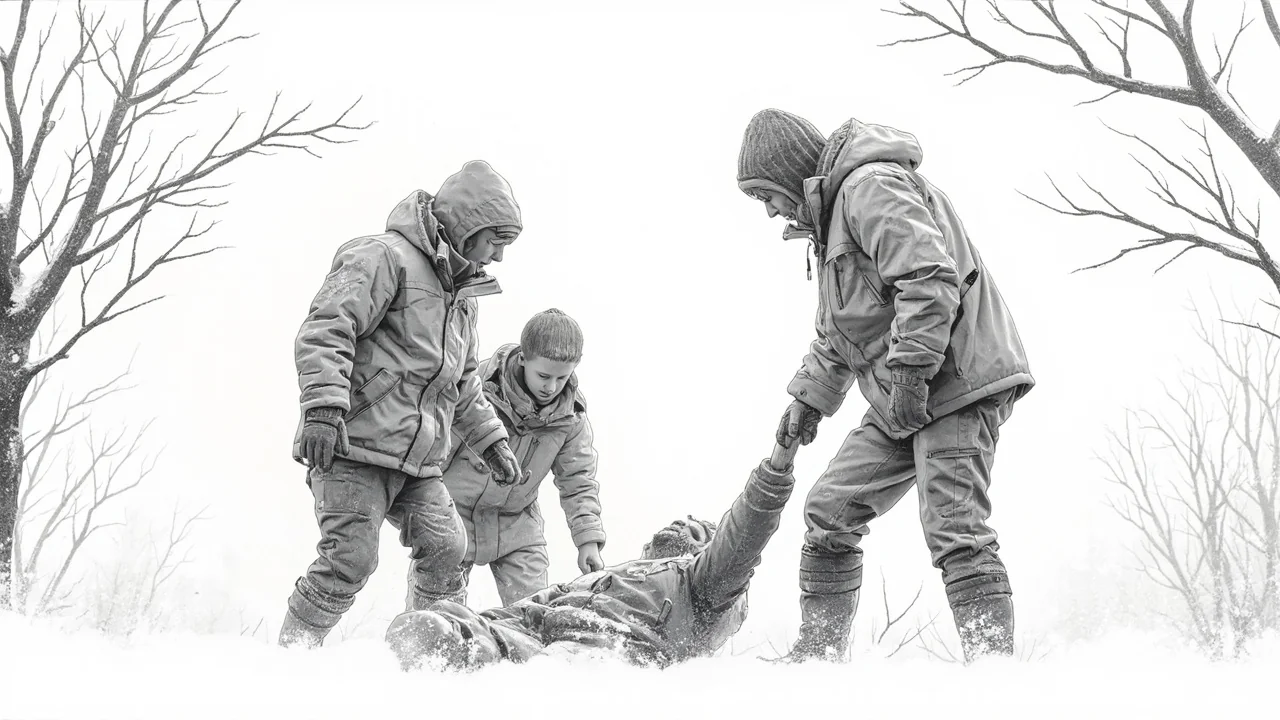
Swedish society witnessed a powerful act of kindness when four teenage friends in their modified car, known as an 'EPA tractor,' saved an elderly man from freezing to death in the extreme Arctic cold. The temperature in Vittangi, a small village in Sweden's far north, had plunged to minus 35 degrees Celsius. On a dark January evening, 17-year-old Ante Blind and his friends Tage, Ebbe, and William, all aged 15 to 17, were driving along Centralvägen. They spotted an elderly man leaning against a pole. They drove past at first, but something didn't feel right. After a short distance, they decided to turn back and check on him. What they found was a man in grave danger, wearing thin sneakers and ill-prepared for the deadly cold. This simple decision to look back likely saved his life.
A Deadly Chill in the Arctic North
The incident occurred in Norrbotten county, where winter temperatures regularly test human limits. The polar night brings long darkness, and the cold can become lethal within minutes. Proper winter clothing is not a luxury but a necessity for survival. The man the teens encountered was disoriented and dangerously underdressed. His thin shoes offered no protection against the frozen ground. "He seemed tired and wasn't dressed for the extreme cold that evening," Ante later recounted. The boys didn't hesitate. They stopped their vehicle, a common sight in Swedish rural areas where teens use these limited-speed cars for mobility, and approached him. They offered him a ride and warmth.
From Suspicion to Lifesaving Action
The teens' initial drive-past is a relatable human moment. In today's fast-paced world, it's easy to ignore small signs of distress. But their quick reconsideration marks the crucial turn in this story. They helped the man into the front seat of their car, the warmest spot. As they drove, he slowly shared his name. Ante then called his mother, who contacted the local home care service. This chain of communication, leveraging both family and municipal support systems common in Swedish society, was key. They obtained the man's address and drove him safely home. Their care didn't end at the curb. "We went inside with him, helped him take off his clothes, and waited for the home care staff," Ante explained. They ensured he was secure until professional help arrived.
A Family's Eternal Gratitude
The profound impact of their actions was expressed by the 92-year-old man's granddaughter, Johanna Winman. In a heartfelt message, she spoke for her entire family. "The whole family is eternally grateful to Ante and the boys!" she wrote. "If they hadn't been out driving just then, or if they hadn't realized something was wrong, it could have ended really badly. He could have frozen to death out there. The boys performed a real act of heroism! We need more humanity among people today, and the boys proved there is hope for that." Her words highlight a universal longing for community and watchfulness, values deeply embedded in Swedish cultural ideals like 'omtanke' (consideration) and 'gemenskap' (togetherness), even as society modernizes.
The Unsung Heroes: EPA Culture and Rural Life
This story is also uniquely Swedish because of the vehicle involved. The 'EPA tractor' or 'A-traktor' is a cultural phenomenon. It's a car modified to have a top speed of 30 km/h, legally driven by 15-year-olds in rural areas. Often mocked in cities for their slow speed, these vehicles are lifelines in the countryside, providing independence to teens where public transport is sparse. In this case, the EPA was not a nuisance but a rescue vehicle. It enabled these teens to be out on that road, to have the mobility to help, and to provide a warm cabin for a freezing man. It underscores how rural Swedish life fosters a different kind of responsibility and community awareness from a young age.
The Bigger Picture: An Aging Society and Community Care
Sweden, like many Nordic nations, has a rapidly aging population. This brings challenges for elderly care, especially in remote northern regions where distances are vast and winters harsh. The formal safety net of 'hemtjänst' (home care service) is robust, but this incident shows how the informal network—neighbors, passersby, and even teenagers—is equally vital. It raises questions about social isolation among the elderly and the collective responsibility of a community. The boys' actions exemplify the Swedish principle of 'duktighet'—a blend of competence, diligence, and doing the right thing without expectation of reward. Their story is a potent reminder that societal safety is built on both strong institutions and everyday human kindness.
Why This Story Resonates Across Sweden
News of the rescue spread quickly, touching a national nerve. In a time when headlines are often dominated by division or crisis, a story of simple, effective compassion offers a powerful counter-narrative. It features young people, often stereotyped as self-absorbed, acting with maturity and empathy. It shows the strength of rural communities. And it presents a positive model of Swedish masculinity—one based on helpfulness, calm action, and care rather than bravado. The story resonates because it feels authentically Swedish: practical, cooperative, and quietly heroic. It’s a modern-day saga that fits alongside tales of storm-rescuing fishermen and forest-dwelling helpers, updated for a generation that drives modified Volvos.
A Lesson in Looking Out for One Another
The legacy of this cold night in Vittangi is more than a rescued life. It's a lesson in attentiveness. The teens didn't perform a dramatic water rescue or fight a fire. They noticed, they turned back, and they used their resources to solve a problem. This is the bedrock of a functional society. As Sweden continues to debate immigration, integration, and social cohesion, this story from its northern frontier offers a simple, unifying truth. Compassion needs no passport. Community is built in small acts. The hope expressed by the man's granddaughter is validated by four boys in an EPA, proving that the fundamental Swedish value of looking after one another—'att se till varandra'—is alive and well, even in the deepest freeze.