
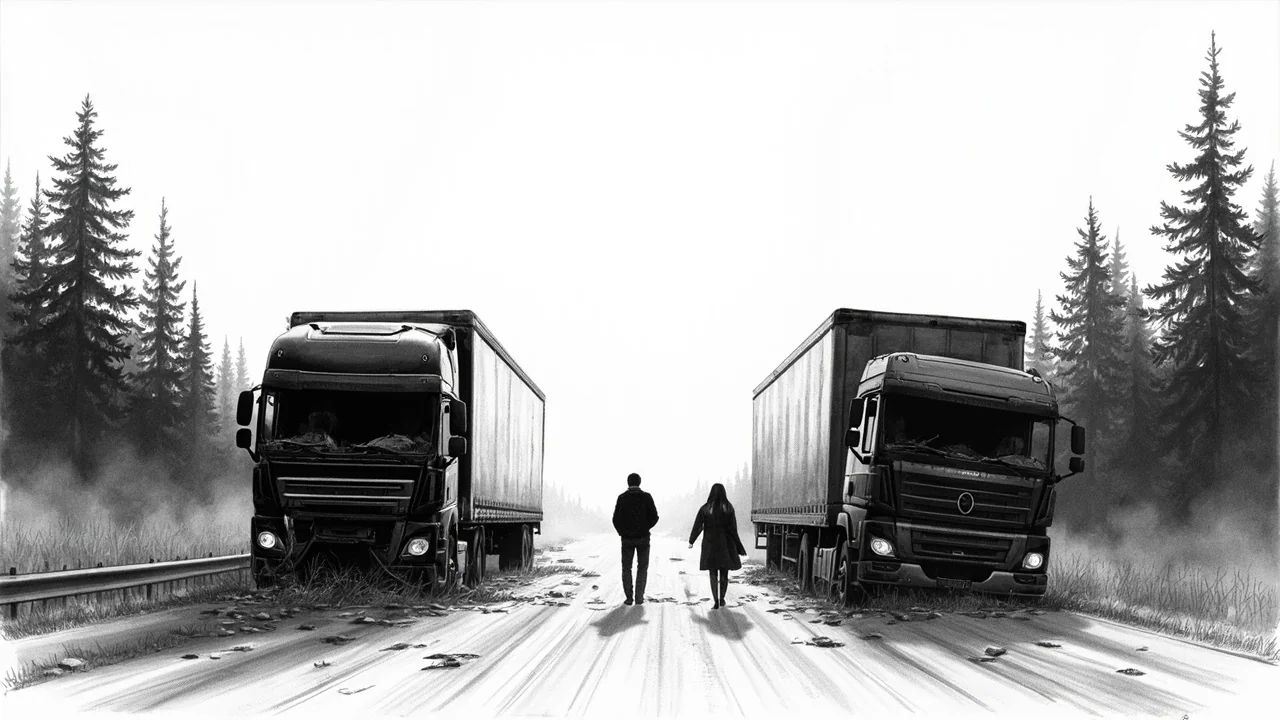
Sweden's Riksväg 62 was closed for over three hours Thursday morning after a head-on collision between two heavy trucks near Torsby. Both drivers suffered serious, life-threatening injuries in the crash. They were trapped in the wreckage for nearly an hour before rescue crews could free them.
One was airlifted by helicopter ambulance. The other was taken by road. Police spokesperson Sophia Jiglind confirmed both men were in serious condition at the hospital. “It was pretty poor road conditions with ice and slush,” Jiglind said. “But the investigation will have to show if that was the cause of the accident.”
A Long and Quiet Road
Riksväg 62 cuts through the forests of Värmland. It’s a major transport route, but not a motorway. Long stretches are just two lanes. You get these long-haul drivers, local timber trucks, and then suddenly, a family car heading to a summer cottage. The mix can be tense. Especially in March. We’re in that weird in-between season. Winter’s grip is slipping, but it hasn't let go. You get surprise ice patches, wet snow that turns to slush. The road where it happened, well, locals say it's a known spot. Not necessarily dangerous, but you need to pay attention. Always.
The Scene at the Barrier
The road closure started just before noon. I spoke to a few motorists who got turned around. Elin, who was driving to deliver parts to a workshop in Torsby, was one of the first stopped. “You could see the flashing lights way down the road,” she told me. “Blue, red, yellow. Lots of them. They weren't letting anyone through. They just said there'd been a very serious accident.” She ended up taking a 50-kilometer detour on smaller, unplowed roads. “You think about your own drive then. You slow down. You think about who might be in those trucks.”
That’s the thing about these stories. They ripple out. It’s not just two drivers. It’s the families waiting for a call. It’s the other drivers stuck in the queue. It’s the logistics managers somewhere, watching a tracking dot stop moving. The economic impact of a three-hour total shutdown on a key road isn't small either. Goods don't move. People are late. It all stacks up.
What Happens Next
The police have started a criminal investigation. A preliminary investigation into gross negligence in traffic and causing bodily injury is underway. That’s standard procedure in a crash this severe. Both trucks have been impounded. Experts will go over them, piece by piece, looking for mechanical failure. Investigators will be looking at dashcam footage, if it exists. They’ll be interviewing witnesses, examining tire marks on the asphalt.
No one has been served with suspicion of a crime. That often comes later, after the technical investigation. It’s a slow, meticulous process. The priority now is the medical care of the two drivers. Their names haven't been released. They’re just two men, from somewhere, who had a very bad morning on a quiet stretch of Swedish highway.
A Cultural Reckoning with Road Safety
We talk a lot about road safety in Sweden. The Vision Zero policy is world-famous. But it’s often focused on cars, on city streets, on pedestrian crossings. The reality of the long haul, of the arterial roads that keep the country running, is different. These drivers face immense pressure. Tight schedules. Lonely hours. The monotony of the forest road, then the sudden demand for total focus.
There’s a culture in trucking. A pride in skill, in handling a big rig in bad weather. But this crash feels like a brutal reminder. Skill can meet a patch of black ice. Judgment can be clouded by fatigue. The machine, no matter how well-maintained, can fail. It’s a fragile system. We’re reminded of that every time the blue lights flare up on a roadside.
I drove a section of that road last autumn. It’s beautiful. Pine forests, glimpses of lake, the odd red cottage. Peaceful. It’s hard to square that image with the violence of a head-on collision between two forty-ton vehicles. The cleanup alone was massive. They had to bring in heavy cranes. The debris field was significant. It took all those three hours just to clear the roadway enough to let traffic flow again.
The Human Cost
At the end of the day, beyond the traffic reports and the police bulletins, this is a human story. Two people are fighting in a hospital. Their families are living a nightmare that started with a phone call no one ever wants to get. The rescue workers who cut them free will carry that scene with them. The first responders who stabilized them on the asphalt, in the cold, did a job few of us could stomach.
We’ll see the headlines about the investigation in the coming weeks. Maybe there’ll be a conclusion about road conditions, or a vehicle fault. But for now, in Torsby and wherever those drivers call home, there’s just the waiting. And the hope. The road is open again. The traffic is flowing. But for some, everything has stopped.
It’s the quiet accidents on the quiet roads that sometimes hit hardest. No scandal, no major negligence headline yet. Just a terrible moment on a Thursday morning that changed everything. Life is just that fragile. A routine delivery run turns into a life-flight. We all share these roads. We all depend on the people who drive them professionally. Today, that dependence felt very, very real.