
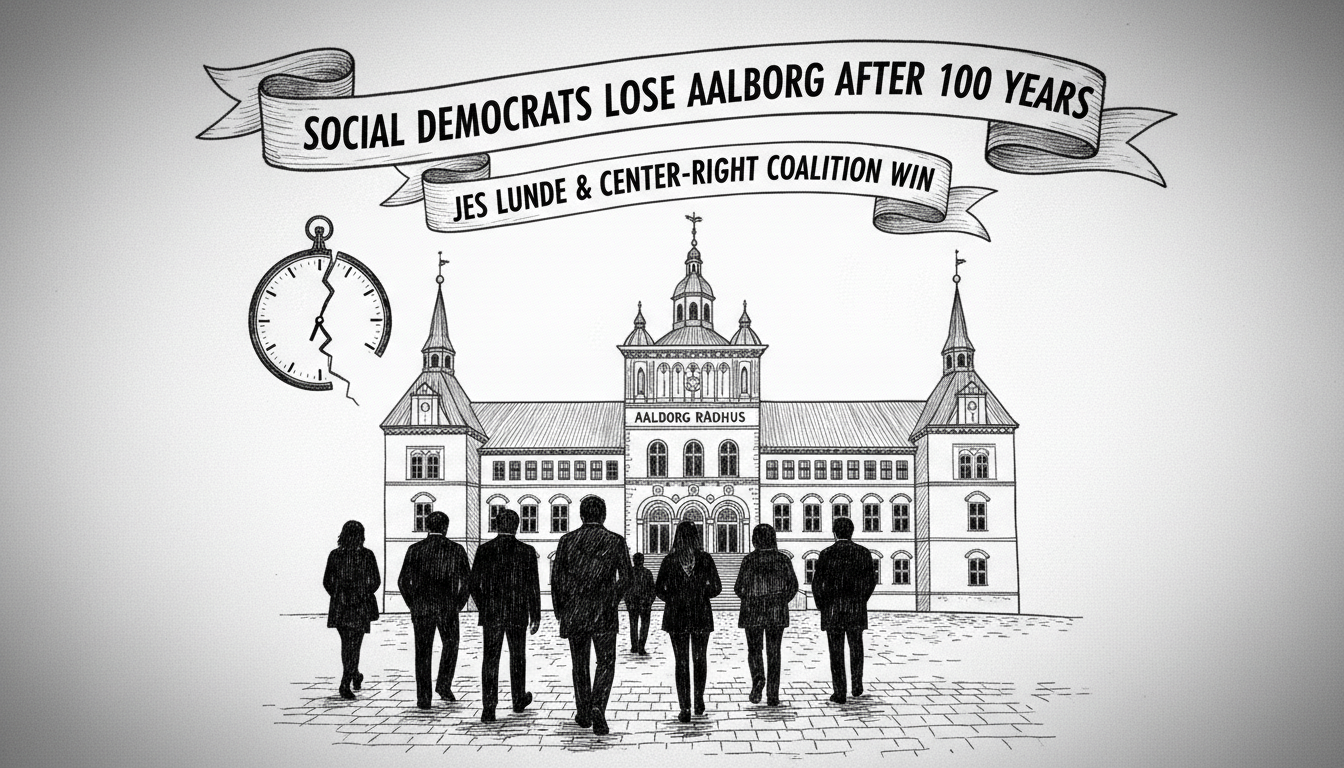
Aalborg experiences a dramatic political shift as the mayor's office changes hands unexpectedly. Jes Lunde from the Social Liberal Party now secures the position with support from a new majority coalition. This development ends over a century of Social Democratic leadership in Denmark's fourth-largest city.
The change comes despite Social Democratic candidate Lasse Frimand Jensen initially appearing victorious on election night. Jensen had secured backing from three left-leaning parties immediately following the vote. The Social Democrats captured 10 of the city council's 31 seats, making them the largest single party.
Jes Lunde explained his decision to accept the mayor position. "The center-right parties offered me the mayor role based entirely on my election platform," Lunde stated in a press release. "On behalf of the Social Liberal Party, I cannot refuse such an offer."
The new governing coalition represents the narrowest possible majority. It brings together five parties holding exactly 16 seats. The alliance includes the Conservatives with 3 seats, Liberal Alliance with 2, Denmark Democrats with 2, Danish People's Party with 1, and Lunde's own Social Liberals with 2 seats.
This arrangement bypasses the city's largest political force entirely. The Social Democrats have controlled the mayor's office in Aalborg since 1925, making this transition particularly historic.
A regional political correspondent described the development as completely unexpected. "We're witnessing a very surprising situation unfolding in Aalborg right now," the correspondent noted.
The political maneuvering continued throughout the post-election period. Center-right parties initially offered Lunde the mayor position on election night but withdrew the offer temporarily. Negotiations then focused on council committee positions before the final agreement emerged.
Lunde previously indicated on social media that the center-right bloc had offered him the mayor role overnight. He noted that his party held the balance of power between left and right blocs.
The correspondent explained the final outcome. "The center-right parties ultimately went in a completely different direction," they observed. "They presented Jes Lunde with an offer that apparently improved upon the election night proposal."
This political realignment in Aalborg reflects broader trends in Danish municipal politics. Traditional party alliances are becoming more fluid as smaller parties gain influence. The situation demonstrates how medium-sized parties can leverage their strategic position in fragmented councils.
The change carries practical implications for Aalborg's governance. The new coalition must now implement its agenda with the slimmest possible majority. This could make the city council particularly sensitive to individual member absences or disagreements.
International observers might find parallels in other European municipalities where longstanding political dominance has recently shifted. The Aalborg case shows how local politics can sometimes diverge from national trends and party loyalties.
City officials continue working to obtain comment from the outgoing mayor Lasse Frimand Jensen about this political transformation.