
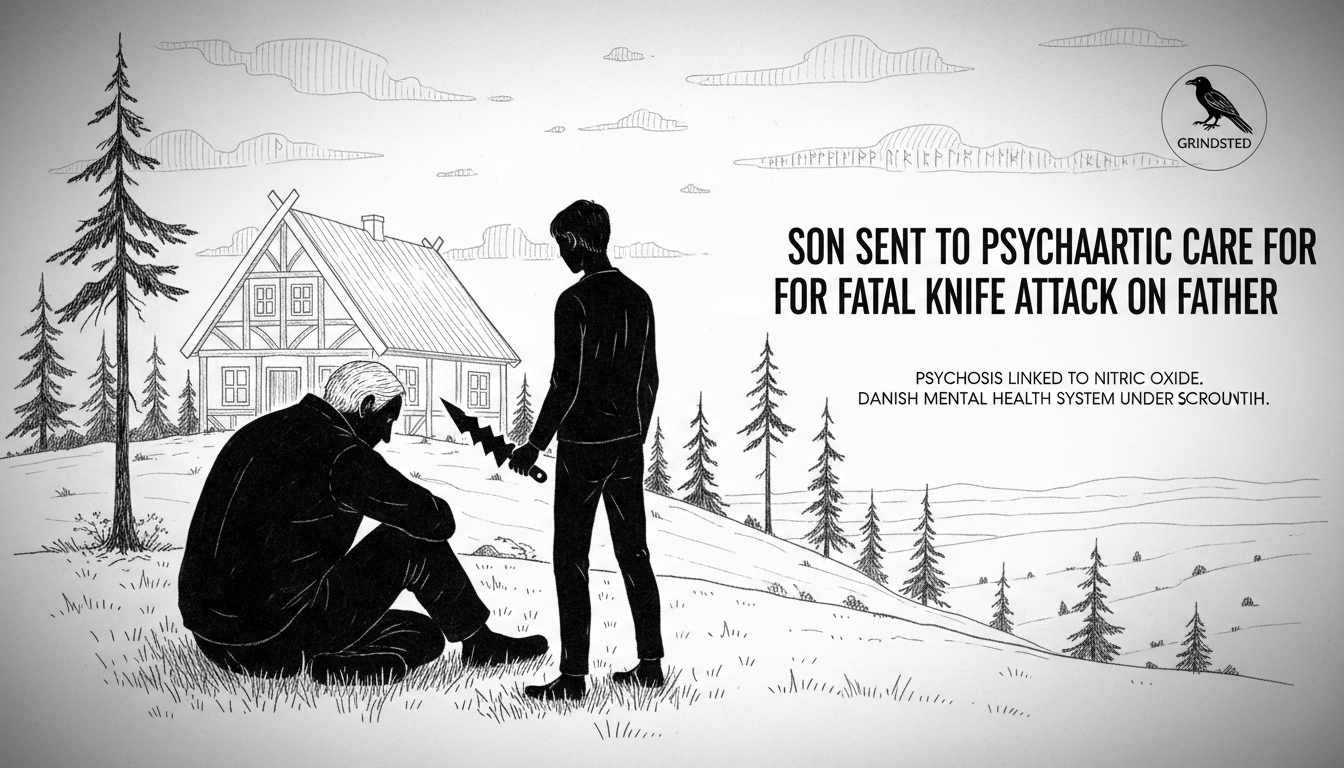
A Danish court has ordered the indefinite psychiatric commitment of a young man who killed his father with a knife in their Grindsted home. The 22-year-old was found to have been psychotic at the time of the attack, a condition prosecutors linked to massive nitrous oxide inhalation in the preceding days. This case forces a difficult look at mental health crises, substance abuse, and family violence within the Danish welfare system.
The incident occurred in early August when the son stabbed his father multiple times in the torso. He later called emergency services himself to report the stabbing but initially failed to disclose his location. Police found the 43-year-old father deceased inside the property and the son sitting outside in a garden chair. The young man reportedly told officers he had been watching a horror film, taken nitrous oxide, and become frightened, prompting him to call for help. The gravity of the situation only became clear upon the discovery of the victim.
Prosecutors presented a psychiatric assessment during the trial, concluding the perpetrator was legally insane during the attack. His defense lawyer described the case as deeply tragic before the ruling. The court in Kolding followed the prosecution's request for placement in a psychiatric department without a specified time limit. The young man also received a conviction for possession of 100 grams of cocaine, part of which he had already sold. He accepted the court's judgment and will not appeal.
Special prosecutor Susan Nielsen stated after the verdict that it was a tragic case but expressed satisfaction with the ruling. The court imposed a reporting ban on the details of the young man's confession. This legal measure aims to protect the integrity of the judicial process and the individuals involved.
This tragedy intersects with critical discussions in Danish society news concerning mental health support and substance abuse. While Denmark's social policy framework is often praised, cases like this reveal potential cracks where individuals and families fall through safety nets. The conviction for drug possession adds another layer, highlighting how criminal activity and severe mental health crises can become tragically intertwined.
Integration and social policy experts often debate the capacity of municipal social services and psychiatric care systems. A key question is whether earlier intervention could have altered this outcome. Danish municipalities and social centers bear the frontline responsibility for identifying and assisting vulnerable citizens before crises escalate. Statistics on integration and education often dominate policy discussions, but acute mental health and addiction services remain a persistent challenge.
The case in Grindsted, a town in West Jutland, is not an isolated incident but part of a broader, somber pattern. It raises uncomfortable questions about the accessibility of mental healthcare, the societal impact of recreational drugs like nitrous oxide, and the silent struggles within families. The Danish welfare system is designed to prevent such extremes, yet they still occur. Community leaders in Copenhagen and beyond frequently call for more robust, preventative outreach, especially to young men who may not seek help voluntarily.
What happens next for the young man involves long-term psychiatric treatment with no predetermined release date. His future hinges on therapeutic progress within a system that is both compassionate and constrained. For the community and Danish social policy, the case is a stark reminder of the work that remains in building a society where such profound breakdowns are not just managed but prevented.