
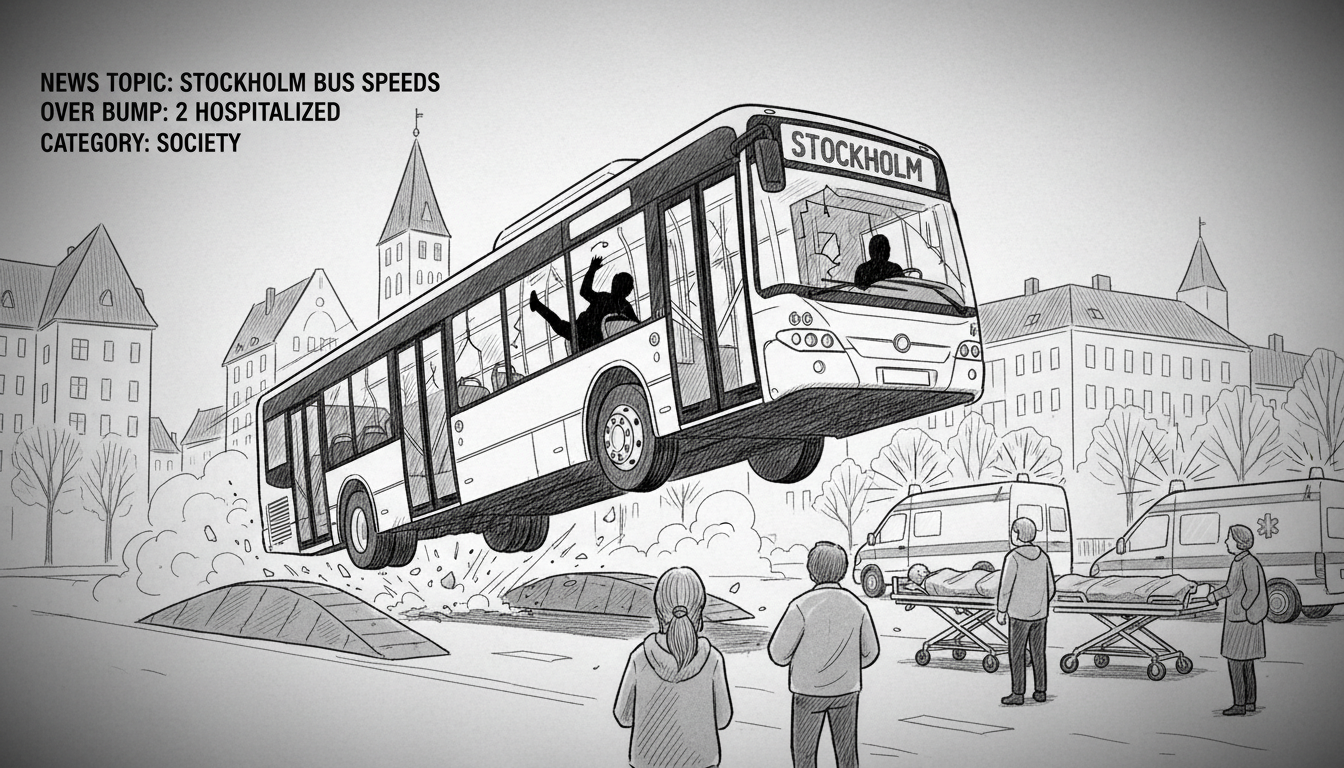
Stockholm's public transport safety is under scrutiny after a bus driver's excessive speed sent two passengers to hospital. The incident occurred on Täbylundsvägen in western Stockholm when the bus hit a speed bump at high velocity. The force launched a man in his 40s and a younger man in his 20s from their seats. Both suffered back injuries and required ambulance transport to the hospital for treatment. For the 730 million annual passengers who trust Storstockholms Lokaltrafik (SL), this event raises urgent questions about driver training and passenger safety on routine journeys.
A Violent Jolt on a Routine Journey
Täbylundsvägen is a typical residential street in Västerort, the western suburbs. Speed bumps, or 'farthinder,' are commonplace, designed to calm traffic and protect pedestrians. The bus, operating under contract for SL, was meant to be a safe link in the city's extensive network of 650 bus lines. Instead, it became a site of sudden trauma. Police reports confirm the driver's speed was 'so high' that the two men were physically lifted from their seating. The immediate complaint from both was severe back pain, a common injury from vertical impact. This wasn't a collision with another vehicle; it was a failure of basic operational safety on a standard piece of road infrastructure.
The human impact is immediate and personal. Imagine settling into your seat, perhaps scrolling your phone or gazing out at the passing apartments in Täby. The expectation is one of uneventful safety. Swedish public transport is built on a social contract of trust and reliability. This violent jolt shatters that calm. The injured men, whose identities are protected, became statistics in an incident log, but their experience echoes a fear every passenger can understand: that your safety is entirely in the hands of an unseen driver.
SL's Response and Systemic Questions
Storstockholms Lokaltrafik (SL), owned by the Stockholm County Council, has built a reputation for efficient, widespread service. Following the incident, standard procedure is initiated. The contracted operating company will investigate the driver's actions. SL stated that all drivers undergo rigorous training and must adhere to strict speed limits. "Passenger safety is our highest priority," a press officer said in a statement. "We take this incident very seriously and are conducting a full internal review alongside the police investigation."
Yet, this response feels familiar. It prompts larger questions. How is driver compliance monitored on hundreds of daily routes? Is there adequate oversight of the private companies SL contracts? The system's scale is immense. With 730 million passenger journeys annually, even a tiny percentage of incidents represents significant risk. This event on Täbylundsvägen isn't just about one driver's mistake. It tests the resilience of the entire oversight framework.
Transport safety experts point to multiple factors. "It's a chain of responsibility," says Lars Friman, a former traffic safety investigator. "The vehicle maintenance, the road design, the driver's training and momentary attention, and the company's safety culture. A break in any link can lead to injury." Speed bumps, while effective for cars, pose a specific challenge for buses with high passenger loads. Drivers must be acutely aware of them. Excessive speed over a bump doesn't just cause discomfort; it transfers dangerous g-forces through the vehicle's suspension directly to the passengers' spines.
The Cultural Contract of 'Trafiksäkerhet'
In Sweden, traffic safety—'trafiksäkerhet'—is a core societal value. It's embedded in everything from stringent drink-driving laws to Vision Zero, the policy aiming to eliminate road fatalities. Public transport is central to this vision, promoted as the safe, collective alternative to private cars. An incident like this strikes at the heart of that promise. It transforms the bus from a safe haven into a site of vulnerability.
Stockholmers have a pragmatic relationship with their SL cards. They endure winter crowds on the tunnelbana and plan their lives around bus timetables. Trust is assumed. When that trust is broken by something as preventable as speeding over a known bump, it fuels public anxiety. Comments on local community forums in the Täby area reflected this. "Was the driver rushing to keep schedule?" one resident posted. "I take that bus with my kids," wrote another. The concern extends beyond the two injured men to a communal sense of security.
Looking Ahead: Accountability and Action
The police investigation will determine if charges are warranted. The driver could face penalties for reckless driving. For the injured men, the path involves medical recovery and potential insurance claims. For SL and its contractor, the path involves damage control and preventative measures. Will this lead to targeted re-training? To stricter telematics monitoring of bus speed near bumps? The outcome will signal how seriously the breach is taken.
This incident serves as a stark reminder. A city's mobility relies on countless daily acts of careful, professional driving. In a dense urban environment like Stockholm, where bus lanes weave through residential areas, the margin for error is small. The speed bump on Täbylundsvägen did its job—it forced a speeding vehicle to confront its velocity. Tragically, the passengers paid the price.
As Stockholm continues to grow and push for increased public transport use, the foundation must be unshakeable safety. Can 730 million annual journeys all be safe? The city's ambition demands nothing less. The real test lies not in the statement after the accident, but in the unseen precautions taken tomorrow on every bus rolling out of every depot. For the sake of every passenger heading home, work, or school, that vigilance must be absolute.