
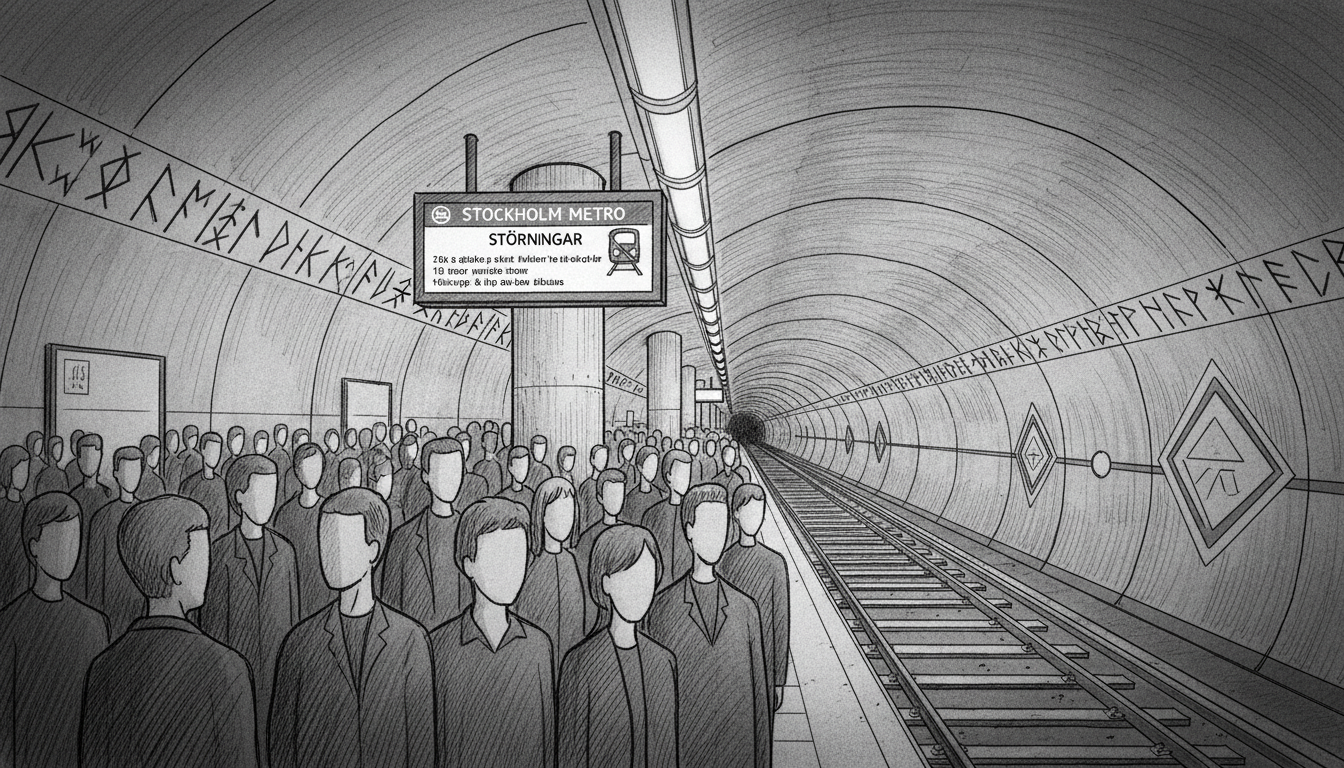
An estimated 500,000 Stockholm commuters faced chaos today as simultaneous stoppages crippled both the Red and Green metro lines. The rush hour paralysis struck a core section of Sweden's most vital public transport network, halting trains between Mariatorget and T-Centralen on the Red Line and between Slussen and T-Centralen on the Green Line. For a city that prides itself on efficiency and punctuality, the breakdown was a jarring halt to the daily rhythm.
"I've been standing here for 40 minutes," said Elias Berg, a graphic designer trying to get from Södermalm to his office near Hötorget. He gestured at the packed platform at Slussen station. "No announcements, just crowds. This is when the city just stops." Around him, passengers checked phones for bus alternatives, their faces lit by the glow of the SL travel app, which showed a sea of delayed or cancelled services.
The disruption severed key connections through the city's heart. The Red Line stoppage isolated the vibrant Södermalm district, home to tens of thousands of residents and popular workplaces. The Green Line failure blocked a primary artery from the inner-city south. Stockholm Public Transport (SL) offered no prognosis for when service would resume, only advising passengers to find alternative routes on buses or commuter trains—options quickly overwhelmed by the sudden surge in demand.
A City Built on Transit Reliability
For Stockholmers, the Tunnelbana is more than infrastructure; it's a cultural touchstone. The 100-station network, famously decorated as "the world's longest art gallery," carries over 1.2 million passenger journeys on an average weekday. Its reliability is woven into the social contract of city life, enabling everything from the famous work-life balance to a car-light city center. A major dual-line failure like this doesn't just cause inconvenience—it breaks a fundamental trust.
"These lines are the backbone," explained transport analyst Karin Lindahl, who has studied Nordic urban mobility for over a decade. "When they fail together, it exposes a vulnerability. The Red Line is 41 kilometers of critical infrastructure. The Green Line serves the historic city core. Their interdependence means a problem in one area can cascade." She notes that while single-line issues are periodic, concurrent major disruptions are less common and point to potential systemic stresses, whether from aging signaling systems, maintenance backlogs, or the strain of rising ridership.
The Human Cost of Standing Still
The impact rippled far beyond the platforms. Cafés near affected stations saw a sudden influx of people waiting out the delay. Bike-sharing stations were emptied. Taxi queues stretched around corners. For many, the disruption meant more than a late arrival; it had real consequences.
Maja Nilsson, a nurse scheduled for a morning shift at Södersjukhuset, finally gave up after 50 minutes. "I called a colleague to swap shifts," she said, sitting on a bench outside Medborgarplatsen. "You feel guilty, but what can you do? The system failed." Her story highlights a less-discussed aspect of public transport failures: the professional and economic toll on hourly workers, caregivers, and service employees for whom punctuality is non-negotiable.
In the business districts of Norrmalm, bosses reported dozens of late arrivals. "We operate on flex time, so it's manageable," said Henrik Ström, a team manager at a tech firm. "But for our guests flying into Arlanda relying on the Arlanda Express and then the metro, it's a terrible first impression of Swedish efficiency."
Communication in Crisis
A point of widespread frustration among commuters was the lack of real-time information. SL's official channels confirmed the stoppages but provided scant detail on causes or resolution timelines. This communication gap left a vacuum filled by speculation and annoyance on social media.
"When there's no 'why,' people get angry," noted Lars Bengtsson, a professor specializing in crisis communication at Stockholm University. "In a digital age, passengers expect continuous updates. A simple 'We are investigating a technical fault between X and Y, expect updates at 10:00' maintains trust. Silence breeds uncertainty and amplifies the perceived crisis." He compared it to best practices in other major European cities, where dedicated disruption accounts and frequent announcements are standard during major incidents.
A History of Art and Engineering
The stalled trains sat in tunnels that are themselves landmarks. The affected Red Line section runs deep under Södermalm, past stations like Mariatorget, known for its playful tile work. The disrupted Green Line section includes Slussen, a complex, newly rebuilt interchange that is one of the city's busiest hubs. This isn't just a transit failure; it's a freeze-frame of a normally flowing piece of living urban history.
The Stockholm Metro opened its first line in 1950. Its expansion mirrored the city's growth. The art-filled stations, a project started in the 1950s, were intended to bring beauty to every citizen's daily commute—to democratize culture. Today, that art was the backdrop for crowded, anxious waits. The contrast between the visionary idealism of the system's design and the reality of its occasional collapse is stark.
Looking Down the Line
As the morning stretched on, technicians worked to resolve the issue. The cause of the dual-line stoppage was not immediately made public, though unconfirmed reports from personnel suggested a signaling fault affecting a central control sector. Transportation experts point to a challenging confluence of factors: a network that is both a cherished historic asset and a modern workhorse, facing the pressure of a growing city.
"Investment cycles and maintenance windows are constant challenges," said analyst Karin Lindahl. "You must upgrade the system while keeping it running 20 hours a day. Sometimes, the complexity wins." She emphasized that Stockholm's metro is still one of the world's most reliable, but that today's event would likely trigger internal reviews and public questions about resilience planning.
By late morning, SL announced that normal service was gradually resuming on both lines. The sigh of relief was almost audible across the city. The platforms cleared, the delayed trains began to move, and the metropolitan rhythm slowly restored itself. But the questions linger like the echo in a tunnel. In a society built on the promise of smooth, sustainable mobility, how does it reckon with a morning when the very heart of that promise stopped beating? And as Stockholm continues to grow, can its iconic underground keep pace, or will commuters face more mornings of quiet frustration under the station's famous art?