
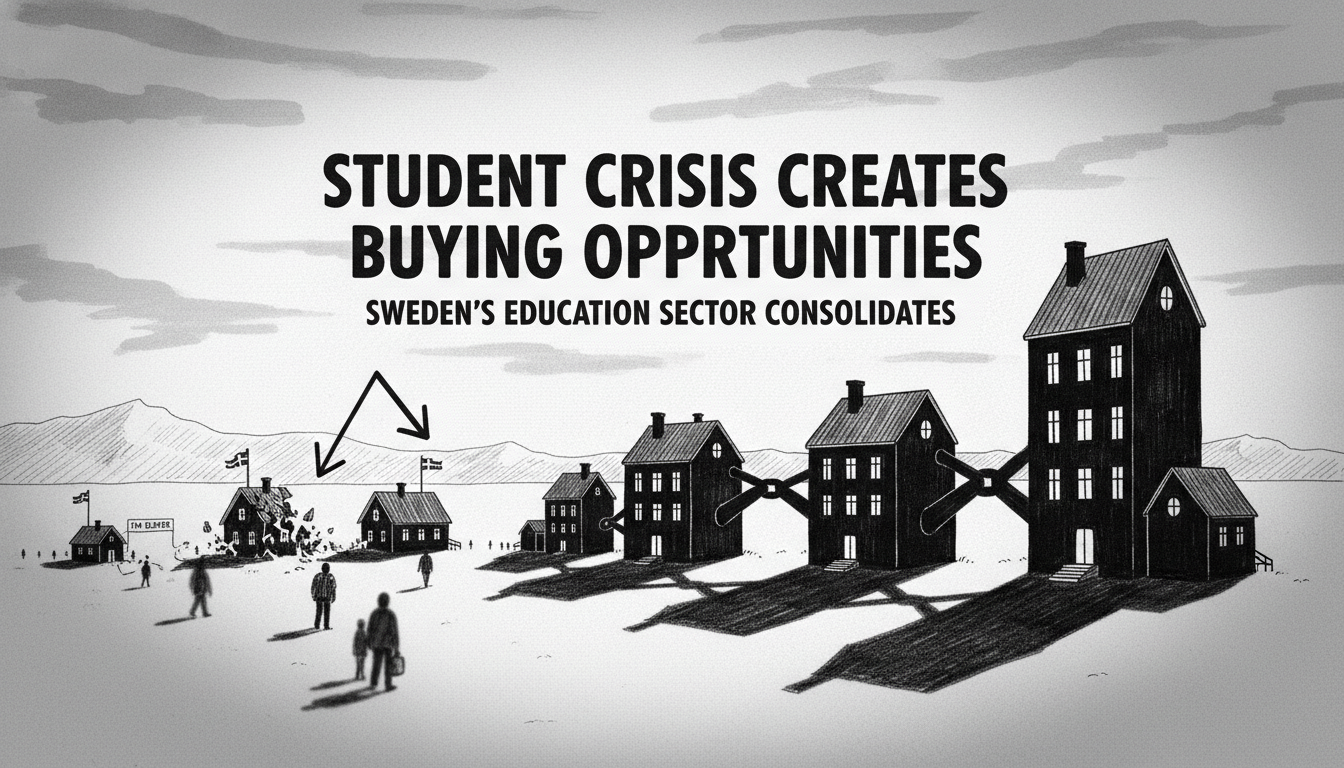
Sweden's independent schools face their biggest challenge in decades as student numbers drop dramatically. For each lost student, revenues fall sharply while fixed costs remain. Non-profit independent schools appear most vulnerable to the demographic shift.
At an ICA supermarket in Stockholm's Södermalm district, a notice board carries an unusual advertisement. A small independent school is seeking students.
The principal of another non-profit independent school in a Stockholm suburb describes her situation. She requested anonymity to avoid alarming parents.
Her school started the autumn term with 170 students, nine fewer than last year. That represents nearly one million Swedish kronor in lost funding.
She explains the difficult choices. Cutting teaching positions isn't practical when losses are spread across grades. Reducing cleaning and food services saves little money. Instead, substitute teachers and student resources disappear.
Remaining staff carry heavier workloads. The principal herself has served as daily playground supervisor for two weeks.
This reluctance to speak publicly stems from the funding model. Swedish schools receive funding that follows each student, approximately 100,000 kronor annually per elementary student in Stockholm.
When students leave, revenues drop quickly while fixed costs for facilities, teachers, counselors and libraries remain.
Stockholm faces the country's most dramatic demographic change. The city expects 10,000 fewer students within eight years. One in ten current students will disappear, equivalent to 400 classrooms.
Stockholm stands out with 40% of elementary students attending independent schools, compared to 15% in Malmö.
Education analysts and school leaders agree independent schools face their greatest challenge ever. Small operators in both rural areas and cities like Södermalm are most vulnerable. Preschool groups in Södermalm have decreased by 20% in recent years.
Johnny Gerdin, principal of Fria Maria elementary school, decided to speak despite risks. He wants to discuss school funding and the vulnerability of small, ideologically-driven schools.
Fria Maria sits in what was once "one of Northern Europe's most child-dense areas." Now it's where student numbers decline most sharply.
Just years ago, Gerdin always had 300 children waiting. The school only needed to provide good education and happy students. Quality spoke for itself.
Fria Maria operates as a staff cooperative started by educators. Surpluses fund operations rather than dividends. Small classes of 20 students require high staffing levels.
These small classes attract many students with special needs. The school recently started a special teaching group. Despite this, national test scores were Södermalm's highest last year.
When local preschools closed, concern grew. That's when the ICA notice appeared.
For surviving demographic shifts, one equation beats all others: having many large units.
Non-profit schools rarely have this advantage. School corporations do.
The largest corporations compare to medium-sized municipalities. Only Stockholm, Gothenburg and Malmö have more elementary students than International English School (IES) with its 30,000 students.
Independent schools average 217 students nationwide. Corporation-owned schools average 353 students. Non-profit schools average just 114 students.
Marcus Larsson, teacher and commentator with independent think tank Balans, explains the funding model encourages large units.
Large units are more efficient regardless of being municipal or independent. They share costs differently and achieve economies of scale. Most importantly, vulnerability decreases.
At Kunskapsskolan with 29 elementary schools, adjusting to changing student numbers is normal according to Sweden chief Sofi Klang.
They can handle temporary dips at certain locations. How student declines impact schools depends on local demographics and competition.
Closing schools is the last resort, Klang says. This considers both students' needs and long lease agreements.
To operate quality schools requires a certain student base. Fewer students mean reducing staffing. More students require expansion.
International English School grew rapidly since starting. This year marks the first without planned new establishments.
Coming years will be tough, says Linda Öholm, head of community relations. But IES can support struggling units during difficult periods.
Major school costs are hard to influence short-term. Schools must be durable and plan long-term.
Methods include reducing class numbers or changing which grades schools offer. IES recently decided to close a Stockholm high school due to weak application numbers. No elementary school closures are planned.
All schools, including IES units, must support themselves through student attendance.
The largest operator, Academedia, already closed one Södermalm school due to declining student numbers. No further closures are planned according to their elementary chief.
School corporations have dominated Sweden's independent school market growth. A trend shows larger operators buying smaller ones. Among operators applying to establish or expand schools recently, a strong majority were corporations.
Could the student crisis help corporations grow further? Commentator Marcus Larsson believes so.
Larger operators can acquire small schools at discounted prices. Then they use economies of scale to press costs and financial muscle to weather the crisis.
At Fria Maria in Södermalm, Johnny Gerdin considers marketing strategies. He believes it shouldn't be necessary and school funding should be different.
But current politics require visibility and showcasing their pedagogy.
No crisis exists yet. The school has buffers for student declines. If impacts worsen in coming years, perhaps one parallel class might need removal.
Abandoning small classes or pedagogical identity isn't an option. That would break their educational philosophy.
Small operators' reluctance to speak is understandable says Andreas Mörck, director at employer organization Almega education.
Announcing difficulties and small margins creates enormous concern among students and parents.
But corporations' most urgent concern involves political proposals to reduce school funding and limit independent school profits.
Current discussions with independent schools focus on political proposals risking well-functioning operations.
Independent elementary schools averaged 217 students last academic year. Schools in the largest corporations averaged 353 students. Non-profit schools averaged 117 students.
Most independent operators have only one school. Independent school companies average 3% profit margins according to Almega.
This situation reveals the inherent tension in Sweden's school choice model—small innovative schools struggle to survive demographic shifts while large corporations consolidate power.