
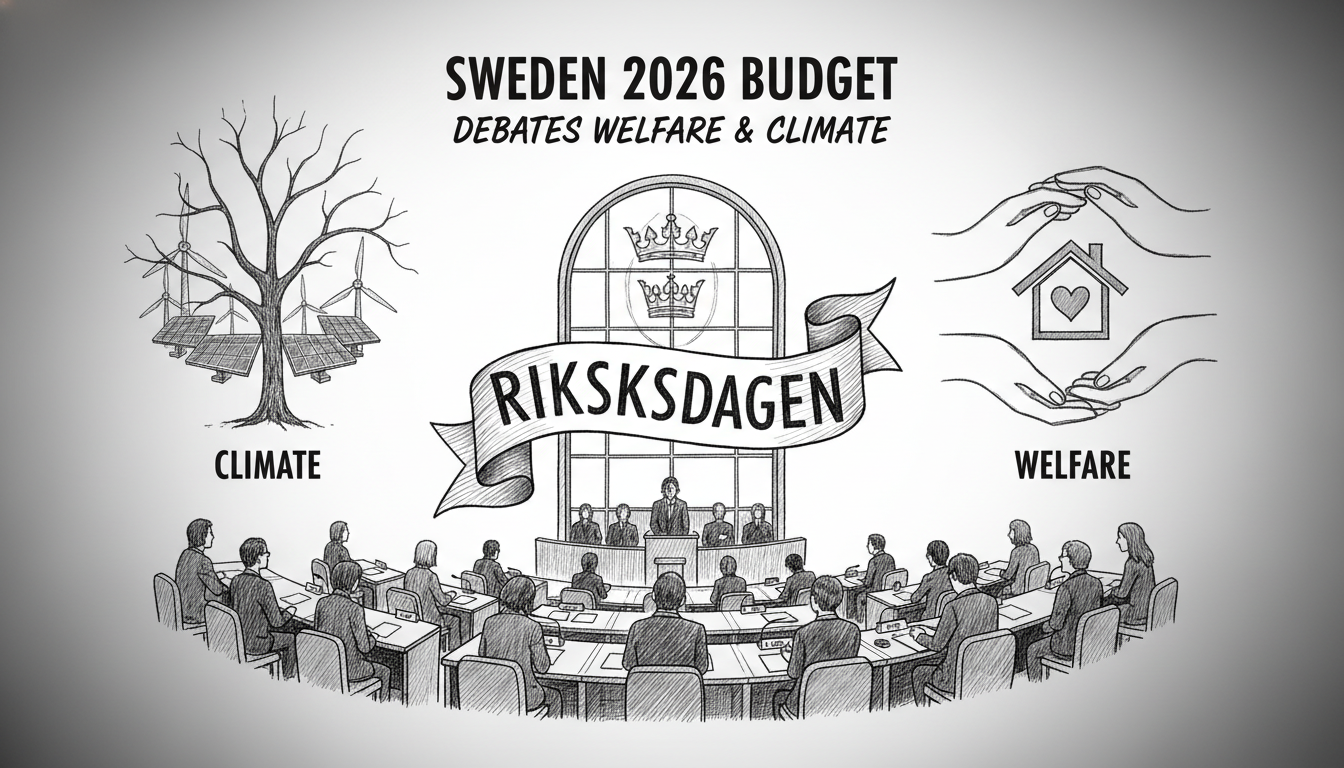
Sweden's Riksdag reconvened this week for its pivotal January 2026 session, setting the legislative agenda for the year with intense debates over the national budget, climate policy, and the future of the social welfare system. The session, held in the Riksdag building on Helgeandsholmen, will determine the government's spending priorities and policy direction. Finance Minister Elisabeth Svantesson presented the government's proposed budget, which immediately sparked cross-party scrutiny. The coalition government holds a narrow majority, making every vote critical for passing its agenda. This session's outcomes will directly influence Sweden's economic and social trajectory.
A Budget Under the Microscope
The proposed 2026 budget, drafted by the Finance Ministry at Rosenbad, allocates significant funds to defense and law enforcement. It also includes targeted tax reductions for middle-income earners. Opposition parties, led by the Social Democrats, have criticized the plan for what they call insufficient investment in public healthcare and schools. "This budget prioritizes tax cuts over the long-term stability of our welfare institutions," said Social Democrat economic spokesperson Mikael Damberg during the opening debate. The government argues its approach stimulates economic growth, which in turn funds welfare. Analysts note the debate reflects a deeper ideological divide on the state's role in the economy.
Detailed committee reviews of the budget bill will occur throughout January. Each of the Riksdag's 15 specialized committees will examine the sections relevant to their area, such as the Finance Committee and the Social Insurance Committee. These reviews often lead to negotiations and amendments before the final vote. The government's ability to secure its budget hinges on maintaining discipline within its own coalition ranks. Political observers are watching the smaller coalition partners closely for any signs of dissent over specific allocations.
Climate Goals Meet Economic Realities
Environmental policy forms another major battleground. Sweden's legally binding target of net-zero emissions by 2045 requires consistent legislative action. The government has proposed a new industrial policy package, dubbed the "Green Industry Leap," which includes tax incentives for clean technology. Climate and Environment Minister Romina Pourmokhtari stated the package aims to "create jobs while accelerating the green transition." However, the proposal faces criticism from the Left Party and Green Party, who argue it relies too heavily on market mechanisms and corporate goodwill.
They demand stricter regulatory measures and a faster phase-out of fossil fuel subsidies. The Centre Party, part of the governing coalition, has pushed for stronger support for rural green energy projects, a potential point of internal negotiation. The debate encapsulates a central tension in Swedish politics: balancing ambitious environmental targets with industrial competitiveness and household energy costs. The final policy shape will signal Sweden's climate strategy direction for the latter half of the decade.
The Welfare State at a Crossroads
Discussions on social welfare reform are perhaps the most emotionally charged. Sweden spends approximately 26% of its GDP on social protection, a cornerstone of the national model. The government has initiated an inquiry into the long-term sustainability of the sickness and unemployment benefit systems. Social Affairs Minister Jakob Forssmed emphasized the need for systems that "encourage work and are financially resilient for future generations." This is widely interpreted as a prelude to proposals for tightening eligibility criteria or adjusting benefit levels.
Opposition parties have vowed to resist any measures they perceive as eroding the universal safety net. "We will fight every proposal that makes life harder for the sick, the unemployed, or pensioners," said a spokesperson for the Left Party. Experts from the Swedish Institute for Social Research suggest the debate is less about the system's existence and more about its calibration in an aging society with evolving labor markets. The Riksdag's decisions here will have a direct human impact, affecting millions of citizens' economic security.
The Parliamentary Mechanics of Decision-Making
The path from debate to law in the Riksdag is a meticulous one. With 349 members elected via proportional representation, building majorities is a constant process of negotiation. The government, led by the Moderate Party, does not command a majority alone and relies on its coalition partners. This dynamic gives smaller parties significant leverage in committee stages. Key votes expected in late January will demonstrate the government's cohesion and the opposition's ability to form counter-majorities on specific issues.
Historically, Swedish politics has valued consensus, but recent years have seen more polarized debates. The tone of this January session will be a key indicator of whether that trend continues. All proceedings are public, with transcripts and votes recorded, allowing for full transparency. The decisions made in these coming weeks will set the concrete framework for government agencies and ministries operating from the Stockholm government district throughout 2026.
Analysis: A Test of Coalition Stability
Political analysts view this session as a critical stress test for the governing coalition. "The budget is the ultimate test of unity," said political scientist Jenny Madestam. "Any significant rebellion or need for external support would be seen as a major weakness." The simultaneous debates on climate and welfare force coalition partners to reconcile sometimes divergent priorities between their urban and rural, or economically liberal and socially conservative, voter bases. The opposition, still regrouping after the last election, sees an opportunity to challenge the government's narrative on economic management and social fairness.
The public's interest in these parliamentary proceedings typically increases during budget season, as the abstract becomes personal. How the Riksdag resolves these debates will influence public opinion and set the stage for the next electoral cycle. The government's success will be measured not just by bills passed, but by the perceived legitimacy and effectiveness of the compromises reached. The sessions in the historic Riksdag chamber are more than procedure; they are the live enactment of Sweden's democratic priorities.
As the January session progresses, the world will watch how Sweden navigates its signature challenges: maintaining a robust welfare model, leading on climate action, and ensuring economic stability. The decisions taken in the coming weeks will resonate far beyond the walls of the parliament building, shaping the daily reality of Swedish society and defining the nation's path in a complex geopolitical era. The question remains: can a fragmented political landscape deliver the coherent policy that these ambitious goals require?