
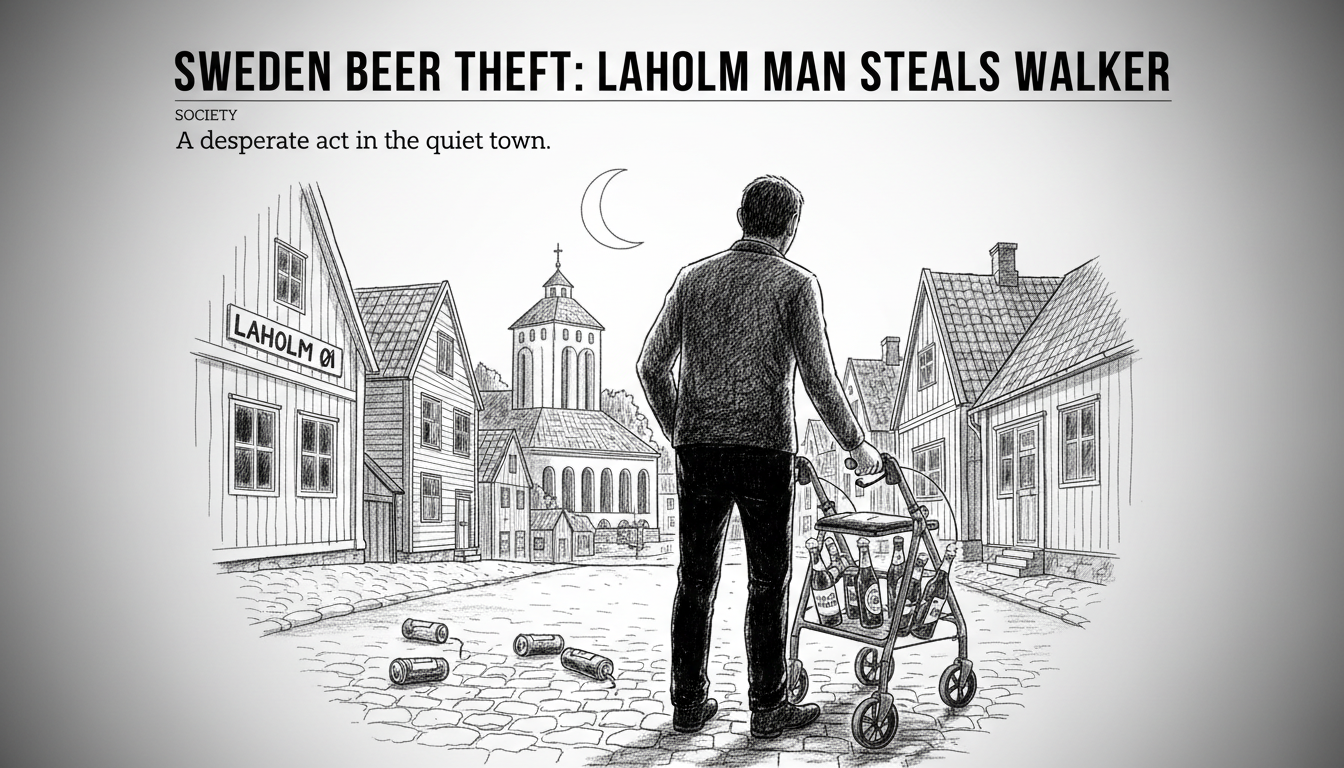
Sweden's low crime rate is often a point of national pride, but a recent incident in the coastal town of Laholm presents a more complicated picture. A man was apprehended by police just before 5 AM after allegedly breaking into a storage shed. His reported loot? A case of beer and a walker. The suspect was also taken into custody for public drunkenness, weaving a short, strange tale that speaks to broader societal questions beneath its surface.
This isn't a story of high-stakes crime. It’s a small, sad event in a municipality of just over 27,000 people. Halland County, where Laholm is situated, is known for its long beaches and relaxed summer atmosphere. Serious crime here is rare. Yet this pre-dawn episode—a theft driven by alcohol, targeting both a commodity and an aid for mobility—feels symbolically heavy. It hints at the quiet struggles that play out in Sweden's smaller communities, far from the headlines focused on major cities.
A Glimpse into a Small-Town Morning
The incident occurred in the early hours, a time when small towns like Laholm are typically quiet. Police found the man at the address after the reported break-in. The items taken are an unusual pair: a 'flak' or case of beer, a common target for petty theft linked to intoxication, and a 'rullator' or rollator walker. This second item shifts the narrative. It’s not typically an object of black-market value. Its theft suggests impulsivity, desperation, or a specific, immediate need that isn't immediately clear from a police report.
"When you see a report like this, your first reaction might be to shrug or even laugh," says Karl Jensen, a sociologist who studies substance abuse and social marginalization in Nordic regions. "But the combination of items is telling. Alcohol abuse is frequently a symptom, not just a cause. The theft of a mobility aid could indicate the individual's own health struggles, or a fragmented thought process under severe influence. It's a snapshot of a person in crisis, not a premeditated criminal act."
Alcohol, Petty Crime, and the Swedish Context
Sweden has a historically complex relationship with alcohol, governed by the state-run Systembolaget monopoly and strict policies designed to reduce harm. While overall consumption is moderate by European standards, problematic drinking remains a persistent social and public health issue. Incidents of petty crime connected to intoxication, especially involving theft of alcohol or minor property damage, are a recurring challenge for police across the country, not just in big cities.
In smaller municipalities like Laholm, the social fabric is tighter. Resources for both law enforcement and social services are different than in Stockholm or Gothenburg. A single officer responding to such a call might be dealing with a familiar face from a previous social disturbance. The response often blends law enforcement with a social care approach, as seen by the man being 'omhändertagen' or taken into custody for his own safety due to drunkenness, alongside the theft allegation.
"In a major urban center, this might be a quick processing and release," notes Anna Forsberg, a former police officer who now writes on community policing. "In a place like Laholm, there's a greater chance the responding officers know the individual's history. The focus might lean more toward ensuring he is sober and has some form of support, not just pushing him through the judicial system. It's a nuanced, resource-intensive way to police."
The Social Safety Net in Focus
This minor event inadvertently turns a spotlight on Sweden's much-vaunted welfare system. The country is famed for its comprehensive social safety net, designed to catch individuals before they fall into cycles of addiction and crime. Yet cases like this suggest gaps, or individuals who slip through them. The theft of a walker, an item often associated with the elderly or those with disabilities, raises quiet questions about the suspect's own access to care and support.
Was he struggling with mobility issues himself? Was the walker stolen for someone else? Or was it simply the nearest object at hand? The police report doesn't say. But experts argue it’s a detail that shouldn’t be ignored. "It moves the story from a simple crime blotter item to a potential sign of unmet social needs," Jensen explains. "It prompts us to ask about the availability of addiction services, mental health support, and assisted living resources in our smaller towns. The efficiency of the welfare state is tested in these individual, messy human situations."
Life Beyond the City Limits
For international readers, Sweden often conjures images of Stockholm's sleek design or the frozen landscapes of the north. But the heart of Swedish society beats in places like Laholm—regional hubs where industry, agriculture, and tourism mix. Life here has a different rhythm. Crime rates are lower, but community ties and visibility are higher. An incident like this doesn't get lost in a metropolitan crime log; it becomes a local talking point.
It also reflects a universal small-town reality everywhere. Urban areas often centralize specialized social services. In rural or semi-rural municipalities, individuals facing complex challenges like addiction coupled with health issues may have to travel farther for help, or rely on generalist local services that can be stretched thin. The man’s actions, though criminal, can be seen as a cry for help that manifested in the only way he knew in that moment.
A Story With No Easy Answers
There will be no dramatic courtroom finale for this case. It will likely be processed through a simplified procedure, possibly resulting in a fine or conditional sentence, coupled with a social services referral. The man's name will not be splashed across national newspapers. In many ways, that's the point. This is the unglamorous, everyday work of maintaining a safe and functioning society at the most local level.
The story of the stolen beer and walker in Laholm is a small puzzle. It doesn't fit neat narratives about Swedish crime or society. It is, instead, a reminder that behind every brief police report is a human story layered with personal struggle, systemic pressures, and the quiet challenges of life outside the urban spotlight. It asks us to look beyond the initial absurdity and consider the fragile threads of individual and community well-being. In the end, the most Swedish thing about this story may not be the crime, but the complex social machinery that now must respond to it.
Will the response be merely punitive, or will it connect a vulnerable individual with the help he likely needs? The answer to that question says more about modern Sweden than any crime statistic ever could.