
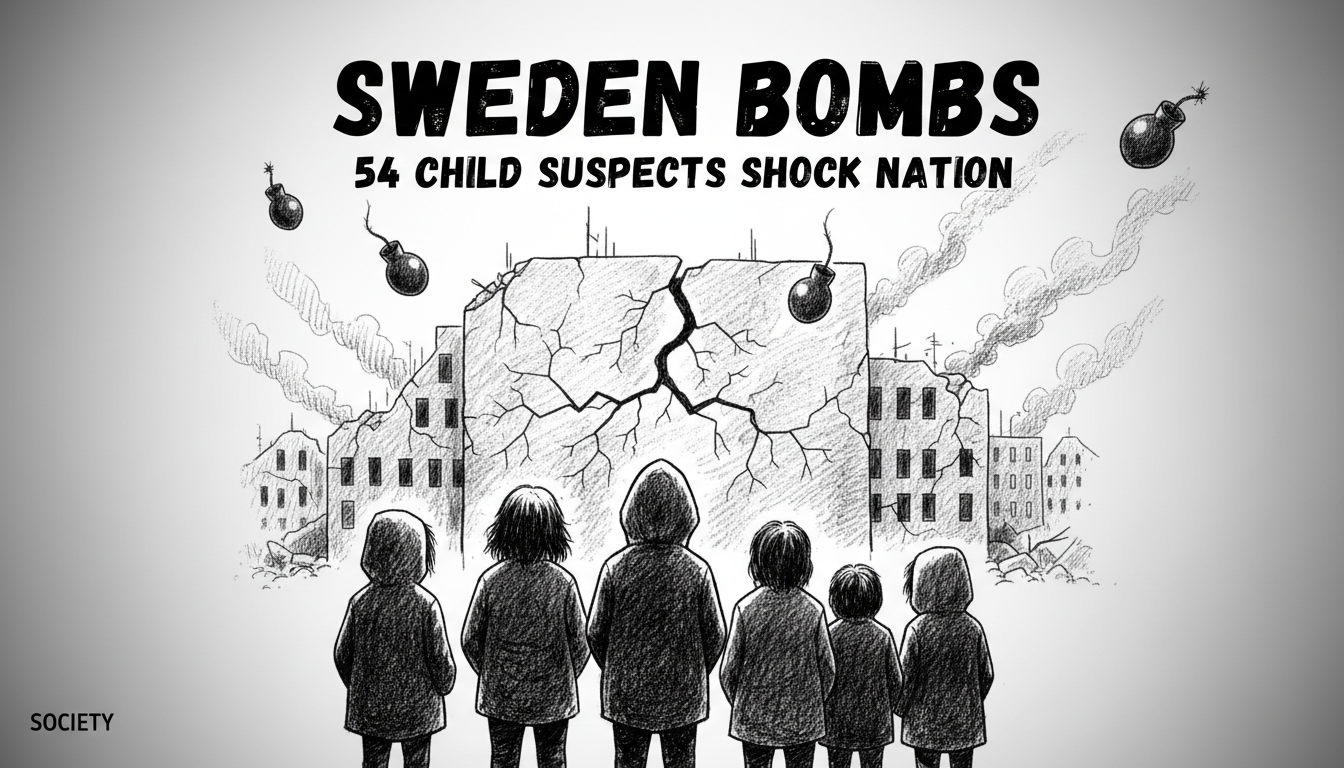
Sweden's gang violence crisis has taken a disturbing turn with 54 children suspected of involvement in bombings this year. That figure represents an almost threefold increase from last year, according to official data, placing vulnerable youth at the center of a national security debate. The numbers paint a grim picture of a recruitment pipeline exploiting Sweden's legal protections for minors. For a society built on a strong welfare model, the involvement of children in such extreme violence signals a profound societal fracture.
From Playgrounds to Crime Scenes
The Swedish penal age is 15, meaning children under that age cannot be held criminally responsible. This legal safeguard, experts warn, is being strategically exploited by criminal networks. Gangs increasingly use younger members to carry out high-risk tasks like placing explosives, knowing the consequences for them are limited. "We are seeing a calculated use of children as instruments," said a senior police analyst who requested anonymity due to operational sensitivity. "They are seen as disposable assets in a brutal business." This tactic transforms playgrounds into recruitment grounds and turns adolescence into a training period for serious crime.
Social workers in affected municipalities describe a pattern of grooming. Children from marginalized areas, often facing challenges at school and at home, are offered money, status, and a sense of belonging. The path from petty delinquency to handling explosives can be alarmingly short. Swedish authorities recorded 245 explosions in 2023 alone, a backdrop of pervasive violence that normalizes danger for these young people. The bombings are frequently tied to gang rivalries over drug territory, a conflict that has escalated in major cities over recent years.
A Triple Failure of Systems
The surge in child suspects points to failures across multiple systems: integration, education, and social services. Many of the children linked to these crimes come from immigrant backgrounds, living in segregated neighborhoods with high unemployment. While not a direct cause, this social exclusion creates fertile ground for criminal recruitment. "When the formal society doesn't offer a future, the informal, criminal one gladly steps in," said Lena Andersson, a criminologist specializing in youth crime. "This is about a lack of hope as much as a presence of evil."
Schools and social services are struggling to identify and intervene early enough. Budget cuts and high caseloads have strained the very safety nets designed to catch vulnerable children. Furthermore, experts note a disconnect between child welfare services and police efforts. A child known to social services for minor troubles may not be flagged as a potential security risk until it is too late. This systemic gap allows criminal networks to operate with a ready supply of impressionable youth.
The Policy Dilemma: Protection vs. Punishment
The situation presents a severe policy dilemma. Lowering the penal age is periodically debated, but many child rights advocates fiercely oppose it. They argue it would criminalize children further and fail to address root causes. The solution, they say, lies in strengthening preventive measures. "Punishing a 14-year-old more harshly won't dismantle the gang structure that recruited them," argued Anna Bergström, head of a major youth outreach NGO. "We need to invest in their families, their schools, and their neighborhoods before the gangs get to them."
Conversely, some lawmakers and police representatives call for tougher measures, including longer sentences for adults who recruit minors and greater surveillance powers in high-risk areas. The Swedish government has recently proposed a package of measures, including increased police stop-and-search powers and mandatory sentences for certain gun crimes. Yet critics question whether a purely punitive approach can succeed where social policies have faltered.
A View from Copenhagen
Watching from Copenhagen, the Swedish crisis feels both familiar and alarmingly extreme. Denmark faces its own challenges with gang crime and integration, but the scale and nature of the violence involving children in Sweden is particularly stark. Danish social policy has long emphasized early intervention and mandatory integration programs, with mixed results. The Swedish case serves as a sobering warning of what can happen when social cohesion breaks down completely.
Key differences exist, notably in gun and explosive violence rates. However, the underlying themes of second-generation alienation, segregated urban areas, and criminal entrepreneurship are common to both sides of the Øresund. The Danish model, with its active employment policies and earlier language intervention, is often cited as a possible alternative path. Yet even here, successes are fragile and the pull of criminal networks remains strong for some disaffected youth.
What Future for the 54?
The immediate fate of the 54 children is unclear. Those over 15 may face prosecution in juvenile courts. Those under the penal age will likely be referred to social services for intervention, which may include counseling, supervised activities, or family support. The real question is what their long-term future holds, and what future they will shape for Sweden. Without effective diversion, these children risk becoming the next generation of gang leaders, perpetuating a cycle of violence.
The statistic is more than a number; it is a snapshot of 54 childhoods diverted towards destruction. It represents 54 potential failures of community, family, and state. Addressing it requires moving beyond a simple law-and-order debate to a fundamental examination of the promises Swedish society makes to its youngest and most vulnerable citizens. As one Malmö community leader put it bluntly, "We are losing our children. Every one of these 54 is a defeat for all of us." The challenge now is whether Sweden can rebuild the bridges that have burned, before more children are lost in the fire.