
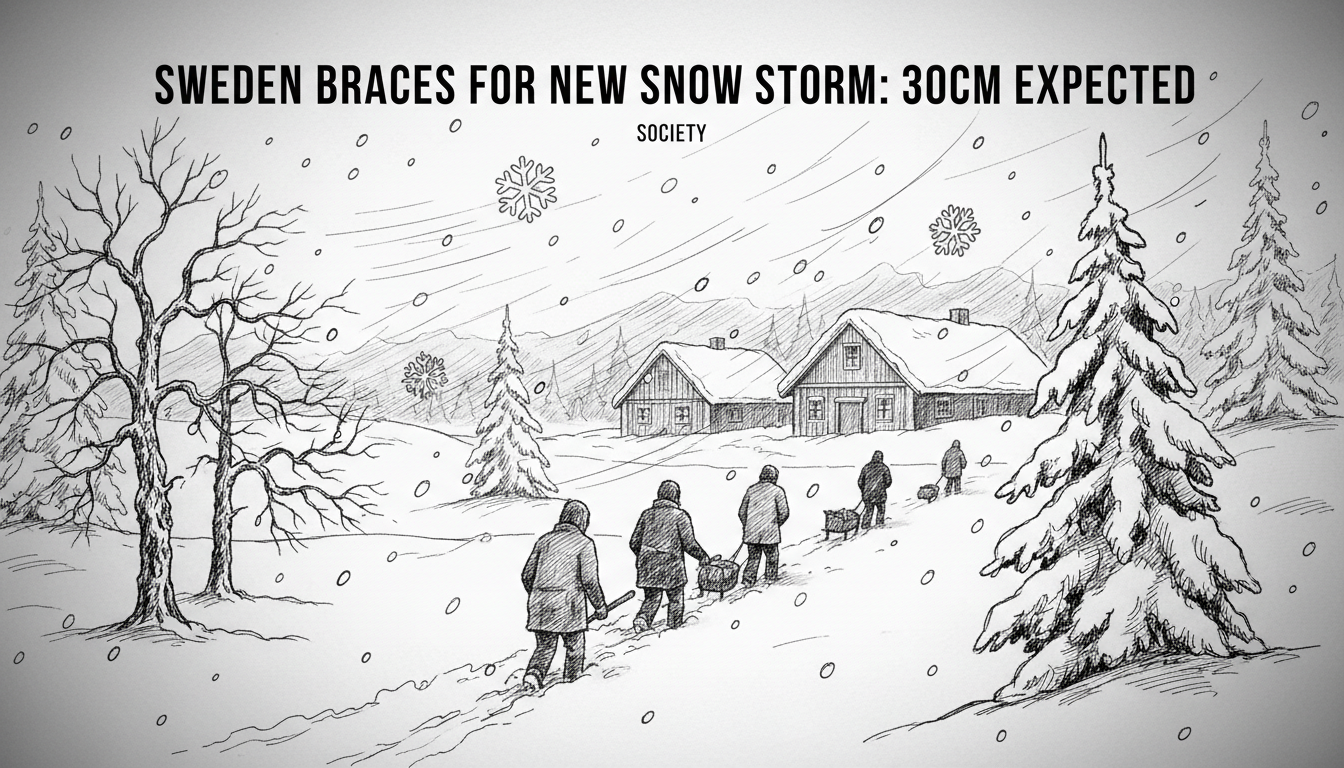
Sweden's winter weather is far from over. The Swedish Meteorological and Hydrological Institute (SMHI) warns of a new snowstorm hitting on Thursday, with meteorologist Max Schildt delivering a simple, stark message: "There's more coming." This fresh low-pressure system, currently over the British Isles, is set to sweep into western Sweden on Wednesday. It's part of the same weather pattern that has already caused hundreds of flight cancellations and delays across Western Europe. For Swedes, it means another round of shoveling, travel disruptions, and the familiar, stoic preparation for nature's next test.
"What's moving up over Sweden is perhaps the cousin of that system," Schildt explained, clarifying the storm's origin. "But it's not the same low-pressure center." The cousin, however, is packing a serious punch. The storm is forecast to intensify as it moves across Värmland, Dalarna, and central Norrland, becoming particularly heavy on Wednesday evening and throughout Thursday. SMHI has issued a yellow warning for snow across northwestern Götaland, southwestern Svealand, and the coastal and inland areas of central Norrland. A yellow warning signifies weather that could pose a risk to the public, requiring caution and preparedness.
A Nation Already Under Snow
The new warning comes as several existing alerts remain in effect for Tuesday and Wednesday. The situation is most acute in Gävleborg County and its surrounding areas, which have already been buried under significant snowfall. That snow has already taken a toll, disrupting train traffic and straining the power grid. Now, residents there are bracing for another 10 to 20 centimeters, with some local areas potentially seeing up to 30 centimeters of fresh powder. It's a scenario that transforms daily life from a routine into a logistical challenge.
In Stockholm, the mood is one of weary anticipation. At a hardware store in Södermalm, the aisle for snow shovels and ice melt is conspicuously bare. "We sold out of the good shovels on Monday," said store clerk Erik Lundström. "People see the warnings and they remember last week. They don't want to be caught out." This practical, prepared response is a hallmark of Swedish winter culture. The concept of 'mys'—creating cozy comfort—often becomes a strategic retreat when the weather turns harsh.
The Ripple Effect of a Storm
The impact of such a storm extends far beyond snowy driveways. Sweden's infrastructure, while robust, is tested by persistent heavy snow. Railway operator Trafikverket often preemptively reduces speeds on certain lines, leading to delays and cancellations, particularly on regional routes north of the capital. Road maintenance crews work around the clock, but secondary roads in rural areas can become impassable for hours. For parents, it can mean checking school closure websites first thing in the morning. For commuters, it adds an hour of buffer time to any journey.
"These systems are a reminder of our dependence on shared services and personal preparedness," said Dr. Elin Mårtensson, a sociologist at Uppsala University who studies community resilience. "There's a cultural script for this in Sweden. We check the SMHI app, we make sure we have candles and food, we help dig out a neighbor's car. It's a collective experience, even if it's a difficult one." This shared ordeal often strengthens community bonds, with local Facebook groups buzzing with offers of help and updates on which roads are cleared.
The Science Behind the Warning
Meteorologists like SMHI's Schildt are the first line of defense. Their warnings are based on complex models tracking atmospheric pressure, temperature gradients, and moisture. The current system's link to the chaos at European airports like London Heathrow and Amsterdam Schiphol highlights how interconnected Europe's weather truly is. A low-pressure system brewing in the Atlantic can, within days, shutter schools in Dalarna.
Climate scientists are also watching these patterns closely. While no single weather event can be directly attributed to climate change, the trend in Scandinavia points towards more volatile conditions. "We are observing an increase in the intensity of precipitation events, including snowfall, in certain regions," explained Professor Karin Bergström, a climate researcher. "Warmer air holds more moisture. When that air mass meets cold Arctic air over Sweden, the result can be these significant dumps of snow. It aligns with broader models for a changing Nordic climate."
This adds a layer of long-term concern to the immediate hassle of a snowstorm. Are these disruptive events becoming the new normal for Swedish winters?
Life in the Warning Zones
For those directly under the yellow warning, preparation is key. In the coastal towns of Norrland, fishermen secure their boats as the storm approaches from the sea. In the forests of Värmland, homeowners with wood-burning stoves ensure their woodpiles are accessible under a tarp. The Swedish Civil Contingencies Agency (MSB) routinely advises citizens to have emergency supplies for at least three days: water, non-perishable food, a radio with batteries, and necessary medication.
Local authorities swing into action. In Gävle, where the additional snow threatens to compound existing problems, municipal snowplow operators prepare for extended shifts. "It's about priority," said municipal operations manager Lena Forsberg. "We clear main arteries for buses and emergency services first, then residential areas. Patience is important. Everyone wants their street cleared first." This orderly system is a point of pride, but it is strained to its limits during back-to-back storms.
A Cultural Perspective on Winter's Grip
Winter storms in Sweden are more than just a news bulletin; they are woven into the national identity. They feature in classic literature and films, from the harsh landscapes of Selma Lagerlöf's tales to the dark, snow-blanketed thrillers of Scandinavian noir. The struggle against the elements is a recurring theme. Modern Swedes navigate this with a blend of high-tech and timeless tradition. They will check the SMHI radar on their phones while ensuring their winter tires are properly studded—a legal requirement from December 1st to March 31st.
There is also a quiet acceptance, even a perverse kind of appreciation, for the winter's power. "It forces you to slow down," said artist Mikael Pettersson, who lives in a cottage outside Mora in Dalarna. "The world gets quiet under the snow. Your plans get cancelled, and you just have to be at home. In a way, it's a reset. A very cold, inconvenient reset." This philosophical take is common, reflecting a society that has learned to coexist with, rather than constantly fight against, its climate.
Looking Beyond the Forecast
As the country braces for the storm's arrival, the immediate focus is on safety and minimizing disruption. But the recurring nature of these severe warnings prompts broader questions. Is infrastructure investment keeping pace with the potential for more extreme weather? How do cities like Stockholm, with a growing population, manage snow removal when urban space is at a premium? The conversation is shifting from mere coping to long-term adaptation.
For now, the practical advice stands. SMHI urges people in affected areas to stay updated on the forecast, avoid unnecessary travel when the storm peaks, and check on elderly or vulnerable neighbors. The storm, dubbed "Low-pressure system from the west" in typical understated Swedish fashion, will pass. The snow will eventually be plowed, melted, or compacted into icy sheets on side streets. But it leaves behind a familiar lesson in resilience. As the days slowly begin to lengthen after the winter solstice, each storm is a reminder that spring's arrival is earned, not given, in this part of the world. The Swedish winter, it seems, always has the final word.