
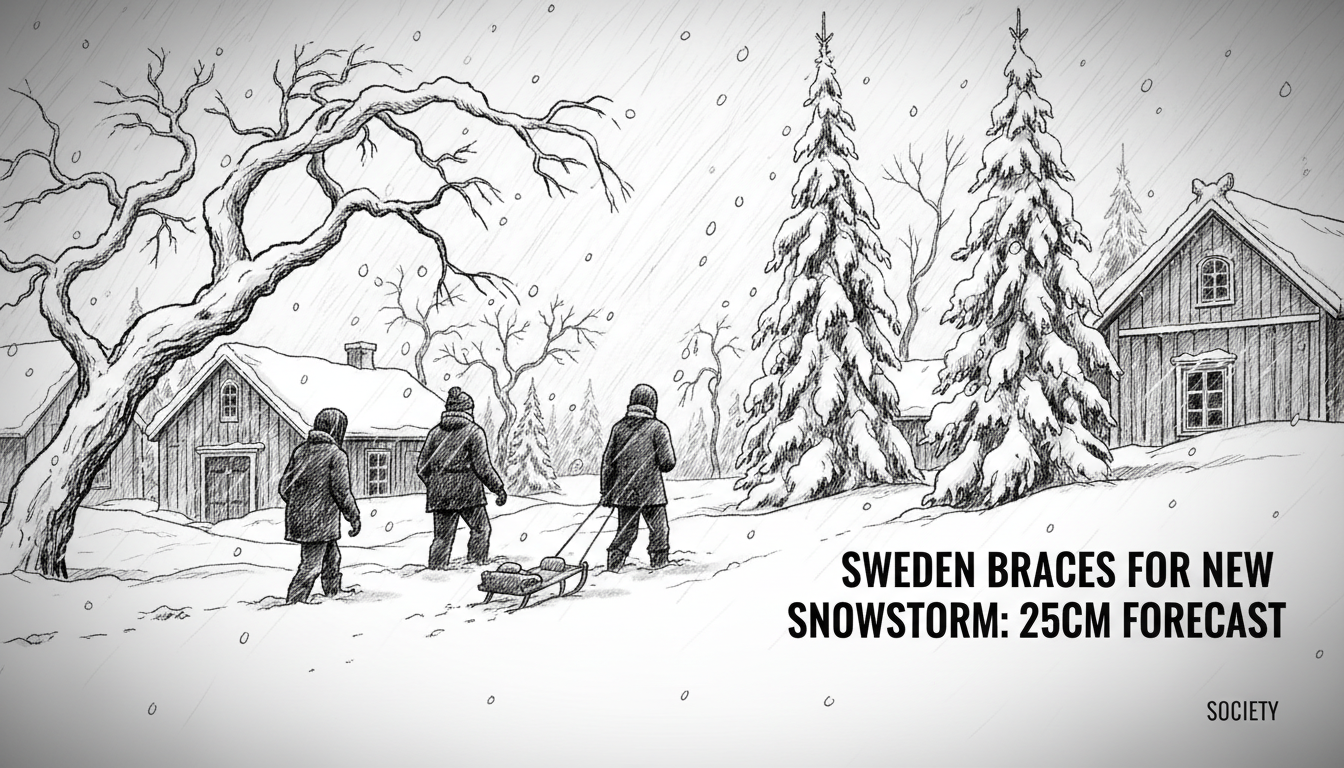
Sweden's weather agency SMHI has issued a fresh warning for a significant snowstorm, forecasting up to 25 centimeters of snow in parts of the country. Meteorologist Max Schildt delivered a simple, stark message: "It's coming more." The new low-pressure system, expected to hit northwestern Götaland and southwestern Svealand from Wednesday evening through Friday, threatens to extend a winter that many Swedes thought might be easing. This system is related to the same weather pattern that has caused hundreds of flight cancellations across Western Europe, a reminder of how interconnected the continent's weather truly is.
For residents in cities like Gothenburg and towns across Värmland, the warning means another round of shoveling, potential travel disruptions, and the familiar hunkering-down mentality of Swedish winter. "What's moving up over Sweden is perhaps the cousin of that," Schildt said, distinguishing it from the core low causing chaos further south. "But it's not the same low-pressure center." Yet, its impact will be keenly felt. The forecast calls for 10-15 centimeters widely, with local accumulations potentially doubling that. In a country where daily life continues through the cold, such forecasts trigger a well-rehearsed societal response, from municipal snowplow teams gearing up to parents checking school closure websites.
The Rhythm of Swedish Winter
This incoming storm fits into the familiar, if sometimes grueling, rhythm of the Nordic winter. Unlike the sudden, paralyzing snowfalls seen in some climates, Swedish winters are often a prolonged conversation with the cold. This season has been a classic example: periods of crisp, sunny frost followed by heavy, wet snowfalls that blanket the landscape in silence. The storm warning highlights the specific regions of Götaland and Svealand—areas encompassing both major urban centers and vast, forested countryside. The response in Stockholm's archipelago communities, where ferries can be halted by ice, will differ from the inland rural areas, where isolated farms rely on clear roads.
Swedish culture is, in many ways, shaped by this seasonal negotiation. The concept of "mys"—roughly translated as cozy contentment—is a direct psychological counterweight to the dark and cold outside. As this new storm approaches, you'll see the signs everywhere: candles glowing in windows, supermarkets with increased stocks of coffee and cinnamon buns, and a collective shift towards indoor activities. It's not just about practicality; it's a cultural adaptation. "We don't fight the winter, we adjust to it," says Lars Bengtsson, a retired teacher in Karlstad. "The SMHI warning isn't alarmist. It's the information we need to make that adjustment smoothly."
Infrastructure and the Art of Snow Management
The true test of a Swedish snowstorm lies in the response of public infrastructure. Swedish municipalities pride themselves on efficient snow clearance, a operation that is both a logistical challenge and a point of civic pride. When SMHI issues an orange-level warning, as it has for this event, it sets municipal snowplow teams on high alert. The priority is clear: keep main arteries and public transport routes open. In Stockholm, the Storstockholms Lokaltrafik (SL) network begins preparing for potential delays on bus routes and ensuring rail switches are heated to prevent freezing.
For international observers, the Swedish approach to winter can be instructive. There is rarely a complete shutdown. Instead, there is a managed continuation. Schools may start later if bus routes are affected, and employers often show flexibility. The underlying principle is preparedness, which starts with clear communication from agencies like SMHI. This storm, while significant, is within the expected range of a normal Swedish winter. The systems are built to handle it. However, experts note that the increasing volatility of weather patterns poses new challenges. "The snow itself isn't the issue; we know how to deal with that," says Anna Kjellström, a civil engineer specializing in climate adaptation. "The greater concern is the pattern of these events—heavy precipitation, sometimes as rain, sometimes as snow, followed by quick freezes. That tests our infrastructure in different ways."
A Society Built on Forecasts
The authority of SMHI in Swedish daily life cannot be overstated. Its forecasts dictate everything from weekend getaway plans to major industrial logistics. When SMHI speaks, people listen. This trust is built on a long history of accurate modeling and clear communication. The agency's website and app become essential viewing several times a day for millions during the winter months. This new warning for 10-25cm of snow is not just a meteorological statement; it's a social signal. It prompts individuals to check their emergency supplies, to consider whether to work from home, and to offer help to elderly neighbors who might struggle with snow clearance.
This communal aspect is key. The Swedish ideal of "dugnad"—communal, voluntary work—often manifests during tough weather. It's common to see people not only shoveling their own driveways but helping to clear a shared courtyard or checking in on others. The storm, in a sense, reinforces social bonds. In apartment blocks, notices might go up about shared shoveling duties. In rural villages, neighbors with tractors will often clear roads for everyone. The weather warning acts as a starter's pistol for this low-key, collective preparedness.
Looking Beyond the Snowfall
While this specific event is a short-term weather phenomenon, meteorologists are increasingly looking at the bigger picture. The low-pressure system affecting Sweden is part of a larger, energetic pattern across the North Atlantic. Schildt's comment about it being a "cousin" to the system disrupting European flights is a nod to this complex interplay. For climate scientists, studying the frequency, intensity, and tracks of these winter storms provides crucial data. Is this a typical late-winter blast, or part of a trend toward more extreme precipitation events?
Research suggests that a warming climate can actually lead to heavier snowfall in certain regions during winter, as a warmer atmosphere holds more moisture. The waters of the North Atlantic remain a significant heat reservoir, fueling these intense low-pressure systems. So, while Swedes are experts at handling snow, the future may require adapting to storms that deliver more snow, more rapidly, or in more unpredictable patterns. This makes the role of SMHI's forecasting and early warnings even more critical for long-term societal resilience.
The Human Element in a Winter Landscape
Ultimately, behind every weather warning are millions of individual stories. It's the nurse in Gothenburg planning an earlier commute to make her hospital shift. It's the farmer in Dalsland ensuring his livestock have shelter and access to water. It's the parent in Örebro deciding if it's a day for sleds or a day for indoor crafts. The Swedish relationship with winter is deeply personal, forged in childhood memories of skating on frozen lakes and the specific quality of winter light.
As the clouds gather over the North Sea, heading for the Swedish coast, the country does what it has always done. It prepares. It adjusts. It finds the "mys" within the challenge. The snow, when it comes, will transform the landscape once again, covering familiar paths in a fresh, silent blanket. The plows will run through the night, their yellow lights cutting through the flurries. And by morning, Sweden will be dealing with the latest chapter in its long, ongoing story with winter—a story of respect, adaptation, and a quiet determination to carry on, whatever the weather brings.
Will this be the last major snowstorm of the season? Only time, and the next SMHI forecast, will tell.