
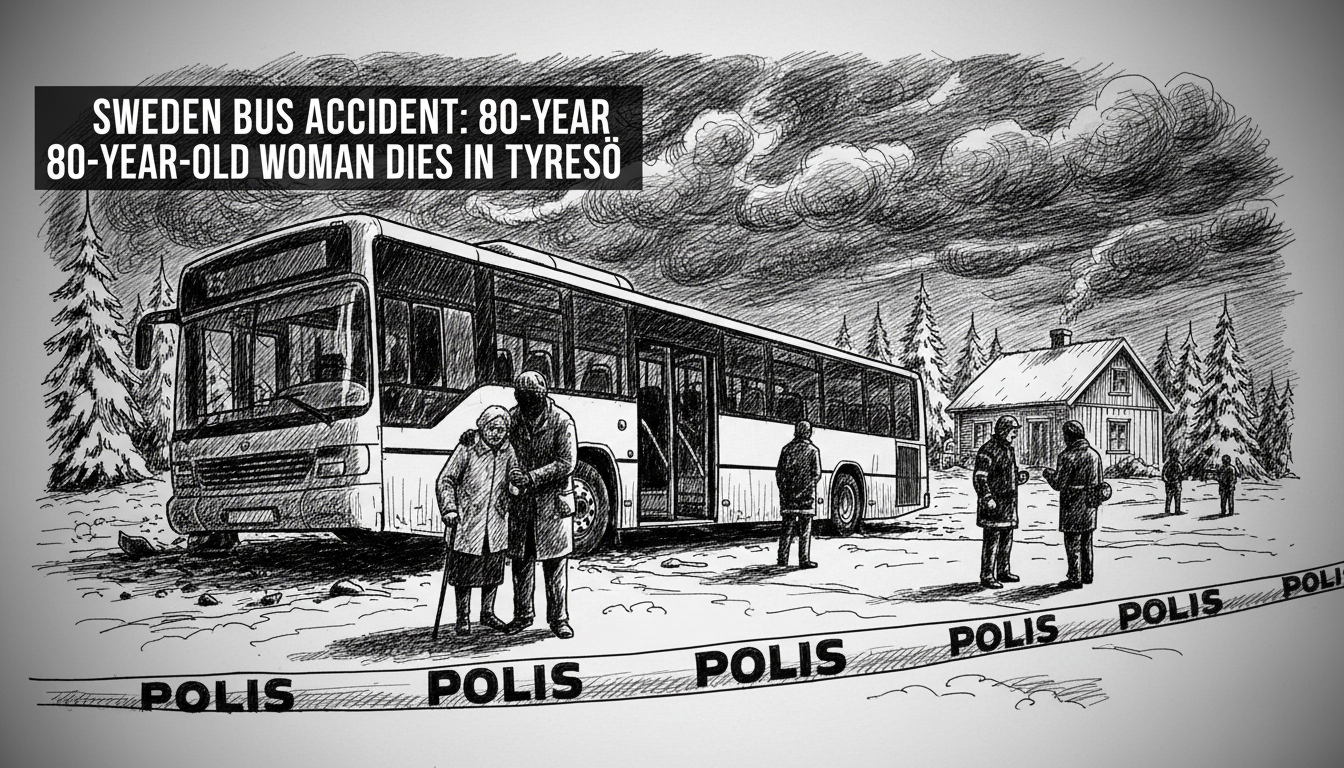
Sweden's latest fatal traffic accident has claimed the life of an 80-year-old woman in Tyresö, a suburb southeast of Stockholm. She was struck by a public bus near Tyresö Centrum around 6 PM on Monday. The incident has sent shockwaves through the quiet residential community, raising urgent questions about pedestrian safety and urban design for an aging population.
Tyresö is known for its green spaces and family-friendly atmosphere. It is a place where many envision a peaceful retirement. Monday evening's tragedy starkly contradicts that image. The accident occurred during the evening rush, a time when visibility decreases and traffic patterns shift. For residents, the familiar bus stop and crossing near the town center have now become a site of profound loss.
A Community in Mourning
The mood in Tyresö Centrum on Tuesday was somber. At the Pressbyrån kiosk, a common meeting point, conversations were hushed. "You think you're safe in your own neighborhood," said Anna, a local resident in her 70s who declined to give her full name. She was doing her weekly shopping. "We all use that crossing. The buses come through here all the time. It makes you think twice." Her sentiment echoes a common fear among elderly Swedes who rely on walking and public transport to maintain their independence.
This accident touches on a core aspect of Swedish society: the promise of a secure and active old age. Sweden has one of Europe's highest life expectancies and a strong social contract that supports senior citizens. Incidents like this one feel like a breach of that contract. They expose vulnerabilities in the physical infrastructure that everyone depends on.
The Complex Dynamics of Bus and Pedestrian Safety
Road safety experts point to a confluence of factors in accidents involving buses and elderly pedestrians. "Buses have large blind spots, especially close to the front and sides," explains Lars Bergström, a traffic safety consultant with over twenty years of experience. He is not directly involved in this investigation. "For an older pedestrian, reaction times might be slower. A moment of hesitation, a misjudgment of speed or distance, and tragedy occurs. The investigation will look at vehicle speed, driver attention, and the specific road design at that location."
The location is key. Tyresö Centrum is a typical Swedish suburban hub with a library, shops, and a bus terminal. These centers are designed for accessibility. Yet, they also create zones where vehicles and pedestrians are in constant, close interaction. As dusk falls around 6 PM in Sweden at this time of year, lighting conditions change rapidly. This period, known as 'mörkertimmen' or the dark hour, is a noted risk time for accidents.
A Broader Look at Swedish Road Safety Trends
Statistically, Sweden is one of the world's safest countries for road travel. Its Vision Zero policy, adopted in 1997, aims to eliminate all traffic fatalities and serious injuries. The policy has been largely successful, cutting deaths by more than half. However, each fatality represents a failure of the system. Elderly pedestrians remain a particularly vulnerable group. According to the latest data from the Swedish Transport Administration, pedestrians over 75 are over-represented in fatal traffic accidents.
Public transportation operator SL, which runs the bus network, has strict safety protocols. In a statement, a spokesperson said, "We are deeply saddened by this tragic event. We are cooperating fully with the authorities in their investigation. Our thoughts are with the family and friends of the deceased." The driver of the bus has reportedly received crisis support, standard procedure following a serious incident. The police investigation is ongoing, focusing on the exact sequence of events.
The Human Cost Beyond the Statistics
Behind the police report and the safety statistics is a life lived. While the woman's identity has not been publicly released, her age tells a story. She was part of Sweden's 'folkhemmet' generation, having lived through the country's transformation into a modern welfare state. She likely raised a family, contributed to society, and was enjoying her later years in a community she called home. Her death is not just a data point for road safety analysts. It is a profound loss for her family and a rupture in the social fabric of Tyresö.
Local politicians have already called for a review of safety measures around Tyresö Centrum. "We must immediately examine the traffic environment in this area," said municipal councilor Erik Johansson (Moderaterna). "Our seniors must feel safe when they are out walking. This is a fundamental prerequisite for a good quality of life." Such reviews often lead to physical changes: better lighting, redesigned crossings, adjusted speed limits, or improved signage.
Moving Forward: Safety in an Aging Society
This tragedy in Tyresö serves as a stark reminder. Sweden's society is aging rapidly. By 2040, nearly a quarter of the population will be over 65. This demographic shift demands a continuous evolution of urban planning and traffic design. Concepts like 'tyst trafik' (quiet traffic) zones, extended pedestrian light phases, and more frequent rest benches are not just amenities. They are essential safety features for an aging population.
The promise of Vision Zero is that no loss of life is acceptable. Each death forces a re-evaluation. It demands answers. Was the road design optimal? Was the lighting sufficient? Could the bus's technology have helped? The investigation in Tyresö will seek these answers. For the community, the process of healing will be longer. The familiar sound of a bus approaching the centrum will now carry a different weight.
As the flowers are laid at the site of the accident, a quiet question hangs over Sweden's suburbs. How do we build societies that protect our most vulnerable citizens at their most routine moments? The evening walk to the store, the wait for the bus, the crossing of a street—these should not be acts of courage. They are the simple rhythms of daily life. Ensuring they remain safe for everyone, from the youngest child to the oldest pensioner, is the unfinished work of a nation committed to safety and dignity for all its people.