
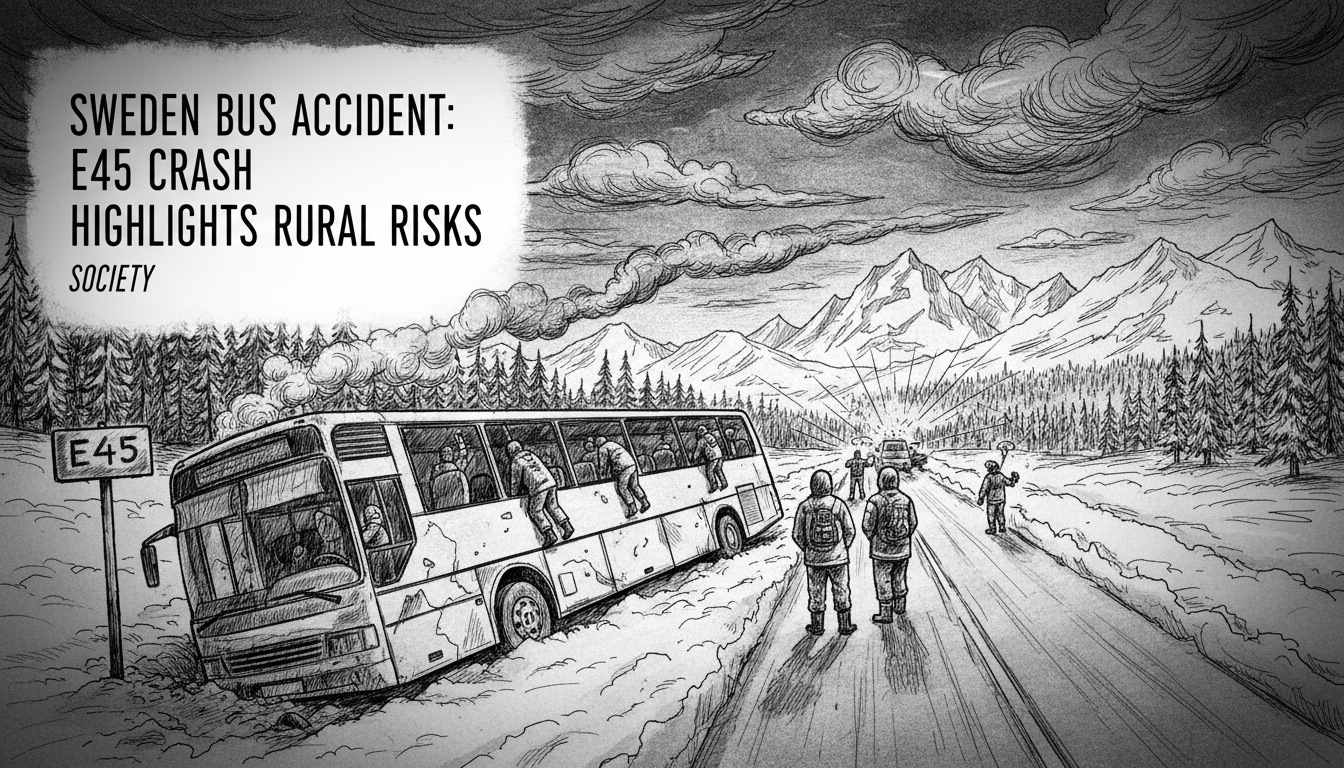
Sweden's E45 highway witnessed a bus veering off the road near Storuman early this morning. The scheduled service bus, operated by Länstrafiken Västerbotten, ended up in a ditch. Remarkably, both the driver and the sole passenger escaped without injury. The incident underscores the persistent challenges of transportation safety in Sweden's vast northern landscapes.
"Yes, it was one of our buses that ended up in the ditch," confirmed Harriet Söder, CEO of Länstrafiken Västerbotten. The bus, belonging to contractor Granbergs Buss, was on its morning run from Östersund. Linus Granberg, the company's CEO, described the event as a gentle, controlled slide. "No injuries have been reported. It went softly and carefully," he said. The passenger was picked up by taxi, but the bus remains stranded, highlighting a key issue in remote areas.
"It is not entirely easy to find a recovery vehicle on site," Granberg admitted, pointing to the logistical hurdles after the immediate danger passed. The company has cited weather conditions as the likely cause. This early-morning incident on one of Europe's northernmost highways is a quiet drama repeated in various forms across the region each winter.
A Highway Through the Wilderness
The E45 is more than a road; it's a 1,690-kilometer lifeline. It stretches from the bustling port of Gothenburg all the way to Karesuando in the Arctic north, brushing the Finnish border. The stretch near Storuman, in Västerbotten County, cuts through a sparsely populated region of forests and lakes. Here, the distance between settlements is measured in tens of kilometers, not city blocks. A stranded vehicle isn't just an inconvenience; it's an isolation event. Recovery services are based in towns that can be hours away, and during a snowstorm, those hours can stretch.
This geography fundamentally shapes the risk profile. A similar slide in central Stockholm would see a swarm of emergency and recovery vehicles within minutes. On the E45 north of Storuman, the response is a logistical operation. It requires coordinating available heavy vehicle operators, who may be dealing with multiple incidents across a huge area. The safety net, while robust, has wide gaps dictated by sheer distance.
The Unseen Passenger: Winter's Constant Threat
While no one was hurt, the incident's attribution to weather is a familiar refrain. Road safety experts consistently identify winter conditions as the dominant factor in northern Swedish transport incidents. "We have to talk about a perfect storm of variables in the north," explains a traffic safety analyst with the Swedish Transport Administration. "It's not just snow or ice. It's the combination of limited daylight, rapidly changing conditions, and driver fatigue from navigating these challenges for months on end."
The analyst, who asked not to be named as they were not directly involved in this case, outlined the common chain of events. Black ice forms on road surfaces. A driver, even an experienced one, makes a minor correction. The vehicle's momentum on a long, straight highway section does the rest. Buses, with their high center of gravity, are particularly susceptible to losing traction and sliding. The outcome of such a slide—a gentle ditch stop or a catastrophic rollover—often comes down to chance, the road's shoulder design, and the driver's skill in the moment.
Life on the Line: The Human Network of Rural Transit
To understand the impact, you must understand what this bus represents. Länstrafiken Västerbotten's network is not about tourists. It's a essential service for residents. It carries students to college, pensioners to medical appointments, and workers to their jobs. The morning bus from Östersund is a thread in the social fabric. Its disruption ripples outward.
I spoke with Anna-Karin, a librarian in Storuman who uses the service weekly. "You become a community on that bus," she says. "You know the driver, you recognize the other regulars. When something like this happens, everyone here hears about it. We worry, because it could be anyone's neighbor or relative. And then you think, 'How will I get to the city now?' The alternatives are few." This sense of shared vulnerability is palpable in small communities. The bus is a mobile piece of public infrastructure, and when it's compromised, a link in the community chain goes slack.
Beyond the Crash: Sweden's Rural-Urban Safety Divide
This accident, though minor, points to a broader, ongoing discussion in Swedish society. There is a tangible divide in service and safety infrastructure between urban south and rural north. Investment in road maintenance, emergency response times, and cellular network coverage (critical for emergency calls) is often concentrated where the population is densest. Yet the risks on the roads are arguably greater in the north due to environmental extremes.
Regional politicians have long campaigned for what they call "infrastructure justice." They argue that the national calculation for safety spending must account for risk, not just user volume. A highway used by 5,000 vehicles a day in the north faces greater natural threats than one used by 50,000 in the south. Shouldn't the safety measures reflect that? This bus slide is a small data point in that large political argument. It's a visual example of what happens when a public service vehicle meets the unmitigated hazard of a northern winter on a remote road.
A Culture of Preparedness
The response to such incidents is woven into local culture. People in Västerbotten and other northern counties often carry emergency kits in their cars year-round: blankets, food, a shovel, traction aids. There's an unspoken rule to check on stopped vehicles. The taxi that collected the passenger in this accident was performing a standard role in a well-rehearsed, informal support network. Official recovery might be slow, but community response is usually swift.
This self-reliance is a point of pride, but also a point of contention. Should citizens have to be so prepared? Or should the state system be robust enough to make that personal preparedness less critical? It's a balance between Swedish individualism and trust in the welfare state. In the north, the individual often bears more of the responsibility for immediate safety.
Looking Down the Road
As climate change brings more volatile weather, with freeze-thaw cycles and unexpected precipitation, these challenges may intensify. The technologies that could help—better road condition sensors, autonomous vehicle safety systems, improved weather-responsive road treatments—are often deployed first on major southern arteries. Transferring these solutions north requires significant investment.
The stranded bus on the E45 will eventually be recovered. The route will resume. For the passenger and driver, it will become a story to tell. But for planners and policymakers, it should be another reminder. Sweden's transportation safety is not one story but two: the urban narrative of congestion and technology, and the rural narrative of distance, climate, and resilience. This morning near Storuman, these two Swedens collided, quietly, in a ditch. The question remains: how does a nation ensure that its promise of safety and connectivity extends with equal strength to the very last kilometer of its longest road, especially when that road is covered in ice?