
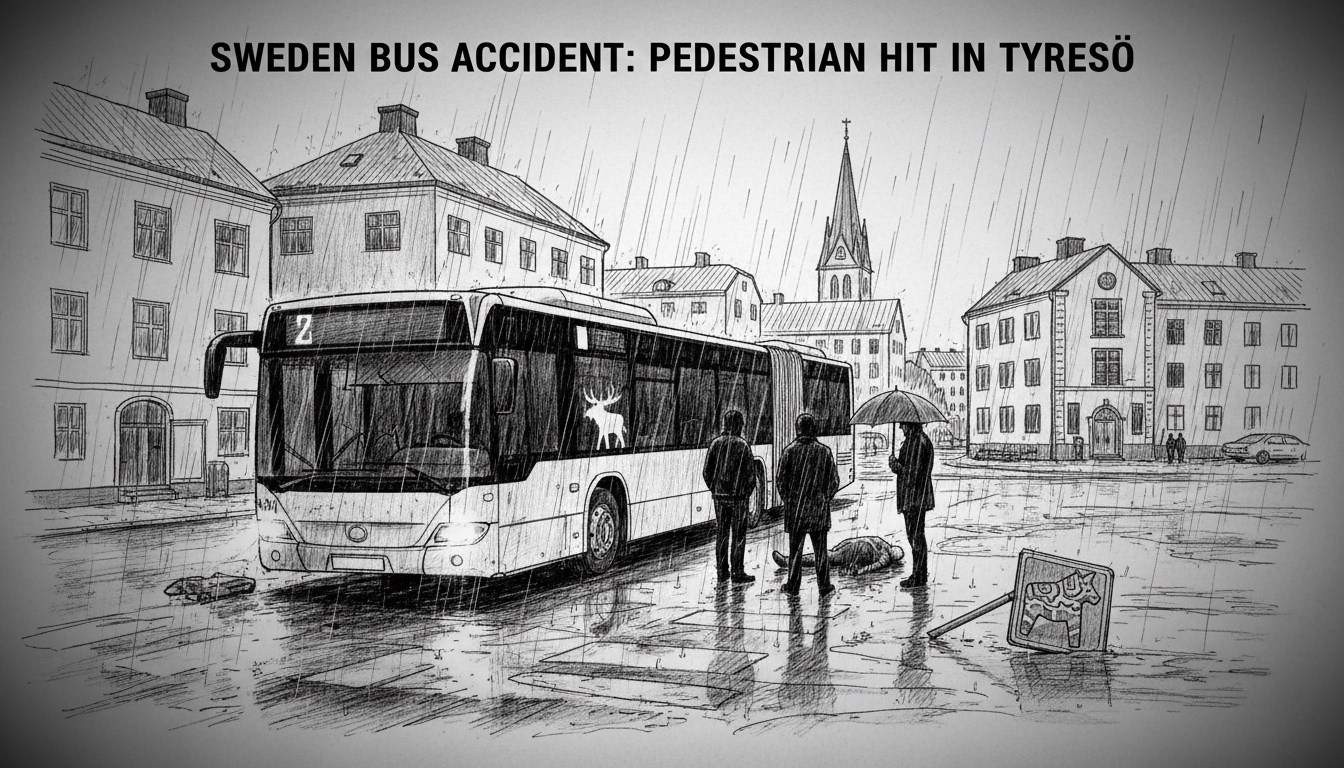
Swedish police and emergency services conducted lifesaving efforts after a pedestrian was struck by a scheduled bus in Tyresö on Tuesday evening. The incident, which occurred around 6 p.m., led to major traffic disruptions and prompted an immediate investigation by authorities.
“Police were first on the scene and began lifesaving interventions,” said Mats Eriksson, a police press spokesperson. The individual was transported by ambulance to a hospital. Sophie Gunnarson, press officer for the Traffic Administration (Trafikförvaltningen), confirmed an investigation is underway, stating, “We will naturally investigate what has happened.”
Emergency Response and Scene
Images from the location showed multiple rescue service vehicles and ambulances at the scene. Police remained on site into the evening, managing the aftermath and initial inquiry. The accident involved a bus operating as part of the regular line traffic managed by SL (Storstockholms Lokaltrafik). This network is the backbone of public transit across Stockholm County, including the municipality of Tyresö southeast of the capital.
The immediate closure of the road for emergency work caused significant traffic complications. “There has been trouble with traffic,” Mats Eriksson acknowledged. Such incidents create a complex challenge for first responders, who must balance urgent medical care with securing the area for a forensic investigation.
The Broader Context of Traffic Safety
This serious accident occurs within a national framework where road safety is a persistent government priority. Sweden recorded approximately 320 road fatalities in 2023. The figure represents a long-term improvement but underscores that each incident triggers a rigorous response protocol.
Andreas Carlson, Sweden's Minister for Infrastructure and Transport, oversees national traffic safety policy. His ministry works with the Swedish Transport Administration (Trafikverket) and regional authorities. A core principle of Sweden's Vision Zero policy, adopted by the Riksdag, is that serious accidents are not inevitable but require systematic preventative measures.
“Every accident is one too many,” a ministry spokesperson told Nordics Today. “The systematic work to improve road safety continues daily, but each tragic event is analyzed to see if new specific measures are needed.”
Investigation and Systemic Checks
The investigation led by police, with support from the Traffic Administration, will follow a standard multi-point process. Officials will examine driver factors, vehicle condition, road environment, and pedestrian actions. SL will also conduct an internal review of operational procedures.
“For public transport operators, public trust is paramount,” said traffic safety analyst Dr. Lena Wallin. “An accident like this triggers not just a legal investigation but a full review of training, schedules, and vehicle maintenance logs. The goal is to identify any systemic flaw, not just assign blame.”
Public transport buses in Stockholm County undergo regular, strict maintenance checks. Drivers complete extensive training, including modules on navigating mixed traffic environments with cyclists and pedestrians. The investigation will scrutinize adherence to all these protocols.
Policy Responses and Funding
Government policy in Sweden channels significant investment into safe transport infrastructure. The 2023 national budget included a 500-million-kronor allocation specifically targeted at improving pedestrian and cyclist safety at intersections and crossings. Municipalities like Tyresö can apply for co-funding from this pool for local projects.
“Decisions in the Riksdag create the framework, but local application is key,” explained political commentator Johan Strömberg. “An accident often leads to a localized safety audit. A crossing might get better lighting, a modified speed limit, or a redesigned platform. The political response is typically technical and data-driven.”
Members of the Swedish Parliament's transport committee regularly review accident statistics and policy effectiveness. While the immediate response is operational, persistent issues can lead to new parliamentary directives or adjustments to the national road safety plan.
The Human Impact Beyond the Statistics
Behind the official statements and investigative procedures lies a profound human trauma. For the injured individual and their family, the event is life-altering. For the bus driver and passengers, it is deeply distressing. Community members in Tyresö may also feel a heightened sense of vulnerability.
“The statistical trend is positive, but that is no consolation to the person fighting for their life in a hospital,” Dr. Wallin noted. “The system is designed to learn from every tragedy to protect others. That is the cold, hard logic of Vision Zero. But while the engineers and politicians study the data, a community is left worrying, waiting for answers.”
Local politicians in Tyresö's municipal council will likely face questions about safety in their specific area. They must interface with regional SL planners and national transport agencies to advocate for any identified local needs.
A Look Ahead: From Reaction to Prevention
The coming days will see the release of preliminary findings from police. The focus will shift from what happened to why it happened and, crucially, what can be done to prevent recurrence. The answer may involve localized changes or, if a broader issue is found, recommendations to SL or even national transport authorities.
This incident tests the resilience of Sweden's much-vaunted safety model. It operates on the premise that no price is too high for a human life. The political and bureaucratic machinery in Stockholm, from Rosenbad to the Riksdag building, is designed to convert that principle into concrete action. The effectiveness of that conversion is measured not in press releases, but in the absence of future headlines.
Can a system built on proactive safety truly account for the chaotic variables of the real world? The investigation in Tyresö will provide one more piece of evidence in Sweden's relentless, and often painful, pursuit of an answer.