
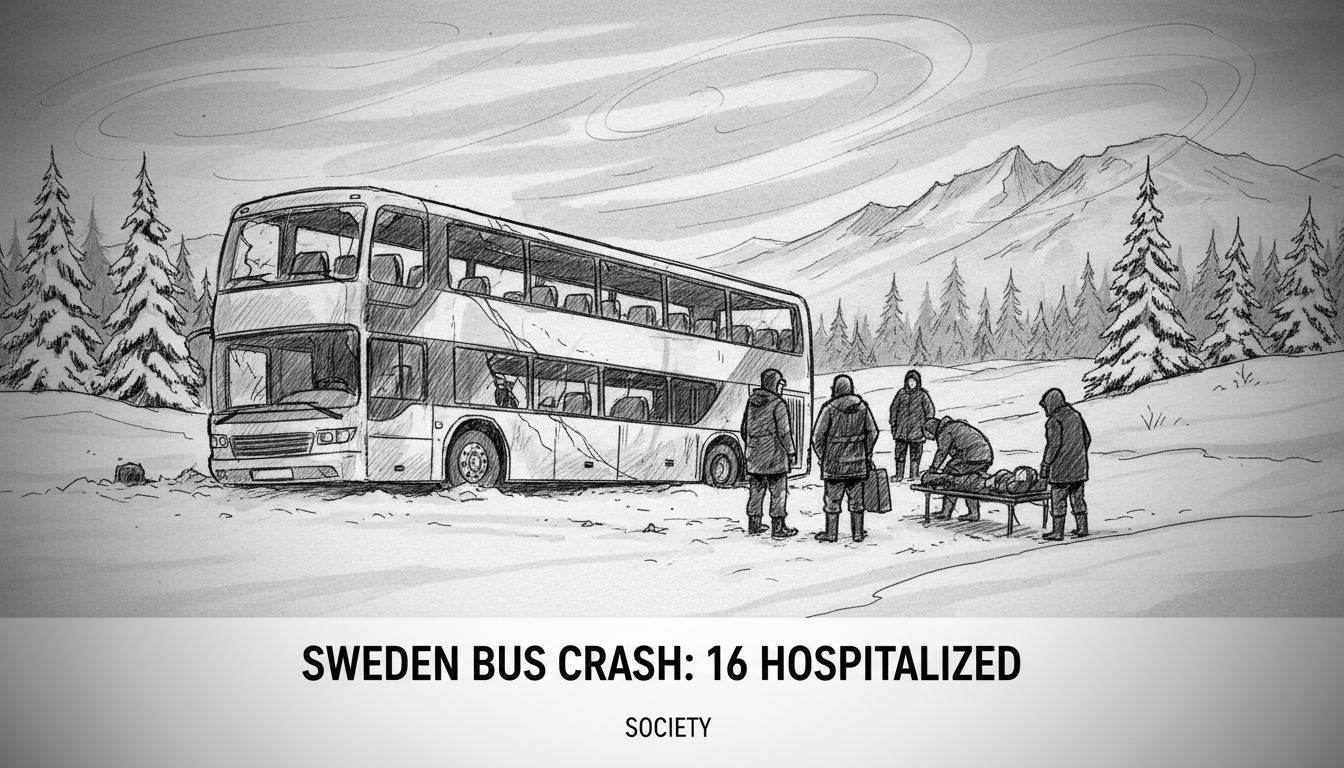
Sweden's E4 highway near Skellefteå became the scene of a major emergency response after a double-decker bus carrying 48 passengers veered off the road and overturned. Sixteen people were rushed to Skellefteå Hospital following the crash, which occurred near Lövånger on a stretch of road known for its heavy traffic and, at this time of year, potentially challenging conditions. The sight of the large bus lying on its side in a ditch, with two cars also off the road nearby, prompted a significant mobilization of emergency services.
"Those involved who do not have this acute need for care or are uninjured have been able to board that bus," said police press spokesperson Elisabeth Glaas, describing how a passing line bus helped transport some of the less seriously affected passengers. The exact severity of the injuries remains unclear, but the hospital's activation of a reinforced emergency mode underscores the seriousness of the incident. For the families waiting for news and the community of Skellefteå, it was an afternoon of profound anxiety.
A Chaotic Scene on a Vital Artery
The E4 is more than just a road in northern Sweden; it is the region's lifeline. Connecting Stockholm to the north, it is essential for commerce, travel, and daily life. An accident here, especially one involving a large passenger vehicle, creates immediate logistical chaos. The response was swift. Ambulances converged on the scene south of Skellefteå, a city of about 75,000 that serves as a key hub for Västerbotten County.
Skellefteå Hospital prepared for a mass casualty event, shifting into its reinforced operational stance. This protocol involves mobilizing extra staff, clearing emergency room capacity, and coordinating with regional health authorities. The fact that the hospital later scaled down to a standby alert level is a positive sign, suggesting the initial crisis has been managed. However, for the 16 individuals transported for care, their personal ordeal was just beginning.
The Uncommon Sight of a Fallen Giant
Double-decker buses are not a common feature on Swedish roads. They are primarily used for long-distance tourist routes or specific intercity lines, offering more seating capacity in a single vehicle. Their higher center of gravity makes them subject to different handling dynamics, especially in crosswinds or on slippery surfaces. While statistically safe, their involvement in any accident often draws particular attention from traffic safety investigators.
"Every accident is unique, but investigators will look at a standard set of factors," explains Lars Holmqvist, a retired traffic safety analyst based in Stockholm. "Road condition at that exact time and location is paramount. Was there ice, slush, or standing water? Driver behavior and alertness is another critical line of inquiry, as is vehicle maintenance and tire status. For a bus of this type, the load distribution and passenger count also become relevant factors."
The investigation will take time. Police will have measured skid marks, examined the wreckage, and interviewed the driver and as many passengers as possible. The two cars found in the ditch on the opposite side raise questions about whether they were involved in the initial sequence of events or if they separately lost control trying to avoid the bus.
Sweden's Safety Record and Winter's Persistent Threat
Sweden is globally recognized for its Vision Zero approach to road safety, an ambitious policy aiming to eliminate fatalities and serious injuries. The country has one of the lowest road mortality rates in the world, with approximately 220 deaths in 2022—a remarkable figure given the population and often harsh driving conditions. This success is built on safer car designs, extensive median barriers, strict drink-driving laws, and a cultural emphasis on safety.
Yet, winter remains the great equalizer. From late October through April, black ice, sudden snow squalls, and limited daylight test even the most experienced drivers. The law mandates winter tires with a specific tread depth from December 1st to March 31st, but the transition periods in late autumn and early spring can be particularly treacherous. A clear road one minute can be an icy patch the next, especially on exposed highway stretches like parts of the E4.
"Technology and regulation have brought us very far," Holmqvist notes. "But they cannot completely override physics. Preparedness means adjusting your speed to the conditions you can see and those you anticipate. For professional drivers operating heavy vehicles, this responsibility is magnified."
The Human Cost Beyond the Statistics
Behind the numbers—48 passengers, 16 hospitalizations—are individual stories of disrupted journeys, fear, and relief. Many were likely traveling for work, to visit family, or perhaps as tourists drawn to the northern lights or the unique culture of Swedish Lapland. The psychological impact of such a violent event can linger long after physical injuries heal.
For the local community in Skellefteå, the response is a point of pride. The hospital staff, police, and firefighters who reacted are part of the fabric of this northern city, which has recently gained international attention for its massive battery factory investment. Today, however, the focus was purely on crisis management and care.
The incident serves as a stark, seasonal reminder. As Sweden moves deeper into autumn, with winter waiting in the wings, road safety conversations intensify. Are your tires ready? Is your journey necessary in this weather? For the passengers on that double-decker bus, these questions are now retrospective. For the rest of us sharing the roads, they remain vitally urgent. How many more seasonal reminders will it take before every driver truly internalizes the fragility of safety on ice?