
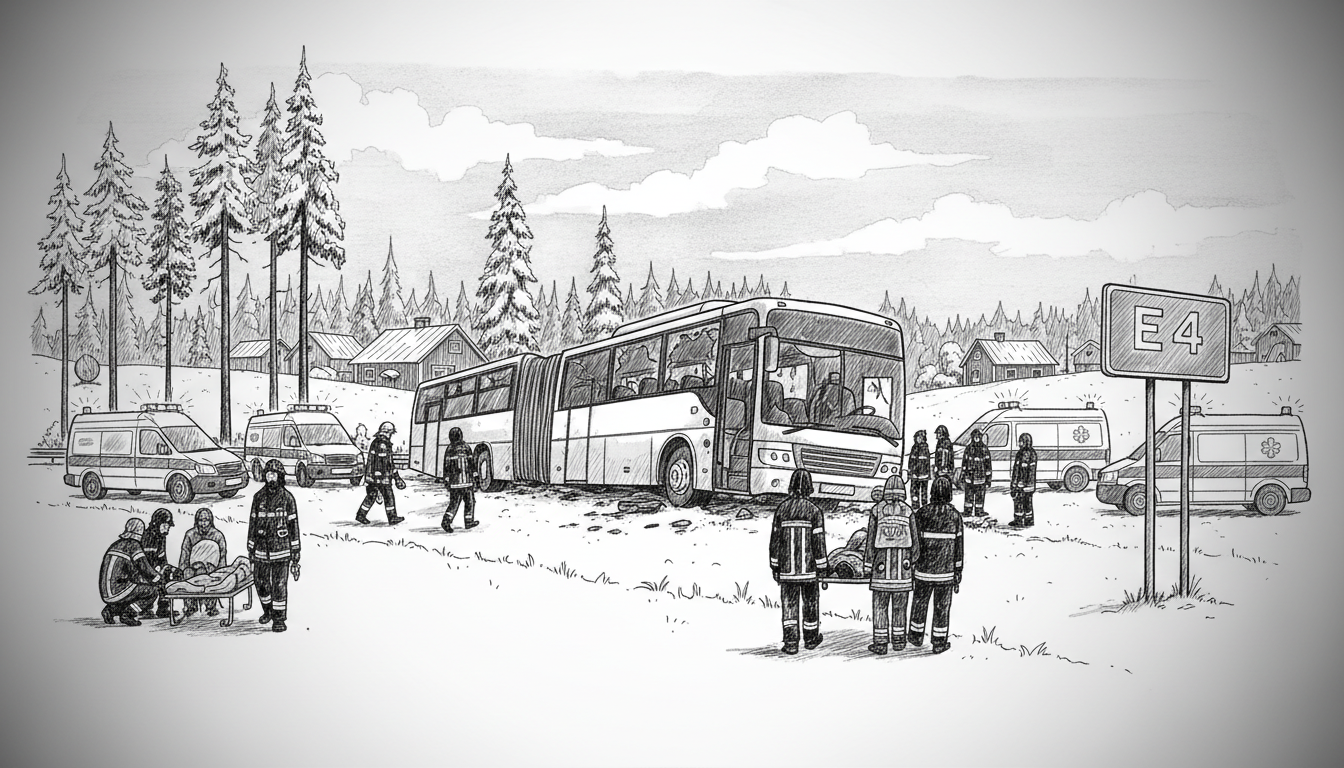
Sweden's E4 highway near Skellefteå became the scene of a major emergency response after a double-decker bus carrying 48 passengers veered off the road and overturned. Sixteen people were rushed to Skellefteå Hospital, with the facility activating its reinforcement protocol to handle the influx of patients. The accident occurred near Lövånger, a quiet area south of Skellefteå, turning an ordinary travel day into a crisis.
Police spokesperson Elisabeth Glaas described the chaotic scene. "Involved parties who didn't have that acute need for care or were unharmed were able to board another bus," she said, referring to a passing line bus that helped transport uninjured passengers. The double-decker lay on its side in a ditch, a startling sight on Sweden's crucial north-south artery. Two passenger cars were also found in a ditch on the opposite side of the road, though their connection to the bus accident wasn't immediately clear.
For the residents of Västerbotten County, the E4 is a lifeline. It connects remote northern communities to larger cities like Umeå and Stockholm. Long-distance double-decker buses are a common sight, offering an affordable and scenic way to traverse Sweden's vast landscapes. This routine journey was violently interrupted, leaving passengers shaken and injured.
Emergency Response in Northern Sweden
When the call came in, Skellefteå Hospital shifted into high gear. The hospital entered what's called "förstärkningsläge" – reinforcement mode. This protocol mobilizes extra staff and resources to manage a sudden surge in patients. Ambulances ferried about ten of the most seriously injured directly to the emergency department. The hospital's ability to handle such an event is a testament to Sweden's decentralized healthcare system, designed to serve sparse populations across large areas.
Later in the afternoon, the hospital downgraded its alert level to "stabsläge," or staff level, just below reinforcement mode. This indicated the initial crisis had been managed, though patients remained under care. The fact that sixteen people required hospital transport suggests a significant impact, though authorities have not detailed the severity of injuries. In Swedish society, where trust in public institutions runs high, such incidents test the systems people rely on.
The Unpredictable Risks of Road Travel
Sweden prides itself on road safety. The country's "Vision Zero" policy, aiming for no road fatalities or serious injuries, is world-renowned. Investments in safer infrastructure, strict drink-driving laws, and winter tire mandates have made Swedish roads some of the safest globally. In 2022, Sweden reported around 220 road traffic deaths—a low number for a country of its size. Yet, accidents like this one are a stark reminder that risk can never be fully eliminated.
Double-decker buses are particularly common for longer routes, offering more seating and better views. Their higher center of gravity, however, can be a factor in rollover accidents, especially in windy conditions or during sudden maneuvers. While the cause of this crash is under investigation, experts often point to a triad of potential factors: vehicle condition, driver action, and the external environment.
"Every accident is a complex puzzle," says Lars Åström, a retired traffic safety analyst based in Stockholm. "On a highway like the E4, factors could include sudden wildlife on the road, a tire blowout, driver distraction, or adverse weather. The investigation will look at everything from the bus's black box data to road surface conditions at that exact time." Winter in northern Sweden, though receding in April, can still present patches of ice or slush, creating treacherous driving conditions.
A Community's Capacity to Cope
The response to the crash highlights a key aspect of Swedish society: a collective readiness to help. The driver of the passing line bus didn't hesitate to stop and take on uninjured passengers. Local police and emergency services coordinated swiftly. This communal reflex is ingrained, a product of both the Swedish principle of "dugnad" (communal work) and professionalized crisis training.
For the passengers, many likely tourists or students traveling during the spring period, the experience will be traumatic. The psychological impact of such an event often lingers long after physical injuries heal. Sweden's healthcare system typically includes psychosocial support in the aftermath of major accidents, recognizing the need for mental as well as physical care.
What Comes After the Crash
The investigation by Swedish police will now take center stage. They will meticulously reconstruct the event, examining the vehicle, interviewing the driver and witnesses, and analyzing weather and road data. The goal is not just to assign blame, but to understand the sequence of events to prevent future tragedies. Findings could influence safety recommendations for bus operators or specific stretches of the E4.
For the bus company involved, which has not been named in initial reports, there will be serious scrutiny. Sweden's transport industry is highly regulated, with strict requirements on driver hours, maintenance, and operator licensing. Any lapse could result in significant penalties.
This accident also serves as a broader cultural moment. It interrupts the narrative of Sweden as a perfectly safe, flawlessly engineered society. It shows that despite the advanced infrastructure and thoughtful urban planning that define modern Swedish life, unpredictability remains. The sight of a toppled double-decker in a ditch is a powerful, unsettling image.
As the injured recover in Skellefteå Hospital, and the investigation continues, people across Sweden will be reminded of the fragility of daily life. The open road, especially in the country's beautiful but demanding north, always demands respect. This incident, sadly, underscores that truth. How Sweden learns from it will be the next chapter in its ongoing story of pursuing safety for everyone.