
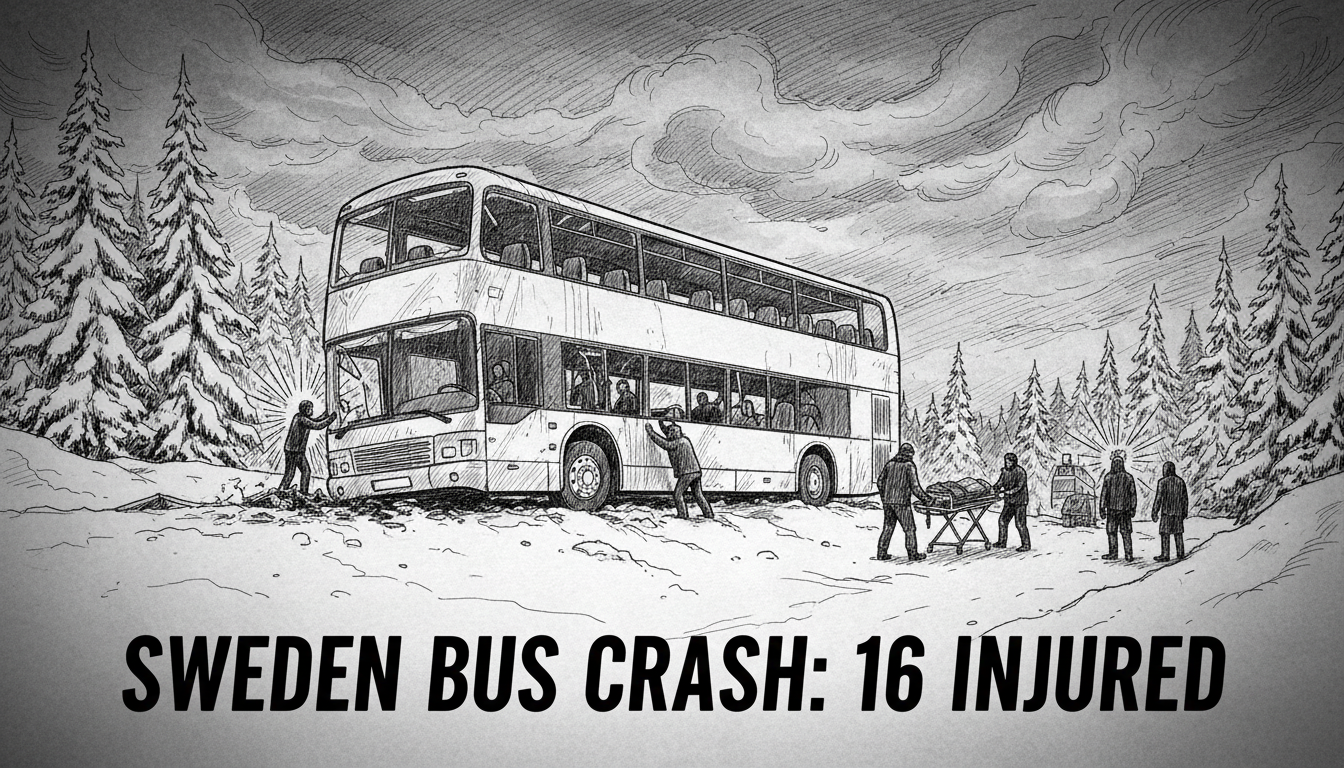
Sweden's E4 highway near Skellefteå became the scene of a major emergency response after a double-decker bus carrying 48 passengers veered off the road and overturned. Sixteen people were transported to Skellefteå Hospital for treatment following the dramatic crash near Lövånger, which left the large vehicle lying on its side in a ditch. The incident forced the hospital into a heightened state of alert to manage the influx of patients, highlighting the severe consequences when Sweden's generally safe public transport system is disrupted.
A Chaotic Scene on the E4
Police and ambulance crews arrived to find a chaotic scene. The double-decker bus, a common sight on longer intercity routes in northern Sweden, rested on its side. Two passenger cars were also found in a ditch on the opposite side of the highway, though their connection to the bus accident remains unclear. A passing scheduled bus was able to stop and pick up several uninjured or lightly injured passengers from the wreckage. 'Those involved who did not have that acute need for care or were unharmed were able to board that bus,' said police press spokesperson Elisabeth Glaas. The exact sequence of events leading to the bus leaving the roadway is now the focus of a police investigation.
For the passengers, the experience was undoubtedly terrifying. The E4 is a major arterial route along Sweden's east coast, often busy with commercial and tourist traffic. An accident of this scale in a relatively remote area stretches emergency resources. Skellefteå Hospital initially activated its 'förstärkningsläge' or reinforcement mode, a protocol for handling mass casualty events. This involves calling in off-duty staff, clearing emergency room capacity, and coordinating with regional health authorities. By later in the afternoon, the hospital had downgraded to 'stabsläge,' or staff level, indicating the immediate crisis had been managed.
The Safety Paradox of Swedish Roads
This accident presents a stark contrast to Sweden's renowned road safety record. The country is a global leader in traffic safety, famously championing the 'Vision Zero' policy which aims to eliminate all traffic fatalities and serious injuries. Roads like the E4 are built and maintained to high standards. Yet, when accidents do occur—especially involving vehicles with many occupants—the human cost can be high. 'Every serious bus accident is a tragedy and a setback for road safety,' says traffic analyst Magnus Lindgren, who has studied Nordic transport patterns. 'The investigation will look at everything: the driver's hours, vehicle maintenance, road conditions at that exact time, and weather.'
Double-decker buses, while offering great views and capacity for scenic routes, come with specific engineering considerations. Their higher center of gravity can affect stability, particularly in high winds or during sudden evasive maneuvers. In Sweden, these buses undergo rigorous annual inspections ('besiktning'), but an investigation will scrutinize the vehicle's recent history. The stretch of the E4 near Lövånger is a mix of straightaways and gentle curves, passing through the forested and coastal landscape of Västerbotten County. Understanding why the bus left its lane is the critical first question.
Community Response and Hospital Mobilization
The response showcases Sweden's integrated emergency system. From the first alert, police, ambulance services, and the hospital coordinated their efforts. Local media reported that around ten patients required ambulance transport, while others may have been taken by other means. The fact that a passing bus could be used as an immediate triage and transport point reflects pragmatic crisis management. For the small communities around Lövånger and Skellefteå, such an event resonates deeply. In close-knit northern Swedish society, it's likely that victims and responders are neighbors, friends, or relatives.
Skellefteå Hospital, like many regional hospitals in Sweden, is a central hub for a large geographic area. Its ability to swiftly switch to emergency mode is a testament to prepared protocols. Patients were likely assessed using the standard triage system—tagging the critically injured for immediate care while treating those with minor injuries. The hospital has not released details on the nature of the injuries, citing patient confidentiality. The psychological impact on the 48 passengers, many of whom were probably traveling for work or to visit family, will also be significant and may require follow-up support.
What Happens After the Crash?
The immediate aftermath involves medical care and investigation. The Swedish Accident Investigation Authority ('Haverikommissionen') may launch a probe alongside the police investigation, especially given the number of people involved. They will examine the bus's 'tachograph' data, which records speed and driving time, and interview the driver and witnesses. The two cars found in the other ditch will also be part of the puzzle. Were they involved in the same incident, or was that a separate, coincidental event? Police have not yet clarified this point.
For the survivors, the experience will linger. Bus travel is a fundamental part of Swedish life, connecting cities and towns across vast distances. Trust in this system is high. An accident like this, while rare, shakes that collective confidence. It also puts a spotlight on the human stories behind the headline. Who were these 48 people? Students returning home? Tourists exploring the north? Workers on a commute? Their individual journeys were violently interrupted on a routine highway trip.
A Look at the Broader Picture
Statistically, serious bus accidents in Sweden are uncommon. The country's focus on safe road design, strict drunk-driving laws, and vehicle safety standards has yielded impressive results. However, this incident is a sobering reminder that risk can never be fully eliminated. It will inevitably lead to discussions about regulations for double-decker buses, driver rest periods on long northern routes, and whether any specific factors on this stretch of road need addressing. The 'why' matters not just for assigning blame, but for preventing the next accident.
As the investigation continues quietly in the background, life in Skellefteå returns to its normal rhythm. The hospital staff stand down from their emergency posture. The wrecked bus will be removed from the ditch. But for the 16 people treated and the 32 others who walked away, the memory of the crash will remain. The true measure of Sweden's safety culture will be seen in how thoroughly it learns from this event on the E4. Will the findings lead to tangible changes that make every future bus journey just a little bit safer? That is the question now facing authorities, and the answer matters to everyone who relies on Sweden's roads.