
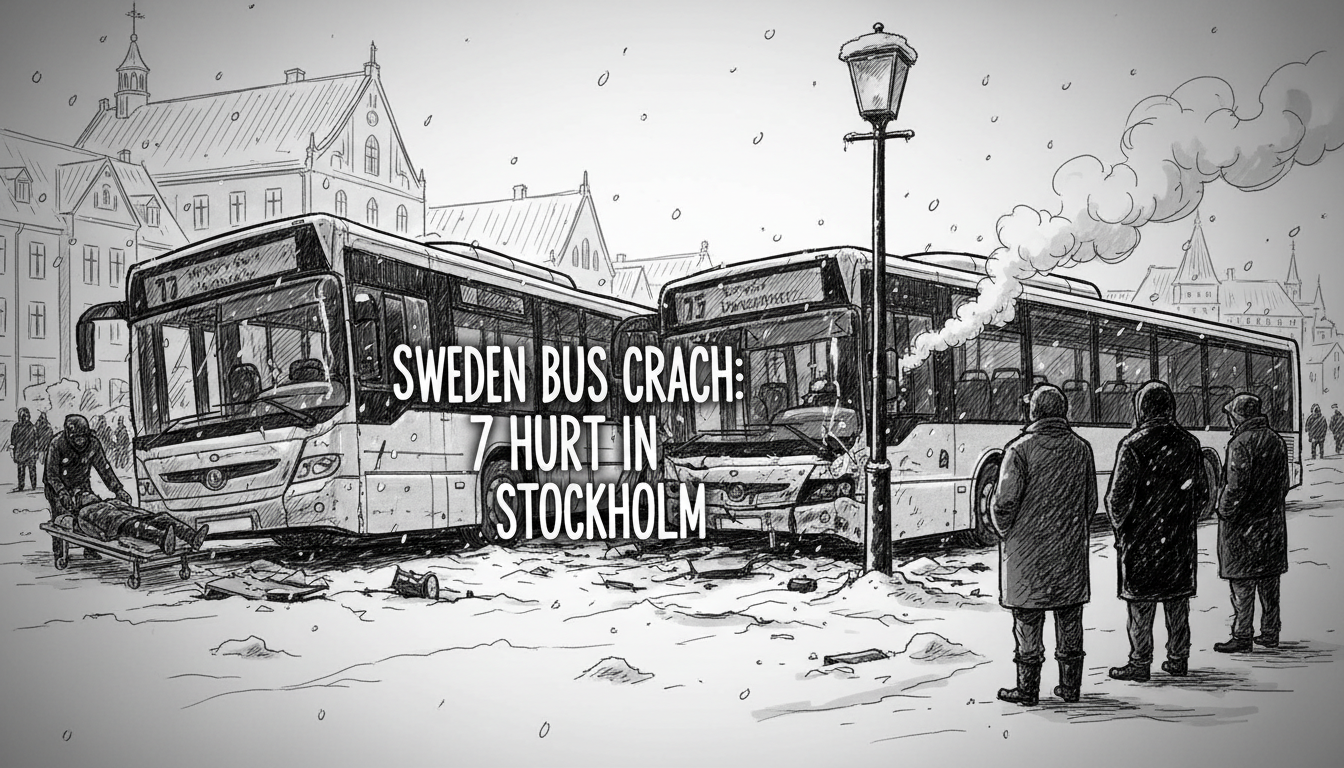
Stockholm witnessed a serious public transport accident on Tuesday when a city bus crashed into a building in the Liljeholmen district. At least seven people, including the driver, were injured after the bus veered off its route and struck a facade, sending passengers tumbling inside the vehicle. The incident occurred near a busy tram station in this densely populated southern Stockholm neighborhood, shaking the local community and raising immediate questions about urban transit safety.
Emergency services rushed to the scene following the 4:06 PM alarm. Police spokesperson Ola Österling described the sudden stop. “It appears to have come to an abrupt halt, and passengers fell over,” he reported. Images from the site showed the bus embedded in the building's exterior. The bus, operated by Stockholm’s public transport authority SL, was on its final approach to Liljeholmen, its scheduled endpoint. Authorities confirmed no pedestrians or people outside the bus were among the injured.
A Community's Sudden Shock
Liljeholmen is a bustling hub. It's not just a transit point but a living area with homes, shops, and schools. “You hear the trams and buses all day, it’s the sound of normal life here,” says Katarina Lind, a local resident who works in a nearby cafe. “To hear a crash instead, and then see the sirens, it changes everything in a second. Your heart just drops.” The area was cordoned off, disrupting evening commutes and leaving many to witness the unsettling aftermath. This sense of disruption in a familiar, trusted space is what resonates deeply in Swedish society, where orderly, safe public systems are a cornerstone of daily life.
The Immediate Aftermath and Response
The priority was swift medical care. Ambulances transported the seven injured individuals to hospitals for treatment. The extent of their injuries remains undisclosed. Police have launched a preliminary investigation to determine the cause. Traffic safety experts point to a range of potential factors common in such urban accidents. “It could be a medical incident with the driver, a technical failure with the vehicle like brake issues, or a momentary distraction,” explains Lars Malmström, a former traffic investigator and now a safety consultant. “The investigation will look at vehicle data, witness statements, and driver history. In an urban environment like Liljeholmen, even a second's lapse can have consequences.”
SL, the transit authority, stated it is fully cooperating with the police and has initiated its own internal review. The company emphasized its safety protocols but acknowledged the seriousness of the event. For regular commuters, the incident is a jarring reminder of vulnerability. “You just get on, tap your card, and trust the system,” says Marcus Berg, a daily bus user in Södermalm. “Something like this makes you think. That bus driver is someone’s neighbor, those passengers are just people going home. It’s very sobering.”
Safety on Stockholm's Streets
Public transport is the lifeblood of Stockholm. Millions rely on the integrated network of buses, trams, and metro each week. Statistically, it remains one of the safest ways to travel. However, isolated incidents like this capture intense public and media attention precisely because they disrupt a deeply held societal trust. Swedish cities are designed around functional, safe transit; when that system falters, it prompts a broad examination. “Every accident is one too many,” says Malmström. “The focus will be on what lessons can be learned. Was there a maintenance schedule? Was driver support adequate? The answer is usually found in a chain of small factors, not one single cause.”
This event occurs amidst ongoing national conversations about urban density, traffic safety, and infrastructure maintenance. As Stockholm grows, pressure on its transit network increases. The city has invested in new bus lanes and safer vehicle designs, but experts argue that constant vigilance is needed. “Our cities are changing, traffic patterns are evolving,” Malmström adds. “Safety systems must adapt just as quickly, from technology to training.”
Looking Ahead: Trust and Transparency
For now, the community waits for answers. The investigation may take weeks. SL will likely review operational procedures across its vast fleet. The human impact, however, is immediate and local. The injured face recovery, the driver a professional and personal reckoning, and the residents of Liljeholmen a temporary scar on their neighborhood’s landscape.
The incident serves as a stark, real-world test of the Swedish principle of tillit – trust. Trust that systems work, that authorities are competent, and that public spaces are safe. The coming days will be measured by how transparently the investigation proceeds and what concrete actions follow. Will this be a brief news item, or a catalyst for renewed safety checks? For the people of Stockholm, who view their efficient transit not as a luxury but a fundamental right, the expectation is for accountability and improvement. The true test of any system is not that it never fails, but how it responds when it does. As the bus is towed away and the building facade repaired, the larger question of preserving safety in an ever-busier city remains, hanging in the Stockholm air like the echo of a sudden, unwelcome crash.