
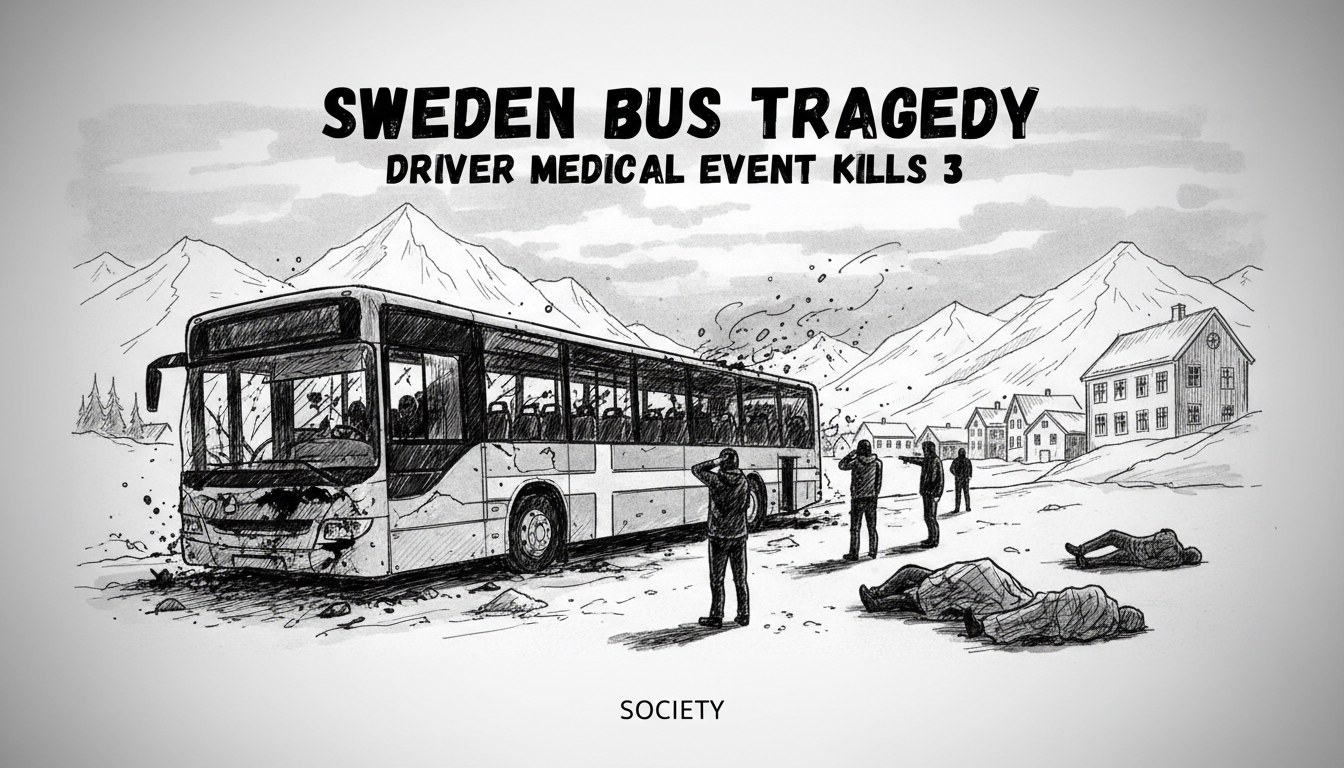
Sweden's Accident Investigation Authority will not open a formal inquiry into the fatal bus crash near KTH Royal Institute of Technology. The decision follows a preliminary finding that the collision, which killed three women and injured several others, was caused by the driver suffering a sudden medical event. The Swedish Accident Investigation Authority (Haverikommissionen) states the driver lost consciousness while the bus was stationary at a pedestrian crossing. The vehicle then accelerated to about eight kilometers per hour, mounting the sidewalk where passengers were waiting. This tragic event in central Stockholm has shifted the public conversation from blame to the complex, silent risks within our transportation systems.
A Quiet Street Turned Tragic
The scene on Valhallavägen, a main artery near the prestigious KTH campus, is typically one of orderly urban flow. Students hurry to lectures, researchers grab coffee, and buses like the one involved in the accident follow their scheduled routes. On the day of the accident, this normalcy shattered in seconds. According to the authority's report, the driver was stopped at a crossing when he lost consciousness. Bus camera footage reviewed by investigators shows he was not conscious at the moment the bus moved forward. The slow speed of eight km/h underscores how quickly a catastrophic event can unfold, even without high velocity. The bus traveled onto the sidewalk, a space meant for safety, turning it into a site of profound loss.
The Investigation's Purpose and Limits
Jonas Bäckstrand, the acting Director-General of the Accident Investigation Authority, explained the decision to forgo a formal investigation. "The reason is that it is now clear that the accident was caused by a medical event," he said in a statement. The authority's mandate is distinct from a police inquiry. It focuses on identifying systemic safety issues and recommending preventive measures for the future. When the direct cause is a sudden, unpredictable health incident with no link to vehicle maintenance, operational procedures, or infrastructure, their scope for actionable findings is limited. This distinction is crucial but offers little solace to a grieving community. The authority's role is to prevent the next accident, not to adjudicate an unforeseeable tragedy.
The Human Factor in Public Safety
This accident forces a difficult conversation about human vulnerability in roles critical to public safety. Bus drivers, train operators, and pilots undergo regular medical checks, but not all medical events can be predicted. "This is a tragic reminder of the inherent risks when human biology intersects with mass transportation," says Lars Friman, a Stockholm-based researcher in public transport safety. He emphasizes that while technology can create safeguards, it cannot eliminate all risk. "We design systems assuming the operator is conscious and in control. A sudden, total incapacitation is one of the most challenging scenarios to mitigate," Friman notes. The conversation in transportation safety circles now grapples with balancing privacy, employment rights, and the collective safety of passengers and the public.
Stockholm's Response and Community Grief
The impact has been deeply felt in the tight-knit academic community around KTH and the wider Stockholm neighborhood of Östermalm. Memorials with flowers and candles appeared near the site, a common Swedish tradition to honor the dead. The three women who lost their lives were part of the daily fabric of the city—perhaps students, professionals, or visitors. Their deaths are a shock to Stockholm's self-image as a safe, efficiently run city. Public transport is a source of pride here, a reliable network that binds the city together. This tragedy introduces a note of anxiety, a recognition that safety is always conditional. Local discussions have focused not on anger, but on a shared sense of vulnerability and a desire to support the injured and the families of the deceased.
Could Technology Have Made a Difference?
Experts are analyzing what, if anything, could have stopped the bus after the driver became incapacitated. Modern vehicles increasingly feature advanced driver-assistance systems (ADAS). Automatic emergency braking (AEB) is designed to prevent collisions, but its primary function is to detect obstacles ahead, not necessarily to respond to an unconscious driver. Some systems require driver input to remain active. "This case is particularly complex," explains safety engineer Mia Karlsson. "The bus was at a full stop, then began moving slowly. Sensor systems might not interpret that as an emergency requiring intervention. Furthermore, any system that could take full control raises significant ethical and practical questions." The search for technical solutions continues, but there is no simple fix for such a sudden medical event.
The Path Forward for Transport Safety
The Swedish Accident Investigation Authority's decision closes one chapter but opens another on preventative health. While they may not issue a formal report, the tragedy will influence ongoing safety discussions. Possible areas for review include the frequency and scope of medical examinations for professional drivers, emergency protocols for passengers to safely stop a vehicle, and vehicle design that considers driver incapacitation. In Sweden, there is a strong cultural emphasis on förebyggande arbete—preventive work. This incident will likely fuel that work in the transport sector. The goal is not to create a perfect system, which is impossible, but to build a more resilient one that can better withstand the unexpected.
A City Reflects on Shared Risk
The KTH bus accident leaves Stockholm with a heavy heart and difficult questions. It was not a story of negligence, mechanical failure, or reckless speed. It was a story of sudden human frailty, a reminder that the people who operate our complex society are themselves fragile. As the city moves forward, the memory of the three women will linger. Their loss underscores a silent contract we all make when we step onto a sidewalk or board a bus—a trust in the health and stability of strangers. How does a society manage that risk with both compassion and rigor? The flowers on Valhallavägen will eventually fade, but the search for answers, and the need for empathy, will remain.