
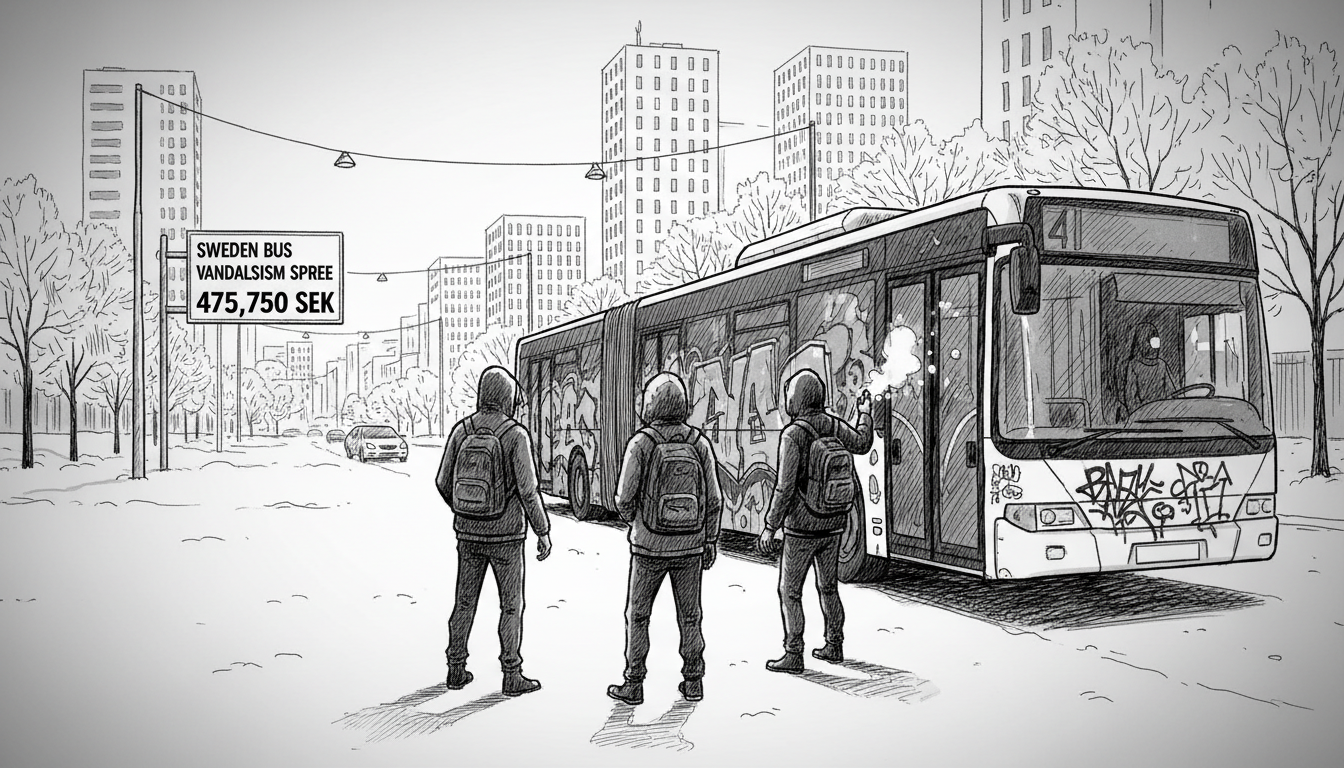
Sweden public transport vandalism hit Stockholm's northern suburbs hard last weekend. The bill for 80 smashed bus shelters could reach nearly half a million kronor, with costs falling directly on the private operators running the local buses. This wave of destruction has left commuters waiting in the cold and sparked a broader conversation about respect for public spaces in Swedish society.
"We are working full-time to fix the damage right now, but it's difficult to say when everything will be finished," said Sophie Gunnarsson, press communicator at Storstockholms Lokaltrafik (SL). The regional transit authority confirmed the extensive damage in the municipalities of Upplands Väsby, Sollentuna, and Sigtuna. Each broken pane of glass in a shelter can cost up to 4,325 SEK to replace. With 80 shelters damaged, the total potential repair cost stands at 475,750 SEK.
A Costly Weekend for Commuters
For residents in these typically quiet suburban areas, the vandalism meant an uncomfortable start to the week. At a shelter on Sigtunavägen in Sollentuna, only shards of glass remained in the frame. "I was waiting for the 515 bus with my daughter on Monday morning," said local parent, Anna Lundström. "There was glass all over the bench. We had to stand in the wind. It's just so pointless and disrespectful to everyone who uses this stop." The shelters serve as crucial waiting points, especially during Sweden's colder months. Their purpose is to offer a sliver of protection from rain, wind, and snow—a basic civic comfort now denied to many.
The financial burden does not fall on the public agency, SL, but on its contracted partners. Transdev, Nobina, and Keolis are the private operators responsible for local bus traffic in the affected regions. They must now foot the bill for what they describe as an unprecedented incident. "It is our responsibility to replace the damaged panes and we cover the cost," said Stefan Johansson, press officer at Transdev. "This is an extraordinary event. I have never heard of vandalism on this scale before in our operations."
The Ripple Effect of Broken Glass
Beyond the immediate repair bill, this incident highlights a persistent, low-grade conflict in public spaces. Vandalism of bus stops is not new, but the coordinated scale of this event is unusual. Experts point to the hidden costs that never appear on an invoice. "The direct financial cost is significant, but it's just the tip of the iceberg," explains Erik Månsson, a sociologist who studies urban environments at Stockholm University. "There is the inconvenience to daily commuters, the potential safety hazard from broken glass, and the resources diverted from improving services. Every krona spent on fixing mindless damage is a krona not spent on better lighting, more frequent buses, or digital displays."
This sentiment echoes among transport workers. A bus driver for Nobina, who asked not to be named, shared frustration. "We see it all the time—graffiti, broken windows, trash. It makes the job feel less respected. And now this? It's a huge amount of work for the maintenance teams who are already busy." The cleanup and repair efforts pull manpower from routine maintenance, creating a logistical ripple effect across the transport network.
Searching for Solutions Beyond Repairs
The question facing officials and operators is how to prevent a repeat. Technical solutions exist, such as using laminated or polycarbonate glass that is harder to break. However, these materials are more expensive upfront. Some municipalities have experimented with community art projects at bus stops, involving local schools to create murals. The theory is that community ownership can deter vandalism. Increased surveillance, either through cameras or more frequent patrols, is another common suggestion, though it raises questions about privacy and cost.
Månsson, the sociologist, suggests looking at the broader social context. "Is this just teenage boredom, or is it a symptom of something else? In these suburban areas, especially for young people, there can be a feeling of having few meeting places or little to do. Investing in youth centers and activities might be a more productive long-term solution than just installing tougher glass." He notes that while Sweden enjoys a reputation for social order, these acts of destruction reveal fractures that are often overlooked.
Who Pays for Public Mischief?
The funding model for public transport in Stockholm County places operational responsibilities—and associated costs like vandalism repairs—on the private operators. These companies have contracts with SL, and their performance, including maintaining infrastructure like shelters, is part of their agreement. Ultimately, however, some analysts argue that these costs are baked into the system and can affect tendering prices over time. It's a cost of doing business in the public realm, but a volatile and frustrating one.
For now, repair crews are working their way through the list of 80 shelters. In Upplands Väsby, a technician replacing a pane noted the frequency of such jobs. "We have a standard procedure for this, unfortunately. It's a common call. But getting 80 in one go? That's a different kind of week." The speed of repairs depends on glass supply and workforce availability. Some commuters may face a wait of days or even weeks before their shelter is fully restored.
A Test for the 'Folkhemmet' Ideal
This incident touches on a core Swedish concept: the 'folkhemmet' or 'people's home' ideal. It's the idea that society should function like a good home for all its citizens, with shared responsibility and care for common spaces. A vandalized bus shelter is a direct affront to this principle. It represents a breakdown of the unspoken social contract where public property is treated with care for the benefit of the next person.
As spring approaches and evenings get lighter, the hope is that this was an isolated outburst. Yet, the nearly half-million-kronor price tag serves as a stark reminder. When a few hours of destruction can wipe out a budget that could have funded service improvements or community projects, everyone loses. The glass will be replaced, the cost will be absorbed, but the question lingers in the chilly spring air: What does it take to build a society where public spaces are valued, not violated?