
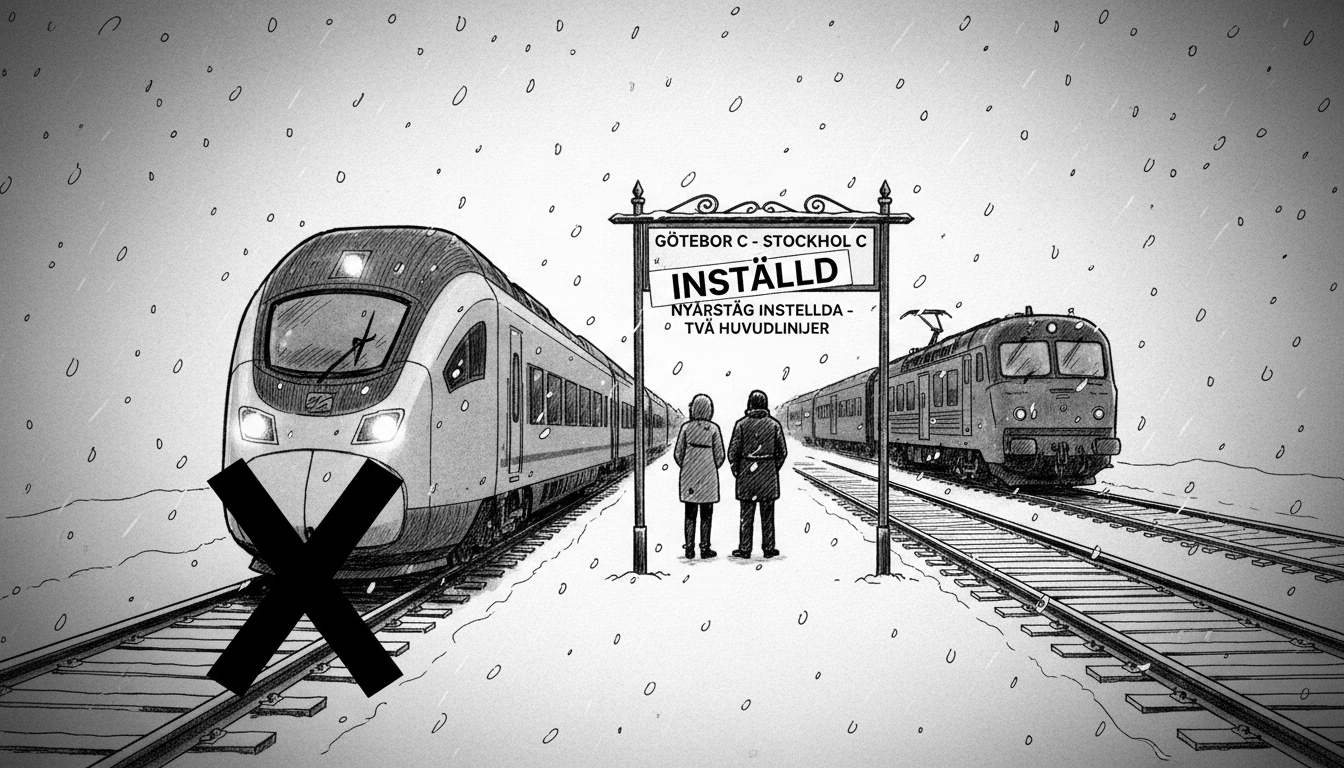
Sweden's state-owned rail operator SJ has cancelled two crucial New Year's night trains from Stockholm to the Arctic north, affecting hundreds of holiday travelers. The cancellations of services to Boden-Riksgränsen and Luleå are a direct response to a severe snowstorm forecast to batter the Gävle region. This disruption highlights the perennial vulnerability of Scandinavian infrastructure to winter's might, stranding passengers during one of the year's busiest travel periods. It is a stark reminder of the power of nature in a nation often celebrated for its efficiency.
The Human Cost of a Snow Forecast
The announcement came as a blow to families and winter tourists packed into Stockholm Central Station. Many were bound for Swedish Lapland's ski resorts and frozen landscapes. 'We had a cabin booked and our kids were so excited,' said Elias, a father from Södermalm, checking his phone for updates. 'Now we are stuck finding a hotel here last-minute. It's chaos.' The cancelled 18:12 service to Boden-Riksgränsen and the 21:55 to Luleå represent vital lifelines to the upper Norrland region. For locals, these trains are a practical link to the capital. For visitors, they are the start of an Arctic adventure. The ripple effect is significant, with connecting bus services and pre-booked activities now thrown into disarray across Norrbotten County.
This scenario repeats each winter. Sweden operates roughly 13,000 kilometers of railway tracks, and SJ transports tens of millions of passengers yearly. Yet, a concentrated snowstorm over a key coastal corridor like Gävleborg can bring the system to a standstill. The decision, while frustrating for travelers, is rooted in safety protocol. Running heavy, long-distance trains in near-zero visibility with high avalanche risk is not a gamble operators take. 'Better a cancellation than a stranded train in a snowdrift,' an SJ conductor remarked, recalling past incidents.
A Recurring Battle with Winter's Fury
Sweden's relationship with its winter is one of proud coexistence punctuated by seasonal struggle. The rail network, particularly the Main Line Through Upper Norrland, is engineered for cold weather. Heated points, snowplough locomotives, and insulated systems are standard. However, the specific conditions predicted—intense snowfall combined with strong winds—create a perfect storm for blockage. Gävleborg County, where the coast meets dense forest, acts as a natural funnel for such weather systems blowing in from the Baltic.
Infrastructure experts note that while the network is advanced, its resilience is being tested more frequently. 'We are seeing patterns change,' says Dr. Lena Karlström, a climatologist at Uppsala University. 'Single extreme events are not new. But the frequency of these high-impact snowfalls, especially in transitional coastal zones, aligns with broader climate instability.' This presents a complex paradox for Sweden. Milder winters in the south coexist with more intense, disruptive snowfall events in central and northern regions, challenging the very infrastructure designed for a stable cold climate.
The Broader Impact on Society and Trust
Beyond the immediate travel chaos, these cancellations affect public trust in rail as a green alternative. The Swedish government promotes train travel over domestic flights to cut carbon emissions. Campaigns like 'Tagskryt' (Train Brag) encourage citizens to choose rail. When key services fail, it pushes people back toward cars or planes, undermining environmental goals. For the tourism-dependent north, reliable winter access is economic oxygen. Resorts in Åre, Sälen, and Riksgränsen rely on smooth transport links for international guests who fly into Stockholm and connect north by rail.
The cancellations also expose a societal split between Sweden's urban south and rural north. 'There's a feeling that if this happened on the Stockholm-Gothenburg line, solutions would be found faster,' comments political analyst Mats Bergman. 'The north often feels like an afterthought.' This perception fuels ongoing debates about infrastructure investment equity. The government's recent National Plan for Transportation Infrastructure pledges billions, but critics ask how much will specifically fortify the northern corridors against these exact weather events.
Adapting to a New Normal
What can be done? Experts point to several avenues beyond reactive cancellations. Increased investment in weather prediction technology along rail corridors allows for more precise, earlier warnings. Hardening infrastructure, such as building more windbreaks and snow tunnels in vulnerable sections like those around Gävle, is a costly but long-term solution. There is also talk of operational flexibility, like having shorter, more frequent trains during storm periods instead of relying on long night trains that are harder to reroute or rescue.
Travel behavior must adapt too. SJ's communications around this event were proactive, informing passengers hours in advance. This allows for rebooking or refunds through their app. Savvy travelers in Sweden are learning to build buffer days into winter itineraries, especially around holidays. They also diversify plans, knowing the backup options for buses or flexible accommodation. The concept of 'storm peace'—accepting nature's interruption—is deeply rooted in Nordic culture, but modern society demands mobility.
Looking Down the Track
As climate modeling predicts more volatile winters, Sweden faces a critical question. Can it future-proof its railways to maintain its reputation for reliable, sustainable travel? The answer requires balancing immense investment with practical, immediate steps. It also requires acknowledging that absolute, year-round reliability in a country stretching into the Arctic Circle may be an impossible dream. The goal shifts to resilience and recovery speed.
For the passengers crowding Stockholm Central this New Year's, the immediate concern is a place to sleep and a new way north. Their disrupted plans are a microcosm of a national challenge. The snow in Gävle is more than a weather report; it is a test of Sweden's ability to connect its vast landscape in an era of climatic change. As one stranded tourist from Germany philosophized, 'We came for the Swedish winter experience. I guess this is part of it.' The true measure of the system will be how quickly it gets everyone moving again when the storm passes.