
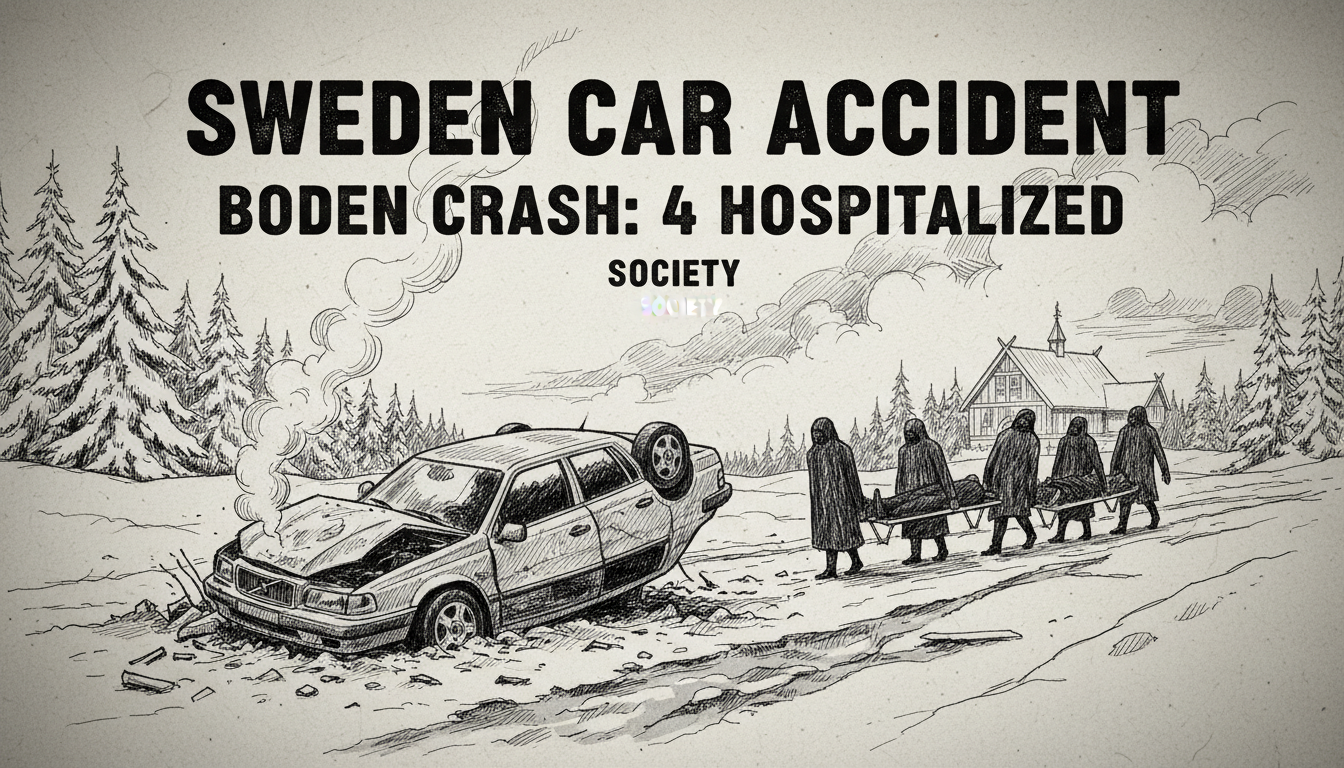
Sweden car accident response teams rushed to a multi-vehicle collision in Boden on Thursday evening. Four people were transported to Sunderby Hospital, their conditions unknown as rescue crews worked to clear debris from the road. The crash occurred around 6:15 PM, forcing a complete closure of the route during the critical rescue operation.
Emergency services, including four ambulances, were dispatched to the scene. An inner ambulance commander confirmed the hospital transports shortly before 8 PM. The road has since partially reopened, but a rescue service unit remains on site. This incident adds to Sweden's ongoing struggle with road safety, particularly in northern regions where winter conditions pose significant risks.
A Routine Evening Interrupted
For residents of Boden, a municipality of about 28,000 people in Norrbotten County, Thursday evening began like any other. The sun sets early this time of year, casting long shadows by late afternoon. Road conditions can change rapidly as temperatures drop. The specific cause of this multi-car collision is under investigation by local police. Initial reports simply state that several vehicles were involved.
"The road was completely closed during the rescue work," a dispatch operator said. "Now traffic is starting to be let through, but there is still debris on the road and one resource from the rescue service is left." This scene of flashing blue lights, crumpled metal, and coordinated emergency response is, tragically, not uncommon on Swedish roads. It represents a sudden, violent rupture in the ordinary rhythm of daily life.
The Northern Winter Driving Challenge
Boden, located just south of the Arctic Circle, presents unique challenges for drivers. Winter here is long, dark, and severe. While Swedes are generally adept at winter driving, equipped with mandatory winter tires, accidents still occur. Black ice, sudden snow squalls, and limited daylight are constant factors from October through April. The Swedish Transport Administration constantly reminds drivers to adjust their speed and increase following distances.
Road safety experts point to a combination of factors in northern accidents. "It's about respecting the environment," says Lars Holmqvist, a retired traffic safety analyst based in Luleå. "You have the technology—the studded tires, the well-maintained cars. But you also need the mindset. That means understanding that a road clear at 3 PM can be an ice rink by 6 PM. It means using your headlights even in twilight. Complacency is a killer." This crash will likely renew local discussions about specific stretches of road and winter maintenance schedules.
Vision Zero: Sweden's Ambitious Road Safety Policy
Every serious accident in Sweden is measured against the nation's pioneering 'Vision Zero' policy. Adopted in 1997, Vision Zero is the ethical principle that no loss of life or serious injury on the road is acceptable. It shifts responsibility from solely the driver to include system designers—road engineers, car manufacturers, and policymakers. The goal is to create a road system where human error does not lead to death.
Sweden has been remarkably successful, cutting traffic fatalities by more than half since the policy's inception. In 2022, there were 270 road traffic fatalities in Sweden, a low number per capita compared to most countries. Yet, as the Boden crash reminds us, the number is not zero. Each statistic represents a person, a family, a community in shock. The policy relies on continuous improvement: better road design, safer car cabins, lower urban speed limits, and separated cycling lanes. For a rural area like Boden, infrastructure investments are a constant topic.
The Human Cost Beyond the Statistics
Behind the brief news alert—"four people taken to hospital"—lies a wave of human consequence. There are the injured, facing pain, recovery, and perhaps lasting trauma. Their families receive the dreaded phone call, the frantic drive to Sunderby Hospital. The witnesses and first responders carry the memory of the scene. For the small, close-knit community of Boden, there's also the unsettling ripple of recognition. It could have been anyone. It might be someone you know.
Sunderby Hospital, located in Luleå about 35 kilometers southeast of Boden, is the main emergency care facility for the region. It is well-versed in handling trauma from road accidents, especially during winter. The hospital's capacity and the severity of the injuries sustained will become clearer in the coming days. The fact that four ambulances were required suggests a significant impact, demanding substantial medical resources.
A National Pattern in a Local Context
This accident fits a national pattern. According to data from STRADA, the Swedish Traffic Accident Data Acquisition system, a significant portion of serious accidents occur on rural roads like those around Boden. Factors often include higher speeds, wildlife crossings, and longer emergency response times. While Swedish roads are among the safest in the world, the risk is never eliminated. The dark, icy months from November to February are consistently the most dangerous period.
Local police will now work to reconstruct the event. They will examine vehicle positions, skid marks, and road conditions. They will interview drivers and witnesses. The purpose is not just to assign blame, but to understand the sequence of events to prevent future occurrences. This investigative mindset is part of the Vision Zero approach—every accident is a learning opportunity for the system.
Community Response and the Road Ahead
In the aftermath, the community's resilience is tested. Neighbors check on neighbors. Local social media groups fill with messages of concern and offers of help. The practicalities of a road closure disrupt commutes and deliveries. But the primary focus remains on the well-being of those injured. There is a collective holding of breath, waiting for updates from the hospital.
For Sweden, the journey toward Vision Zero continues. It involves technological advances like better driver assistance systems, infrastructural changes such as more forgiving roadside barriers, and cultural shifts in driving behavior. The policy acknowledges that people make mistakes, but the system should be designed to prevent those mistakes from being fatal. The crash in Boden is a stark reminder that this work is never finished, especially where the Swedish winter exerts its full force.
As the debris is finally cleared and traffic in Boden flows normally again, the questions linger. What was the decisive factor? Could anything have prevented it? The answers matter, not just for the judicial record, but for every driver who will navigate that same road tonight, tomorrow, and next winter, hoping the system is safe enough to bring them home.