
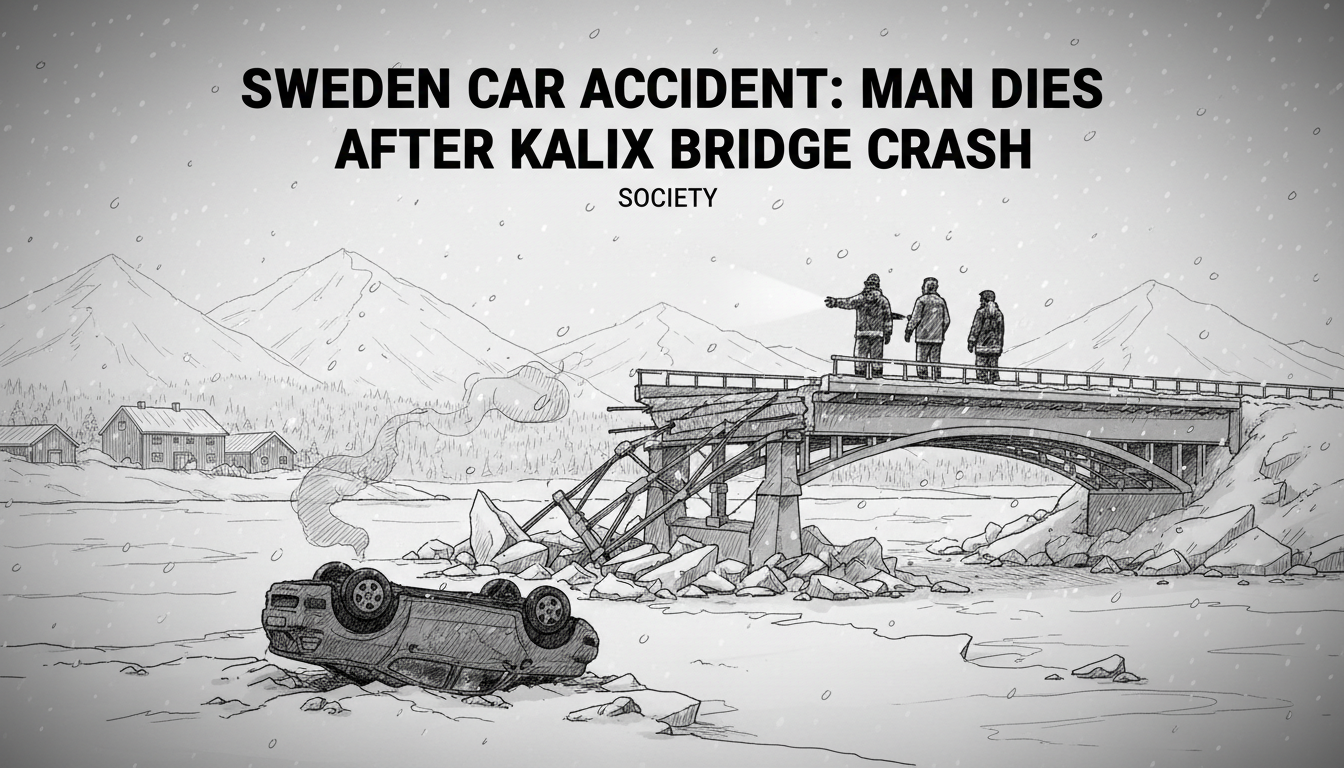
Sweden car accident news reports a man has died after his vehicle plunged into the water near a bridge in Kalix on Sunday evening. Emergency services rushed to the scene, but the driver could not be saved. This tragic event in northern Sweden highlights the quiet dangers of rural roads and the swift, collaborative response of Nordic emergency teams.
Rescue services, police, and an ambulance were all dispatched to the location along the Kalix River. The man was transported by ambulance across the border to a hospital in Finland, a common practice in this border region for specialized care. Despite these efforts, his life could not be saved. Police have confirmed the man's next of kin have been notified. Initial reports indicate no other individuals were in the vehicle at the time of the accident.
A Community Shaken in Northern Sweden
Kalix, a municipality of about 16,000 people in Norrbotten County, is a place defined by its relationship with water. The Kalix River, one of Sweden's last major free-flowing rivers, is a source of pride, famous for its Kalix löjrom (caviar). The community is tight-knit, where news travels fast. An accident like this sends ripples through the entire locality. "It's a small town," says local resident Erik Lundström, who has lived in Kalix for forty years. "When something like this happens, everyone feels it. You wonder if it's someone you know. Your thoughts immediately go to the family."
The bridge where the incident occurred is a familiar piece of local infrastructure. Accidents where vehicles enter waterways are not common in Sweden, but they happen with a tragic regularity that prompts periodic reviews of road safety. Each incident is a stark reminder of how quickly a routine drive can turn fatal, especially on roads that skirt coastlines, lakes, and rivers.
The Cross-Border Race to Save a Life
The decision to transport the victim to a hospital in Finland underscores the practical cooperation within the Nordic region. In sparsely populated areas like northern Sweden and Finland, the nearest major trauma center might be across a national border. The Swedish ambulance service has protocols for such transfers, ensuring continuity of care. This cross-border lifeline is a crucial aspect of public safety in the Arctic region, but in this case, the injuries were too severe.
The immediate response involved multiple agencies. The Swedish räddningstjänst (rescue service) would have focused on extraction from the vehicle and water. Police secured the scene and began the initial investigation into the cause. The ambulance crew provided critical life support during the transport. This coordinated effort is standard, yet each event tests the system.
Investigating the Unthinkable: What Went Wrong?
A police investigation is now underway to determine the exact cause of the crash. Road safety experts point to a confluence of possible factors. "At this time of year, conditions can be particularly challenging in the north," explains Anna Forsberg, a traffic safety researcher based in Umeå. "We're in a period with long hours of darkness, potential for ice on the roads, and weather that can change rapidly. Driver fatigue is also a significant risk factor on long, monotonous rural roads."
The investigation will likely examine the vehicle's condition, the driver's actions prior to the crash, and the road environment itself. Was there a mechanical failure? Was the driver distracted or impaired? Does the bridge's design and approach have adequate lighting and barriers? These are the painful questions investigators must ask to piece together the final moments. The lack of other passengers, as reported by police, rules out one variable but deepens the mystery of what occurred.
The Human Cost Behind the Headlines
Beyond the official statements and investigative details lies a profound human tragedy. A family has lost a loved one. Friends and colleagues are in mourning. The simple, stark headline "Man död" (Man dead) that ran in local media encapsulates a world of grief. In Swedish society, which often values a quiet, private approach to sorrow, such a public loss is deeply felt.
There is a cultural ritual in Sweden known as "minnesstund"—a moment of remembrance. It's not uncommon in workplaces or communities to pause and reflect when a tragedy strikes. In Kalix, this loss will be absorbed quietly, with support offered through close networks and local organizations like the parish or community center.
Road Safety in the Swedish Landscape
Sweden is globally renowned for its Vision Zero traffic safety policy, which aims to eliminate road fatalities and serious injuries. This philosophy has drastically reduced deaths over decades. However, it faces its greatest test on rural roads like those around Kalix. These roads, often single-lane, winding alongside dramatic scenery, present unique hazards. They are the lifelines of the countryside but can be unforgiving.
Accidents involving water immersion are especially deadly. The shock of cold water, the difficulty of escaping a submerged vehicle, and the rapid onset of hypothermia create a critical time window measured in minutes. This underscores the importance of the rapid alarm and response that occurred in Kalix, even if the outcome was tragic.
A Look at the Data and Context
While comprehensive statistics on vehicles entering water are not always separately categorized, single-vehicle accidents on rural roads remain a focus for Swedish transport authorities. Factors like speeding, lack of seatbelt use, and alcohol are frequently cited in fatal crashes. The long, dark winters of Norrbotten significantly increase risk. The period between November and February is often the deadliest on Swedish roads.
The Swedish Transport Administration (Trafikverket) continuously works on improving road infrastructure. This includes assessing and upgrading barriers, improving road markings for better visibility in low light, and installing warning signs for dangerous curves or sections near water. Each fatal accident typically triggers a review of the specific site to see if engineering solutions could prevent a repeat.
The Path Forward: Grief and Questions
For now, the community of Kalix must grapple with its loss. The police investigation will continue methodically, and a report will eventually be filed. The findings may lead to recommendations for that specific bridge or roadway. The man's family will navigate the difficult process of funeral arrangements and legal formalities, supported by Sweden's structured system of bereavement leave and social support.
This Sweden car accident is a somber reminder that safety is a continuous effort. It involves road engineers, policymakers, vehicle manufacturers, and every individual behind the wheel. The Nordic winter, with its breathtaking beauty, also demands our utmost respect and caution. As the people of Kalix know all too well, the river that gives life to their region can also, in a moment of terrible misfortune, take it away. The question that lingers after the emergency lights fade is a universal one: how do we make the journey home safe for everyone?