
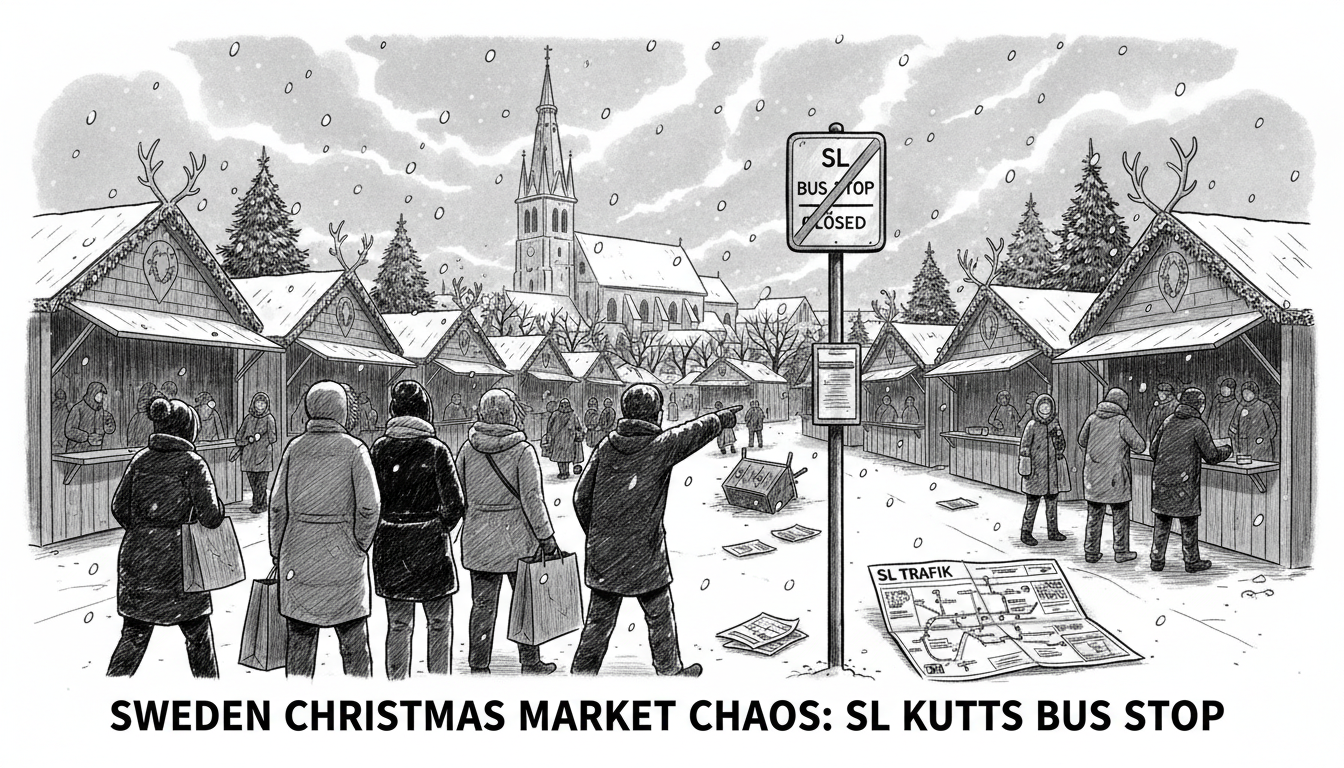
Sweden's Sigtuna Christmas market, one of the nation's most popular seasonal attractions, became the center of a major public transport failure. Thousands of visitors faced confusion and stranded conditions after regional operator SL cancelled stops at seven key locations. This decision, made during the market's busiest days, exposed a critical planning gap between popular event management and essential public service provision.
Jesper Jäger-Ärlestad, a teacher at Sigtuna Folk High School, experienced the disruption firsthand. He and his colleagues, along with students, found themselves trapped after an exhibition. “When we were going to leave and went down to the bus square, there were an incredible number of people there, but no buses came and there was no information to be had,” Jäger-Ärlestag said. The affected stops included Pilsbo, Sigtuna bus station, Klockbacken, St. Persskolan, Stora Brännbo, Stora Brännbovägen, and Folkvägen.
The group moved to another stop, but no buses arrived there either. Frustration grew amid the winter cold. They eventually found an SL official who provided a stark explanation. “We received the answer that SL had shut down the buses to Sigtuna. It feels as if SL had not planned for this despite knowing that it is a Christmas market and there are a lot of people in town,” Jäger-Ärlestad stated. This sentiment was echoed by numerous other visitors left without clear alternatives.
A Systemic Failure in Event Logistics
The incident highlights a recurring challenge for Stockholm's public transport governance. SL, or Storstockholms Lokaltrafik, operates under a mandate from the Stockholm County Council and the Swedish government to provide reliable regional transit. Its operational decisions are closely scrutinized by the Riksdag's Committee on Transport and Communications, especially when they impact tourism and local economies. The failure in Sigtuna suggests a disconnect between scheduled service changes and real-world demand forecasting.
Transportation analysts note that managing large events requires proactive, detailed planning. “A predictable surge in visitors to a known annual event should trigger a service increase, not a reduction,” said Professor Lena Strömberg, a public transit expert at KTH Royal Institute of Technology. “The core mandate of a public utility is to serve the public, especially during peak demand periods. Cancelling stops without immediate, widespread communication and alternative solutions represents a significant service shortfall.”
This event raises questions about the coordination between municipal event planners in historic towns like Sigtuna and the regional transit authority. While local councils promote festivals to boost tourism, the necessary infrastructure support can sometimes lag.
Historical Context and Modern Pressures
Sigtuna, founded circa 980 AD, is Sweden's oldest existing town. Its charming, preserved medieval center is a major tourist draw year-round, with the Christmas market being a pinnacle event. The town's narrow streets and limited parking make efficient public transport not just a convenience but a necessity for managing visitor flow. The market's success, attracting thousands from across Stockholm County and beyond, tests the capacity of systems designed for everyday commuter patterns.
The Swedish government's national tourism strategy actively promotes cultural heritage sites and seasonal events. Incidents like the Sigtuna transport breakdown create friction between policy goals and on-the-ground execution. It places regional bodies like SL in a difficult position, balancing budget constraints, driver availability, and the need for flexible, event-driven service adjustments.
From a bureaucratic perspective, the decision to alter bus routes originates from SL's operational centers. These changes are typically published in advance via SL's website and app. However, the effectiveness of this communication is nullified if the primary user base—event visitors—are not regular commuters who routinely check for such updates. The lack of on-site signage or staff at the affected stops compounded the problem.
The Ripple Effect on Local Business and Trust
For local vendors and businesses, the Christmas market is a crucial revenue period. Transport chaos can deter visitors, tarnish the event's reputation, and have a direct economic impact. When families face uncertainty about their ability to return home, they are likely to cut their visits short, reducing spending. This incident may influence future attendance if confidence in the logistics is not restored.
The trust deficit extends to public perception of SL. In a region where car ownership is discouraged through policy and high costs, reliable public transport is non-negotiable. Failures during high-profile events undermine confidence in the system's resilience and its management's competence. It invites scrutiny from political figures in Stockholm and at the national level, potentially influencing future budget allocations and performance reviews for the transit authority.
Seeking Solutions and Accountability
In response to similar past criticisms, SL has sometimes implemented special shuttle services or increased frequency on key lines during major events. The absence of such measures in Sigtuna is puzzling to observers. A viable solution set could include temporary “event lines,” clear park-and-ride schemes with shuttle buses from larger towns, and vastly improved real-time communication at hubs.
“The solution isn't necessarily more buses everywhere,” Professor Strömberg added. “It's about smarter allocation, dynamic scheduling, and, above all, clear, omnipresent information. Digital alerts, physical signs posted days in advance, and staff at key interchange points are basic requirements.”
Accountability for this planning lapse will likely be sought through official channels. Municipal representatives from Sigtuna are expected to raise the issue with the Stockholm Regional Council, which oversees SL. The matter could also be referenced in parliamentary discussions concerning transport funding and the operational mandates of public utilities.
A Lesson for Future Festivities
The Sigtuna Christmas market debacle serves as a case study for other historic towns and event organizers across Sweden. As Swedish government policy continues to emphasize cultural tourism and sustainable travel, the integration of transport planning into event management must become seamless. The administrative responsibility shared between local councils, regional transit authorities, and national tourism boards requires clearer protocols.
For visitors like Jesper Jäger-Ärlestad and his students, the experience was more than an inconvenience; it was a breakdown of a expected public service. As Sweden looks to host more international tourists and foster domestic travel, the reliability of its infrastructure is paramount. The quiet, snowy streets of Sigtuna, steeped in a thousand years of history, became an unintended stage for a very modern problem of logistics and communication. The question now is whether the lessons learned will lead to more reliable, better-coordinated systems, ensuring that future celebrations are remembered for their joy, not their transport failures.