
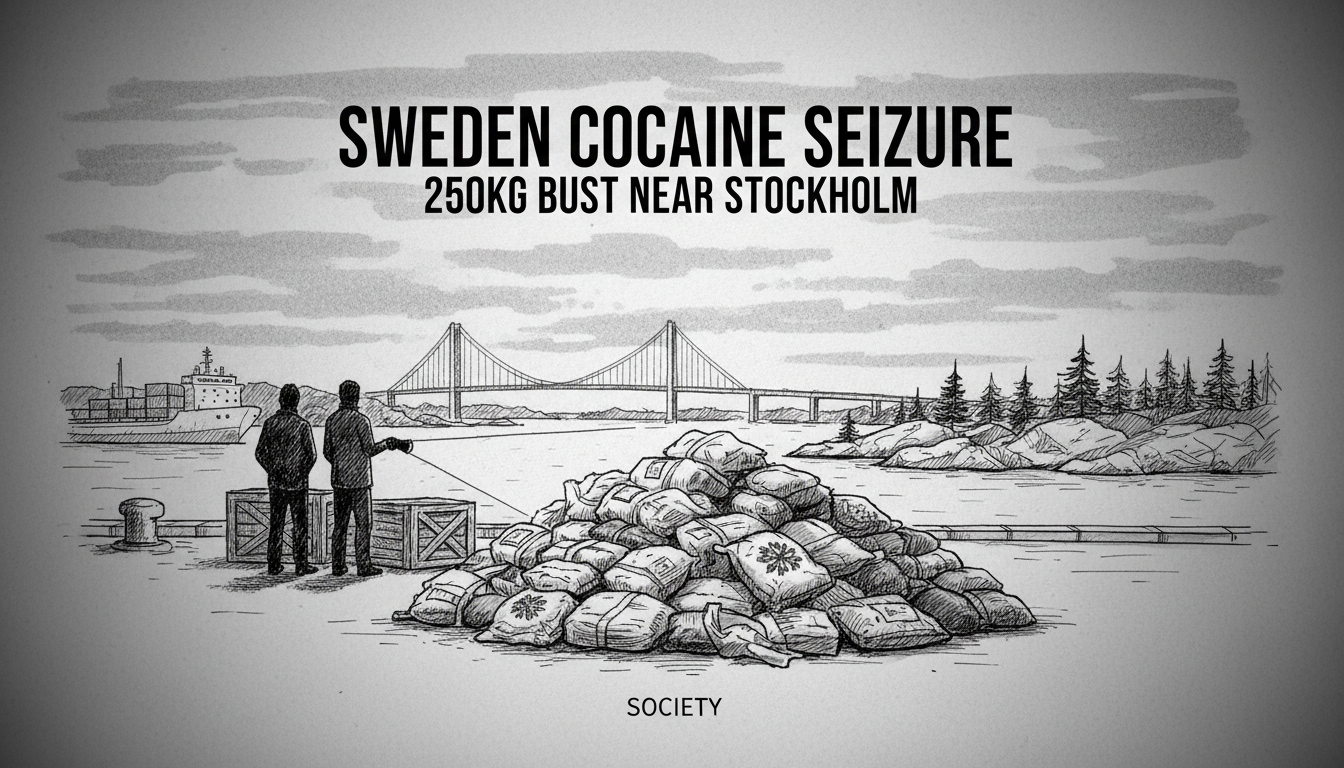
Sweden police have seized at least 250 kilograms of cocaine in a major drug bust in Nykvarn, a quiet municipality just outside Stockholm. A woman, previously unknown to police, was arrested in the Friday operation involving officers from multiple districts. This massive haul, one of the largest in recent Swedish history, highlights the growing scale of narcotics trafficking targeting the Nordic region.
For residents of Nykvarn, the news was a shock to the system. This is a community known more for its commuter trains to Stockholm and its lakeside nature reserves than for international crime. "You hear about these things in the big cities, in places like Rinkeby or Rosengård, but not here," said local shopkeeper Erik Lundström, referencing Stockholm and Malmö suburbs often in the news. "It's unsettling. It makes you wonder who your neighbors really are."
The operation was a coordinated effort. Police from Stockholm, Botkyrka, and Södertälje converged on a location in Nykvarn. While authorities have not released the exact address or property type, the sheer volume of drugs suggests a storage or transit point, not a simple personal stash. The final weight of the seizure is still being confirmed, but the initial figure of 250 kilos is staggering.
A Sobering Scale of Contraband
To understand the magnitude, 250 kilograms of cocaine represents millions of individual doses. Its street value in Sweden could easily exceed 100 million Swedish kronor (over $9 million USD), depending on purity and distribution level. This seizure alone surpasses a significant portion of Sweden's total annual narcotics hauls. In 2021, Swedish police confiscated approximately 1.7 tonnes of all narcotics combined, including cannabis, amphetamines, and heroin.
"A seizure of this size is not a random event," said Karl Ljung, a security analyst and former police intelligence officer. "It indicates a highly organized logistics chain. Cocaine originates in South America, so this represents a successful journey across multiple continents and borders before reaching a Swedish suburb. It speaks to the operational capability of the networks involved."
Ljung explains that Sweden's geography makes it a target. "We are a high-price market. Consumers in Stockholm, Gothenburg, and Malmö can pay premium prices. Furthermore, Sweden's ports and connections to the Baltic region can make it a gateway for distribution to other Nordic and Baltic countries."
The Changing Face of Swedish Drug Crime
The arrest of a woman not previously known to police is a notable detail. It challenges stereotypical images of drug traffickers and suggests networks are using a wide range of individuals. "Organized crime is pragmatic," Ljung notes. "They use whoever is available, trustworthy to them, and perhaps less likely to draw immediate suspicion. This doesn't mean she was acting alone; she is likely one node in a much larger system."
This bust occurs against a backdrop of fluctuating but persistent drug crime in Sweden. The Swedish National Council for Crime Prevention (Brå) reports that drug-related offenses have seen periods of significant increase over the past decade. While Swedish drug policy remains strictly prohibitive, focused on zero tolerance and prevention, the market's profitability continues to attract criminal elements.
Cocaine, in particular, is associated with more affluent users and nightlife scenes in major cities. Its presence in large quantities suggests established demand. "You don't import this much product without confident buyers," said a Stockholm-based club owner who asked to remain anonymous. "The market has changed. It's not just a weekend thing for some; it's a steady business."
Life in the Shadow of a Bust
Back in Nykvarn, the community is processing the event. The municipality, part of Södertörn south of Stockholm, is a mix of residential areas, small industries, and countryside. It's the kind of place where people value tranquility. A bust of this scale puts it on the map for all the wrong reasons.
Local politician Anna Bengtsson, of the Nykvarn municipal council, expressed concern. "Our priority is always the safety and well-being of our residents," she said. "This incident shows that no community is immune. We will be in close contact with the police to understand what happened and what it means for us moving forward. We must support our police and ensure they have the resources they need."
The police have been tight-lipped beyond the basic facts, indicating an ongoing investigation. They are likely tracing the drugs' origin, transportation route, and intended distribution network. This seizure could provide valuable intelligence, potentially leading to more arrests and the disruption of a major supply line.
A Nordic Problem with Global Roots
Sweden's struggle mirrors a broader European trend. Cocaine availability across the EU has been high in recent years, with record seizures reported at ports like Antwerp and Rotterdam. The Nordic countries, with their relative wealth, are attractive end-markets. The Nykvarn seizure suggests traffickers are finding new routes or using smaller entry points to avoid heightened security at major hubs.
"This isn't just a police issue," argues sociologist Dr. Mina Forsberg, who studies organized crime's social impact. "It's a public health issue, a social issue, and an economic issue. The profits from this trade fuel other criminal activities—extortion, violence, money laundering. They can infiltrate legitimate businesses. A seizure this big is a win for law enforcement, but it also reveals the immense scale of the challenge."
For the average Swede, news of such a large bust provokes mixed feelings. There is relief that the drugs are off the street and a recognition of effective police work. But there is also anxiety about the pervasive power of organized crime and its ability to operate in the heart of everyday Swedish life, far from the dramatic shootouts portrayed in series like Snabba Cash.
What Comes Next?
The immediate next steps belong to the judicial system. The arrested woman will be questioned, and prosecutors will build a case. The sheer weight of the cocaine means she faces severe penalties under Swedish law. Meanwhile, forensic teams will analyze the drugs for purity and potential chemical signatures that could link them to other seizures.
The real test, however, is long-term. Can this seizure meaningfully disrupt a network, or will it simply be a cost of business for a resilient criminal organization? The answer depends on the follow-up investigation and continued international cooperation.
As the initial shock in Nykvarn subsides, life will return to normal. Commuters will board their trains to Stockholm. Children will play by the lake. But the incident leaves a mark. It serves as a stark reminder that the global drug trade casts a long shadow, reaching even the quietest Swedish suburbs. The question now is whether this record bust is an end or merely a chapter in an ongoing, and escalating, story.