
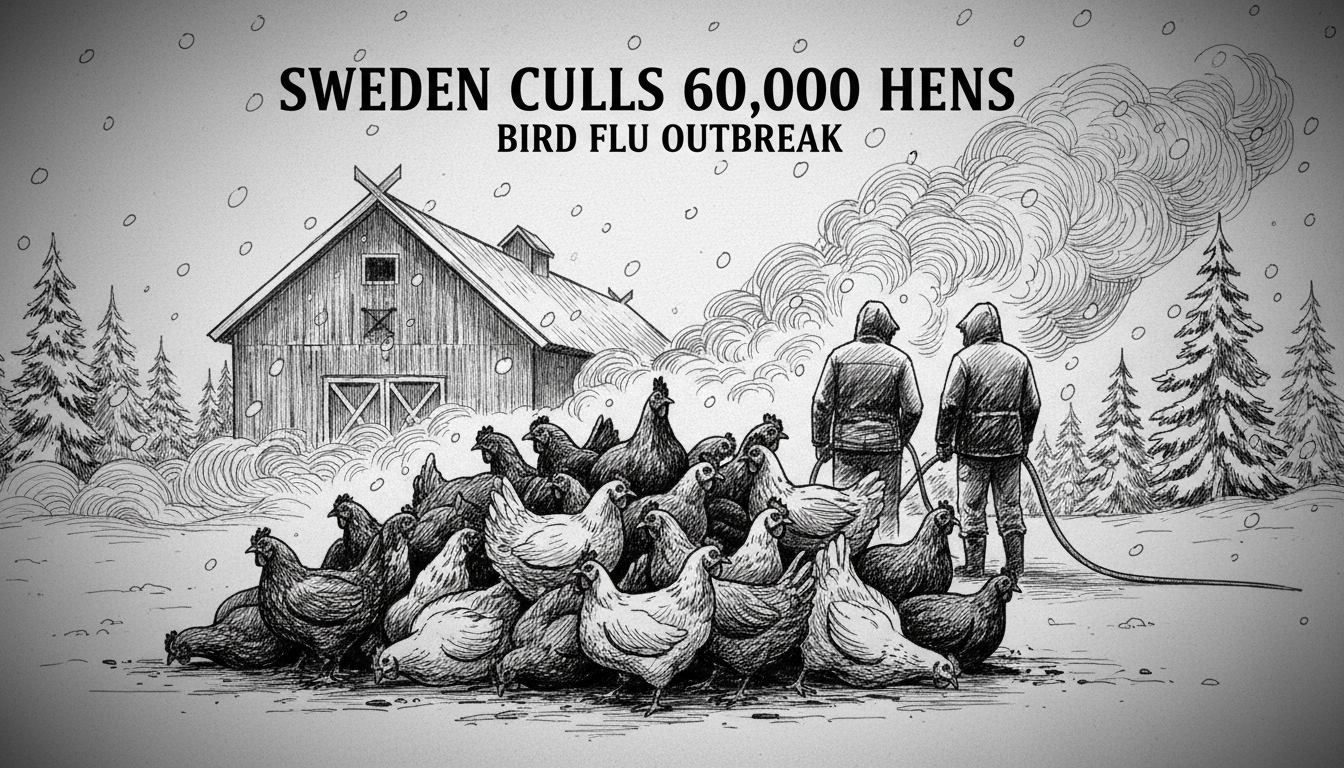
Sweden's poultry industry faces a major blow as 60,000 breeding hens are culled in Skåne following a confirmed avian influenza outbreak. The decision came after a farm owner in Sjöbo municipality noticed a sudden, high mortality rate among the flock last Saturday. This single event represents one of the most significant culling operations in recent Swedish agricultural history, sending ripples through the local farming community and raising urgent questions about biosecurity.
A Quiet Farm in Crisis
The outbreak was confirmed at a breeding facility in the rolling countryside of Sjöbo, a municipality known for its agriculture. The first sign of trouble was an unsettling silence, broken only by the absence of the usual clucking. The farm owner, whose identity has not been released, acted swiftly upon noticing the abnormal number of dead birds. A veterinarian was called immediately, and samples sent for testing confirmed the worst: highly pathogenic avian influenza (HPAI).
“The protocol in these situations is clear and brutal, but necessary,” explained a veterinarian familiar with the case, who spoke on condition of anonymity due to the sensitivity of the operation. “The goal is to contain the virus within a 3-kilometer radius to protect other farms. It’s a devastating loss for the farmer, but a critical step for public health and the wider industry.”
The Ripple Effect of a Single Outbreak
The culling of 60,000 birds is just the beginning of the containment effort. The Swedish Board of Agriculture (Jordbruksverket) has launched a meticulous trace-back operation. Every hatching egg that left the infected farm in the days leading up to the discovery is now being tracked down and destroyed. This prevents the virus from spreading through the supply chain to other farms that might have purchased eggs for their own flocks.
Officials from the Board are also visiting other poultry operations in the surrounding area. They are conducting checks and reinforcing the need for strict biosecurity measures. This includes ensuring wild birds cannot access feed or water meant for domestic poultry, and that farm workers follow rigorous disinfection procedures.
“This isn’t just about one farm,” says Lena Andersson, a spokesperson for the Swedish Board of Agriculture. “An outbreak like this threatens the entire region’s poultry sector. We are working to create a protective buffer zone. The cooperation of every farmer in Skåne is essential right now.”
A Recurring Threat to Swedish Farms
Avian influenza is not a new enemy for Swedish farmers. The country has faced several outbreaks in recent years, often peaking during the spring and autumn migratory seasons. Wild birds, particularly waterfowl, can carry the virus without showing symptoms. As they travel along migratory routes across the Baltic Sea, they can shed the virus in their droppings near domestic poultry holdings.
Once the highly pathogenic strain enters a poultry barn, the results are catastrophic. Mortality rates can reach 100% in an infected flock. The virus spreads rapidly through direct contact and contaminated equipment, feed, or clothing. This is why the response is so immediate and severe. The economic impact extends beyond the loss of animals. It can lead to temporary trade restrictions, affecting exports and disrupting local markets.
“We are in a heightened state of alert every migration season,” says Erik Malmström, an agricultural economist based in Lund. “For a breeding facility, losing 60,000 hens isn't just a loss of stock. It's a loss of genetic lines and future production capacity. The financial and emotional toll on the farmer is immense. It will take years to rebuild.”
The Human Cost Behind the Headlines
While the number 60,000 is a shocking statistic, the true weight of this event is carried by the individuals on the ground. The farm owner in Sjöbo now faces the grim task of cleaning and disinfecting the entire facility. Under Swedish and EU regulations, the premises cannot be restocked for a significant period to ensure the virus is eradicated.
Neighboring farmers are living with anxiety, checking their own flocks obsessively for any sign of illness. The community, often tight-knit in rural Skåne, rallies with support, but also maintains a cautious distance to prevent any potential cross-contamination. Local businesses that supply feed, equipment, or transport services to the poultry industry also feel the secondary economic shock.
“There’s a palpable tension in the area,” notes Karin Bengtsson, a journalist who covers rural affairs in southern Sweden. “Farming is a way of life here, not just a business. These animals are someone’s daily responsibility and livelihood. An order to cull is a professional and personal trauma. The support systems—veterinarians, crisis counselors from the Federation of Swedish Farmers (LRF)—become crucial in the aftermath.”
Balancing Ecology and Agriculture
The outbreak highlights the ongoing challenge of balancing wild ecosystems with intensive agriculture. Sweden’s southern coast, including Skåne, is a major thoroughfare for migratory birds. This makes the region’s dense poultry farms particularly vulnerable. Experts argue that prevention is the only sustainable defense.
This means investing in better-protected housing, mandatory safety protocols for all farm visitors, and continuous surveillance of wild bird populations. The Swedish Veterinary Institute (SVA) constantly monitors for the virus in wild birds to provide early warning to farmers. Some suggest that future farm designs may need to incorporate more robust physical barriers, essentially creating a biosecure bubble for domestic flocks.
“We cannot stop migration, so we must adapt our practices,” states Professor Ingrid Söderlund, a virologist. “This virus is a part of our natural world. The key is minimizing points of contact. It requires constant vigilance and investment. Every outbreak is a lesson, and unfortunately, the lessons keep coming.”
Looking Ahead: Recovery and Resilience
The immediate focus in Sjöbo is on containment and decontamination. The coming weeks will determine if the swift action has successfully ring-fenced the virus. For the Swedish poultry industry, this event is a stark reminder of its fragility. It will likely accelerate discussions about government compensation schemes for farmers, insurance models for such crises, and national strategies for disease resilience.
Consumers may see little direct effect on egg or chicken prices from a single outbreak, due to market buffers. However, a cluster of outbreaks could strain supply. For now, authorities assure the public that properly cooked poultry and eggs pose no food safety risk.
The story of the 60,000 hens in Skåne is more than a news brief about animal disease. It is a story about the intersection of nature and commerce, about the vulnerability of our food systems, and about the quiet crisis unfolding on a farm where the morning chorus has been permanently silenced. The question that lingers is not if another outbreak will occur, but when—and how prepared Sweden will be to face it next time.