
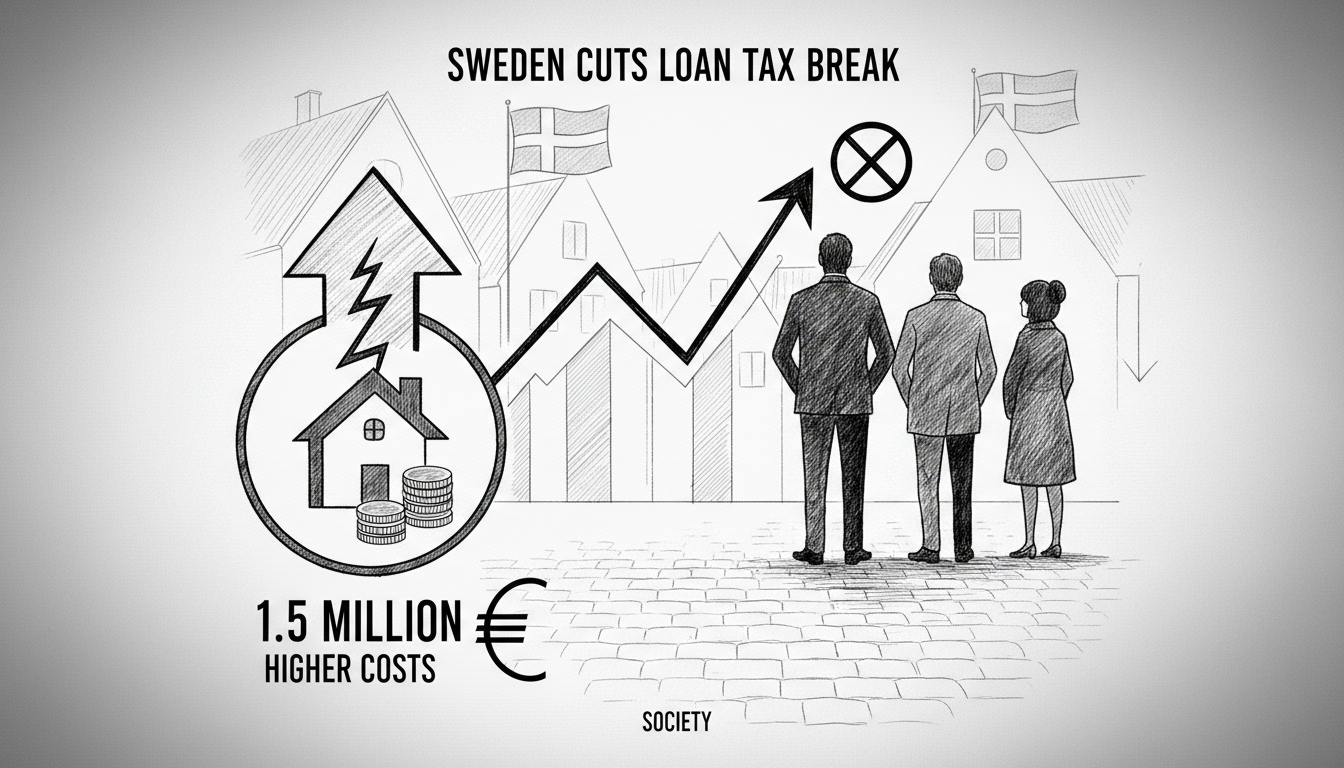
Sweden's long-standing tax deduction for loan interest is ending for unsecured debt, a move that will directly impact an estimated 1.5 million people. For decades, the ability to deduct interest payments from taxable income has been a cornerstone of Swedish personal finance. Next year, that safety net vanishes for those with 'blancolån'—unsecured personal loans and credit card debt—potentially pushing more households toward the debt collection authority, Kronofogden.
I met with Erik Lundström, a 34-year-old graphic designer from Hammarby Sjöstad, at a café near his apartment. He has a 50,000 kronor blancolån he used to consolidate smaller debts. "It felt manageable," he told me, stirring his coffee. "You factor in the tax break. It's a small cushion, but it's there. Now, that's gone. It's just another monthly squeeze." His story is not unique. Across Stockholm, from the student corridors in Lappis to the family homes in Årsta, similar conversations are happening.
The End of a Financial Tradition
The interest deduction, or 'ränteavdrag', is deeply woven into Swedish economic life. Its primary purpose was to promote homeownership by making mortgages more affordable. However, the policy applied broadly to most loan interest, creating an unintended incentive for other forms of borrowing. "We have a cultural comfort with debt in Sweden, partly supported by this system," explains financial analyst Klara Bergman. "The deduction made borrowing cheaper, which was great for mortgages but also softened the real cost of consumer credit."
Removing it for unsecured loans marks a significant policy shift. The government's goal is clear: to discourage high-interest, risky borrowing and cool down household debt levels, which are among the highest in Europe. Bergman notes the paradox. "We encourage massive mortgage debt with one hand, while now discouraging smaller, costlier consumer debt with the other. The logic is about security—a house is an asset, a holiday or a new TV is not."
Who Feels the Pinch?
The 1.5 million Swedes affected are not a monolith. They include students using credit to cover living costs, young adults financing a driver's license or first car, and families using a blancolån for an unexpected expense like a broken appliance. There's also a segment using high-cost credit for daily essentials, a group financial counselors worry about most.
At a debt advice center in Rinkeby, advisor Miriam Hassan sees the frontline. "For many of my clients, a 500-krona increase in monthly payments is catastrophic," she says. "They are already balancing on the edge. This policy might aim for responsible borrowing, but for those already trapped, it's just a push deeper into the hole. The path from a missed payment to Kronofogden can be very fast."
The Swedish Enforcement Authority, Kronofogden, is the end point for unmanageable debt. While its exact caseload fluctuates, any widespread increase in financial pressure will inevitably lead more people to its doors. This means payment plans, enforced deductions from salaries, and a mark on one's credit record that can last for years, affecting everything from apartment rentals to future loans.
A Ripple Effect on Spending and Society
The economic implications extend beyond individual budgets. Consumer spending is a major engine of the Swedish economy. If hundreds of thousands of households suddenly have less disposable income each month, retail, hospitality, and service sectors could feel a chill. "We're looking at a significant withdrawal of purchasing power," says Bergman. "It won't just be the borrower who cuts back. It could mean fewer dinners out in Södermalm, less spending on hobbies, and a more cautious approach to Christmas gifts this December."
This comes at a time when many Swedes are already grappling with high inflation and rising food prices. The removal of the deduction adds another fixed pressure. For some, it may indeed lead to more careful financial planning. For others, it represents a genuine crisis. The policy also raises questions about fairness. Why does someone with a multi-million kronor mortgage on a villa in Danderyd keep their full deduction, while a student in Uppsala with a 20,000 kronor loan loses theirs?
Navigating a New Financial Landscape
So, what can affected Swedes do? Financial advisors are unanimous: act now, don't wait. "The first step is total transparency with yourself," says Hassan. "List every debt, its interest rate, and its term. Then, explore options." These options include contacting lenders to discuss terms, consolidating multiple high-interest loans into a single, lower-interest one if possible, and, crucially, reviewing personal budgets.
Many banks offer budget counseling tools. Non-profit organizations like the Swedish Consumer Agency provide free, impartial advice. The key message is to treat the lost deduction as an immediate, permanent increase in the cost of your debt. For Erik, the designer, it means cutting his streaming services and committing to cycling everywhere instead of using public transport. "It's not the end of the world," he shrugs, "but it's a change. You adapt."
A Cultural Shift in Borrowing?
This policy change might signal a deeper shift in Sweden's relationship with debt. The era of cheap, tax-advantaged consumer credit is over. The cultural norm of 'buy now, pay later' is being challenged by economic reality and political will. Whether this leads to a healthier, more sustainable level of household debt or simply exacerbates inequality and financial stress remains to be seen.
As I left the café, Erik's final thought lingered. "We talk about 'folkhemmet,' the people's home, and taking care of each other," he said. "But sometimes financial policies feel like they're made for a different Sweden than the one I live in." His sentiment captures the core of this story. It's not just about kronor and öre. It's about a changing social contract, about who bears the cost of economic adjustment, and how a nation known for stability navigates the delicate balance between individual responsibility and collective security. The true impact of this lost deduction will be written in the daily choices of 1.5 million Swedes in the months to come.