
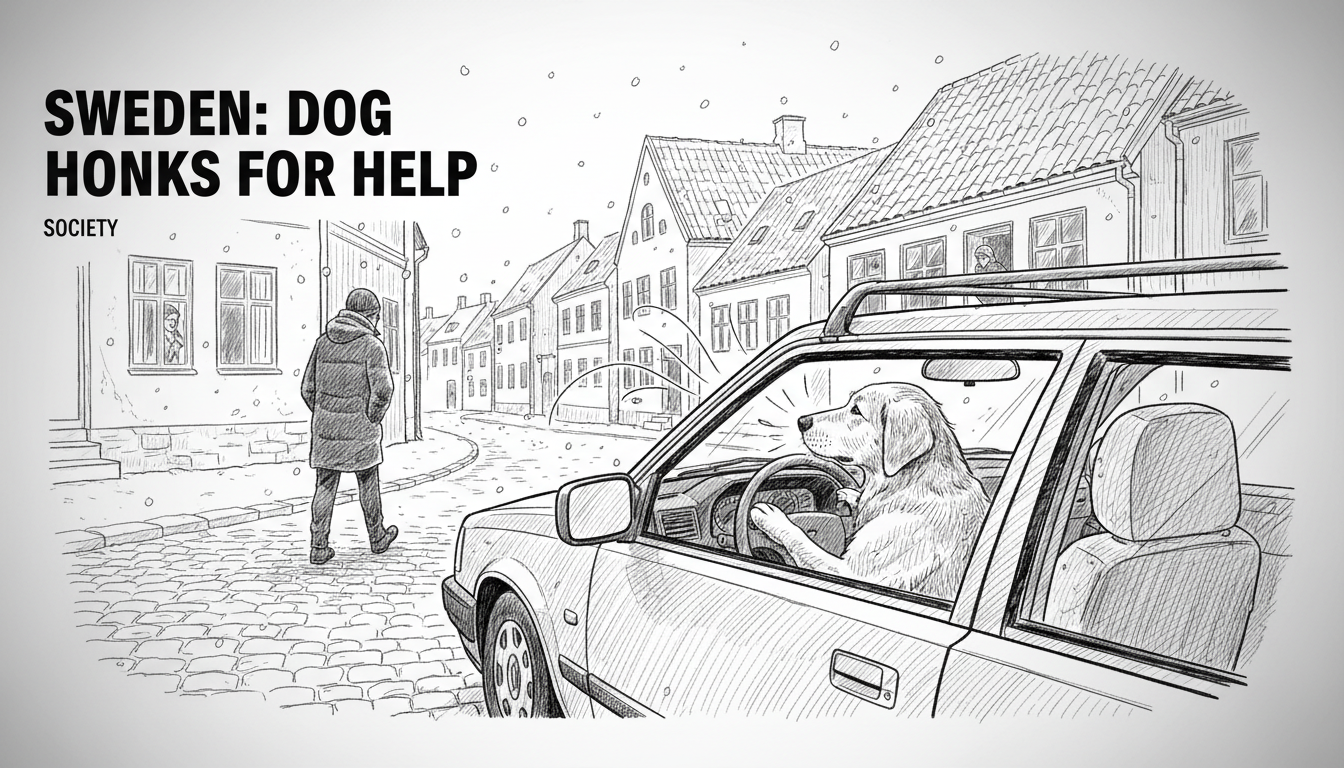
Sweden animal welfare laws were put to the test in Västerås this week when a trapped dog used its own horn to call for help. The incident, which saw a concerned citizen alert police after hearing persistent honking from a parked car, highlights the deep-seated public concern for animals in Swedish society. It also raises questions about responsibility and the limits of legal protection for pets in everyday situations.
A Canine Cry for Help in Västerås
Just before 5 PM on a weekday, an unusual sound broke the ordinary hum of a Västerås street. It wasn't an alarm, but the steady, insistent honk of a car horn. Passersby, attuned to the rhythm of their city on the shores of Lake Mälaren, stopped to investigate. The source was a parked vehicle. Peering inside, they found not a frustrated driver, but a distressed dog. The animal had managed to press its weight against the steering wheel, sounding the horn in what appeared to be a plea for rescue. For many Swedes, where pets are considered family members, the scene was immediately alarming. One person, their concern overriding any hesitation, picked up the phone and called the police.
The Swedish police, known as Polisen, face constant prioritization decisions. Their response to this call reflects a standard protocol. With no immediate threat to human life and no sign of a crime in progress, they did not dispatch a patrol car. Instead, they used available resources to contact the vehicle's registered owner. This pragmatic approach is standard, but it leaves a gap between public expectation and police capacity. The public sees a creature in potential distress; the police see a non-emergency situation that can be resolved indirectly. This disconnect is at the heart of the story.
The Legal Landscape for Swedish Pets
Sweden's Animal Welfare Act is among the most comprehensive in the world. It states clearly that animals must be treated well and protected from unnecessary suffering and disease. The law mandates suitable shelter, care, and a good environment for all domestic animals. Crucially, it is illegal to leave an animal unattended in a way that could cause it suffering from heat, cold, or other distress. On a hot summer day, a car interior can become lethally hot within minutes. On a cold winter day, it can become a freezing trap. The law's intent is unambiguous, but its enforcement relies on observation and reporting.
"The public's role is vital," says a Stockholm-based veterinarian who asked not to be named while discussing legal matters. "The law sets a high standard, but it's the eyes of neighbors and passersby that often trigger action. What happened in Västerås is a perfect example. The dog drew attention to itself, and a responsible citizen took the next step." The expert emphasized that while the dog's action was clever, it was also a sign of significant stress. "A dog doesn't honk a horn out of curiosity. It's panic, confusion, or extreme discomfort. Owners must understand that leaving a pet alone in a car, even for 'just a few minutes,' is a gamble with their well-being."
Public Duty vs. Private Property
This incident taps into a core Swedish value: collective responsibility, or samhällsansvar. People here are generally not hesitant to intervene if they see something wrong, from littering to a potential welfare issue. The concept of Allemansrätten, the public right of access to nature, comes with the duty to care for it. This ethos extends to animals. However, it clashes with the strong cultural respect for personal privacy and private property. Confronting a stranger about their pet care, or taking direct action like breaking a car window, is a major step. Most Swedes would choose the official channel: calling authorities.
This is where the system shows its strain. Local municipalities and animal welfare organizations, like Djurskyddet, handle most animal welfare concerns. Police involvement is typically a last resort for immediate, severe cases. The Västerås response—contacting the owner—is likely the standard outcome. The question left unanswered is: what was the outcome for the dog? Was the owner minutes away at a shop, or had the animal been left for hours? The police report does not say. This lack of public closure can be frustrating for a community that values transparency and results.
Beyond the Honk: A Cultural Mirror
Swedes have one of the highest rates of pet ownership in Europe. Dogs are ubiquitous in cafes, on public transport, and in offices. They are part of the social fabric. Stories of animal neglect or cruelty provoke strong reactions. The image of a dog alone in a car, smart enough to hit the horn but helpless to escape, resonates deeply. It's a narrative that fits into a larger cultural conversation about ethics and care.
In neighborhoods like Södermalm in Stockholm or Linné in Gothenburg, it's common to see dogs tethered outside grocery stores while their owners shop quickly. There's an unspoken social contract that this is acceptable for a brief period in mild weather. The Västerås incident challenges that assumption. What is 'brief'? What is 'mild'? The law is clear on the principle but fuzzy on the practicalities, leaving it to individual judgment—both the owner's and the passerby's.
Prevention Over Intervention
The real lesson from Västerås is not about police response, but about prevention. Animal welfare groups consistently campaign with a simple message: never leave your dog in the car alone. The campaigns ramp up before summer, warning of rapid temperature rises. Yet, every year, similar incidents occur. Education remains key. For tourists visiting Sweden, this cultural priority can be surprising. Bringing a dog into a department store or a restaurant is often more accepted than leaving it panting in a parked vehicle outside.
Perhaps the most Swedish aspect of this story is the dog's alleged action. It didn't just bark; it used the technology at its disposal to solve a problem. It communicated in the only way it could to the human world outside its glass and metal box. And someone listened. That chain of event—animal ingenuity triggering human concern triggering official action—is a small but telling snapshot of society. It shows a system that works, but only when every link in the chain holds.
As the days grow warmer, the memory of the honking dog in Västerås serves as a timely reminder. Sweden's strong laws and caring culture set a high bar for animal welfare. But those standards are ultimately upheld by the vigilance of ordinary people on ordinary streets, listening for signs of distress and choosing to act. The next time a car horn sounds without a visible driver, more eyes might turn to look. And that, in itself, is a form of protection.