
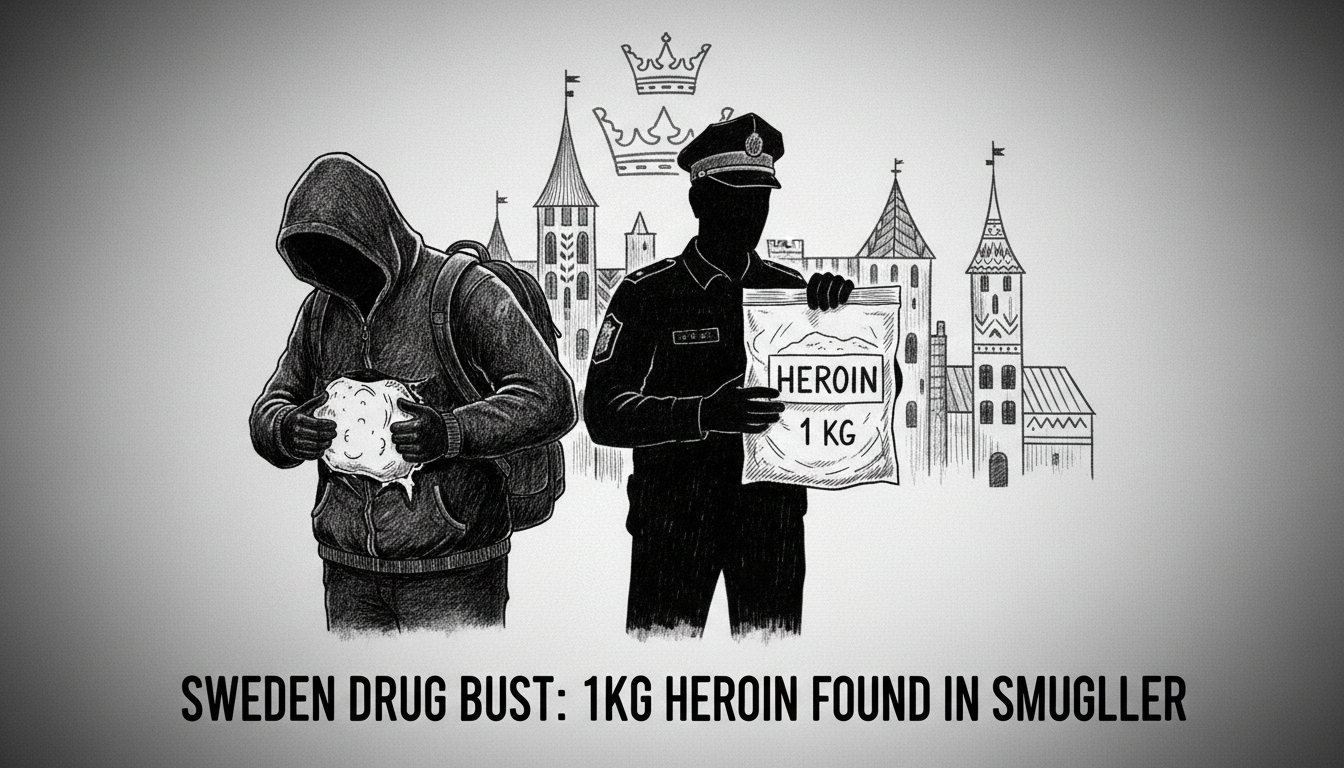
Sweden’s Customs Authority intercepted a major drug shipment after a routine check at Gothenburg’s central bus terminal. A 30-year-old man, arriving on a bus from Copenhagen, was found to have swallowed nearly one kilogram of heroin. The dramatic seizure highlights the ongoing pressure on Sweden’s borders and the severe risks taken by drug couriers.
"He appeared nervous and was visibly beaten," a Customs officer familiar with the case said in a statement. The man, whose identity remains confidential, reportedly told authorities, "I couldn't say no. The alternative to making this trip was ending up in a grave." This statement points to the coercion often employed by criminal networks exploiting vulnerable individuals for high-risk smuggling operations. The incident unfolded at the Nils Ericson Terminal, a critical transit hub connecting Sweden to Denmark and the wider continent.
A Routine Check Yields a Major Seizure
Customs officers at the terminal selected the Copenhagen bus for a standard, randomized passenger control. The selection of buses for checks is a key tactic, exploiting the often less-scrutinized land routes compared to airports. The targeted 30-year-old passenger immediately drew attention due to his nervous demeanor and signs of physical assault. Upon further inspection, officers discovered he was carrying the drugs internally. The nearly one-kilogram haul represents a significant quantity, typically destined for further distribution within Sweden’s illicit drug market.
The method of body-packing, or swallowing drug packages, is notoriously dangerous. "If one of those packages ruptures internally, the courier faces immediate, fatal overdose," explains Dr. Lena Korf, a Stockholm-based forensic toxicologist consulted for this analysis. "These individuals are treated as disposable assets by the organizations they work for. The physical and psychological coercion is immense." The man was immediately transported to a hospital for medical supervision to safely retrieve the packets.
Sweden's Strict Legal Framework and Border Strategy
This seizure occurs within the context of Sweden's stringent narcotics laws, where penalties are severe and based on the quantity and type of drug. A kilogram of heroin is classified as a "particularly serious narcotics offense," which under Swedish law can lead to a prison sentence of up to ten years or more. The Swedish government and the Riksdag have consistently upheld a restrictive drug policy, focusing on prevention and law enforcement.
"Interceptions like this at key transit points are vital," stated Customs Department Head, Anna Lundberg, in a related briefing last month. "Our work at ports, terminals, and border crossings is a frontline defense." The strategy involves combining intelligence, risk profiling, and random checks to disrupt supply chains. Geographically, Sweden’s position makes it a final destination and a transit route for narcotics moving from European production centers into the Nordic region.
The Broader Battle Against Narcotics Trade
While this single seizure is substantial, it is part of a larger annual haul. According to the Swedish Customs' official annual report for 2023, the agency confiscated a total of 1,286 kilograms of narcotics. This figure represents a mix of substances intercepted across all border points. The street value of seized drugs fluctuates based on purity, local demand, and distribution level. Expert assessments suggest one kilogram of wholesale heroin could be worth several hundred thousand Swedish kronor; once cut and sold at street level, its retail value multiplies significantly.
The case underscores a grim reality of international drug trafficking: the lower-level couriers are often victims themselves. "They are frequently individuals trapped by debt or threats against their families," notes criminologist Professor Erik Månsson of Lund University. "While the Swedish legal system must prosecute the crime, this exposes the brutal methods of the criminal networks operating across European borders. The solution requires coordinated international police work targeting the leaders, not just the carriers."
Policy Implications and Future Enforcement
The incident will likely be cited in ongoing discussions at Rosenbad, the Swedish government offices, concerning resource allocation for border security. It validates the continued investment in Customs personnel and technology. Debates in the Riksdag building often center on balancing effective law enforcement with human rights approaches to tackling the root causes of drug-related crime, including addiction and vulnerability to coercion.
For the Swedish police and customs, the focus remains on disrupting logistics. The bus route from Copenhagen to Gothenburg is known to authorities, and this bust will likely lead to increased, if intermittent, surveillance on such connections. The challenge is vast, as criminal networks constantly adapt their methods in response to enforcement tactics.
This event in Gothenburg is more than a single arrest. It is a snapshot of a continuous, high-stakes conflict at Sweden's borders. It reveals the human cost paid by those at the bottom of the smuggling chain and reaffirms the substantial quantities of drugs flowing toward the Nordic market. As the suspect faces serious charges, the broader questions remain: How many similar shipments evade detection, and what more can be done to dismantle the networks that view human beings as expendable packaging? The answer will shape Sweden's security policy for years to come.