
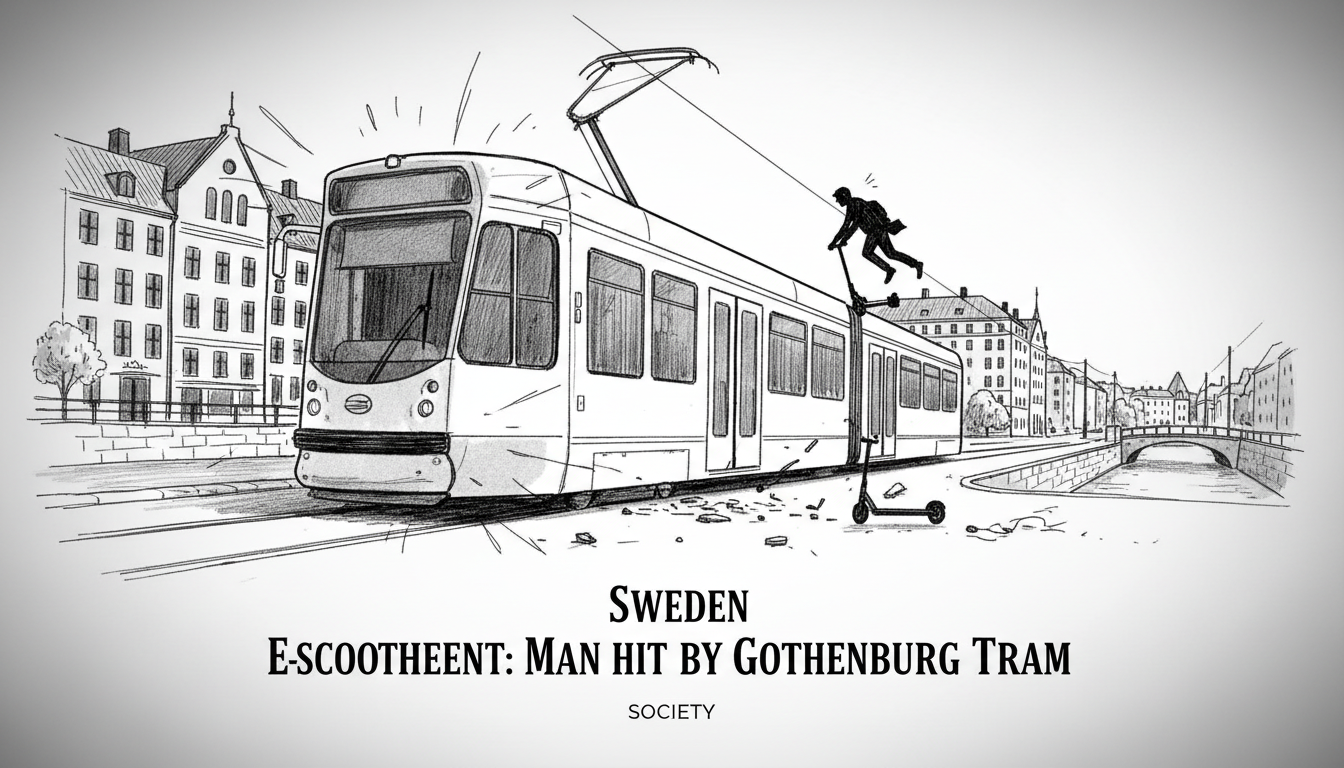
Sweden's latest electric scooter accident involved a man in his 50s being struck by a tram in central Gothenburg on Sunday afternoon. The collision, which left the man with serious injuries, has reignited a fierce national debate about traffic safety, urban planning, and the rapid rise of micro-mobility. For residents of Sweden's second city, the sound of screeching tram brakes is a familiar backdrop to this growing conflict on their streets.
The man was conscious after the collision and was taken by ambulance to Sahlgrenska University Hospital. His condition was reported as serious but stable. Police quickly launched an investigation for reckless driving in traffic. They also seized the electric scooter for a technical examination. Tram services along the affected line were disrupted for nearly an hour, a common ripple effect from such incidents in the tram-dependent city.
A Sunday Afternoon on the Tracks
Gothenburg's tram network is the backbone of the city. Its blue and white carriages are as iconic to the city's landscape as the canals of the Långgatorna district. The accident occurred as weekend traffic was winding down. It happened at a crossing point where the paths of trams, cars, bicycles, and now e-scooters inevitably meet. These are the complex, shared spaces where Swedish traffic safety ideals are being tested daily.
“We have initiated a report for careless driving in traffic and the e-scooter has been seized for technical investigation,” said Jon Franzén, the police officer in charge at the time. His statement reflects a standard procedure, but the context is anything but routine. Each serious accident adds fuel to an ongoing political and social discussion about how to govern our new two-wheeled reality.
The National Clash of Mobility Cultures
This is not an isolated event. Electric scooters exploded onto Swedish streets around 2018. They were marketed as a green, convenient last-mile solution. Their silent, swift presence has since become a point of contention. In Stockholm's bustling Stureplan or Malmö's crowded Triangeln, similar tensions simmer. The Gothenburg incident is a severe symptom of a nationwide adaptation challenge.
Pedestrians complain about scooters speeding on sidewalks. Car drivers report sudden, unpredictable maneuvers. Tram and bus operators now navigate a more chaotic environment. The scooters themselves, often left lying on their sides, have become a symbol of urban clutter. “It’s a free-for-all out there now,” says Erik Lundström, a Gothenburg taxi driver I spoke with. “The rules are unclear, and not everyone follows the ones we have. It was calmer before.”
Searching for Solutions in Swedish Cities
Swedish traffic safety experts have been vocal about the need for clearer regulations. The current framework often treats e-scooters similarly to bicycles. They are supposed to use cycle lanes where available and the roadway where they are not. Riding on sidewalks is prohibited. In reality, enforcement is difficult and user behavior is mixed. The maximum speed limit of 20 km/h is frequently ignored, especially with private, more powerful models.
“The infrastructure was not built for this,” explains urban planner Anette Pettersson, who has studied micro-mobility integration in Nordic cities. “Our bike lanes in many older city centers are too narrow. The sharing of space is not designed intuitively. We need physical separation, better signage, and consistent enforcement of speed limits. Education alone is not enough.”
Some municipalities are taking action. Stockholm has designated specific parking zones and fined companies for poorly parked scooters. Helsingborg has implemented reduced speed zones in certain areas. Gothenburg itself has been discussing stricter measures. The accident on Sunday will likely add urgency to those political talks. The question is whether change will come through gradual policy shifts or in reaction to further tragedies.
The Human Cost Beyond the Statistics
Behind the policy debates are real people and families. The man injured on Sunday faces a long recovery. The tram driver involved will receive crisis support, a standard offer from public transport operator Västtrafik after traumatic incidents. These human impacts are sometimes lost in the broader cultural argument. For every headline-grabbing accident, there are countless near-misses and daily friction that erode the sense of safety in public spaces.
Local residents I spoke to near the accident site expressed a mix of concern and frustration. “I use them sometimes, they are practical,” said Mia, a student. “But I see people driving recklessly all the time, often without helmets. It gives all users a bad name.” An elderly man, Karl, was more blunt. “They are a menace. They belong on the road with cars, not where people are walking. This was bound to happen.”
What Comes Next for Sweden's Streets?
The path forward for Sweden is complex. The genie of micro-mobility cannot be put back in the bottle. The environmental and practical benefits of e-scooters are significant for a nation committed to sustainable transport. The challenge is one of integration and adaptation. It requires investment in infrastructure, clear and fair regulations, and a cultural shift among users to prioritize safety over speed and convenience.
Will we see mandatory helmet laws? Stricter age verification for rental apps? More dedicated and physically protected lanes? The accident in Gothenburg makes these questions more pressing. Swedish society prides itself on consensus and folkhemmet—the idea of the public home where all are safe. That core value is now colliding with a new technology on the streets of its major cities. The solution will need to be as innovative as the scooters themselves, balancing freedom with responsibility in a way that protects everyone sharing the asphalt.
The screech of tram brakes on Sunday was a loud alarm. The question for Gothenburg, and for all of Sweden, is whether we will listen and act before the next one sounds.