
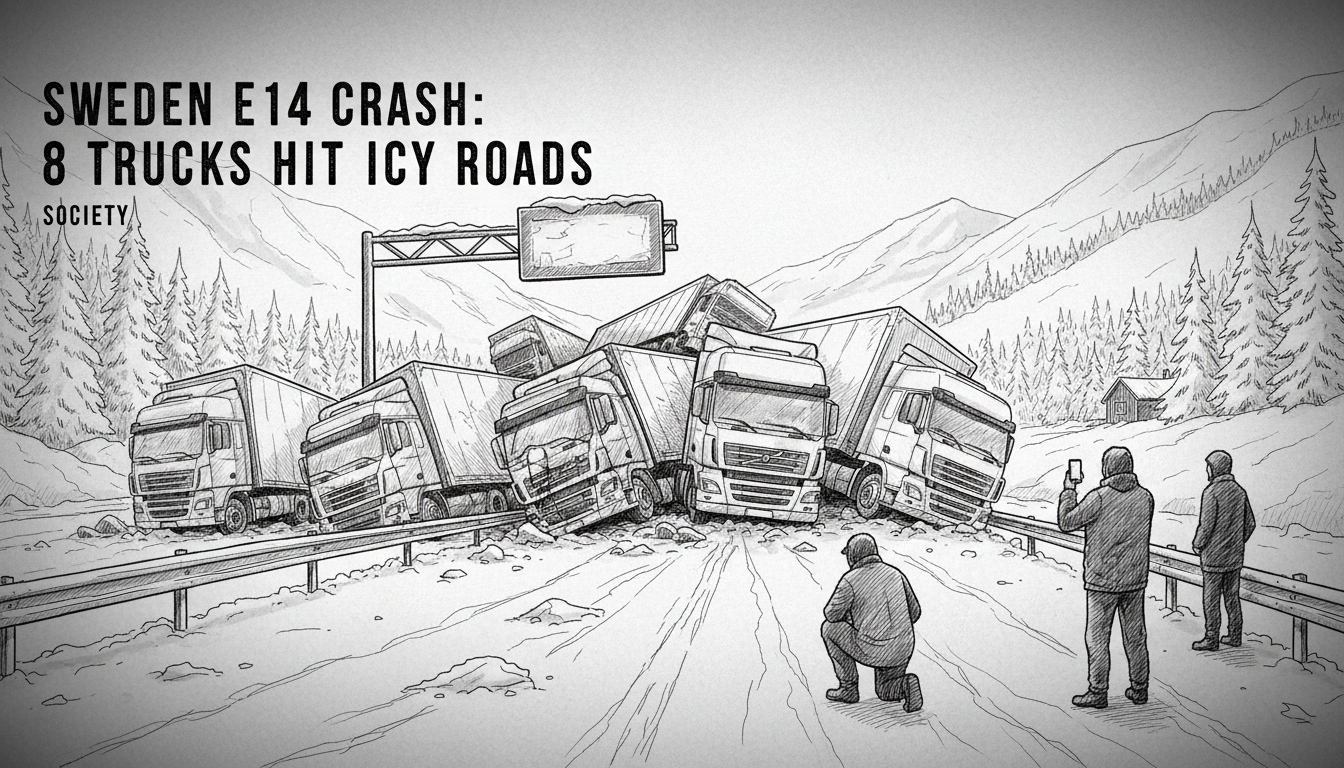
Sweden's E14 highway was the scene of a major collision involving up to eight trucks on Thursday morning. The crash near Enafors in Åre Municipality occurred just after 9:45 AM, with emergency services citing treacherous icy roads as the primary cause. A yellow weather warning for ice from the Swedish Meteorological and Hydrological Institute (SMHI) was active in the area at the time. The full extent of injuries remains unclear as rescue crews from Storlien and Åre rushed to the scene.
“It appears to be the reason,” said Niklas Zander, an alarm and command operator with the rescue service, referring to the slippery conditions. This incident highlights the perennial challenge of maintaining road safety in Sweden during the long winter months, where a sudden drop in temperature or freezing rain can turn a major artery into a hazard within minutes.
A Routine Morning Turned Dangerous
The E14 is a vital transport link, cutting across central Sweden from the industrial port city of Sundsvall on the Baltic coast to the Norwegian border. The stretch near Åre, a world-renowned ski resort, is particularly busy with commercial traffic and tourists. For the drivers involved, Thursday began as a normal haul. They were navigating a landscape of stunning, snow-dusted fells under a sky that promised more winter. Then, the ice took control.
Initial reports vary between four and eight heavy goods vehicles caught in the collision sequence. Such multi-vehicle pile-ups, especially involving trucks, are among the most complex and dangerous scenarios for Sweden's rescue services. They require specialized equipment to handle potential fuel spills, heavy lifting, and securing unstable cargo. The immediate priority is always life-saving: extracting any trapped drivers and providing urgent medical care.
The Invisible Threat on Swedish Roads
SMHI's yellow warning was no mere suggestion. Their color-coded system is a critical public safety tool. A yellow warning signals weather that could pose a risk to the public and cause minor disruptions to society. For drivers, it translates to one clear message: extreme caution. Ice, or ishalka, is arguably the most deceptive winter hazard. Black ice, in particular, forms a nearly invisible glaze on asphalt, offering no visual cue to drivers until their vehicles begin to slide.
“Every winter, we see these accidents,” says Lars Strömberg, a veteran driving instructor based in Stockholm. “The technology in vehicles and tires is better than ever, but it cannot override physics. On ice, the stopping distance is multiplied many times over. The only effective strategies are appropriate winter tires, a drastic reduction in speed, and increasing your following distance to an amount that feels almost absurd. People forget that a fully loaded truck cannot stop on a dime, even with the best tires.”
Strömberg’s point is echoed by official statistics. In 2022, preliminary data from the Swedish Transport Administration recorded 301 fatal road accidents. While not all are winter-related, a significant portion occurs during the October-April period when conditions are at their most challenging.
The Ripple Effect of a Closed Highway
Beyond the immediate human cost, an accident of this scale on the E14 creates a cascade of logistical and economic problems. The highway is a key corridor for transporting goods between Sweden and Norway. A closure, even for a few hours, forces long detours, delays deliveries, and disrupts supply chains. For the municipality of Åre, which thrives on accessibility for skiers and seasonal workers, any blockage of the main road is a significant event.
Local businesses, from hotels to restaurants, monitor such incidents closely. A guest delayed by six hours is a dinner reservation lost. A shipment of fresh produce that doesn't arrive can affect a week's menu. “We are so dependent on that road being open,” says Anna Kjellsson, who runs a lodge just off the E14. “You watch the weather reports and the traffic news with one eye all winter. It’s part of life up here. You have immense respect for the drivers who keep things moving in these conditions.”
A Culture of Winter Preparedness
Living with this reality has shaped Swedish society and culture. The concept of vinterberedskap (winter preparedness) is ingrained. It starts at the municipal level, with fleets of plows and graders working around the clock. But it extends into every home and vehicle. Swedes swap to studded or high-quality friction winter tires by law between December 1st and March 31st, depending on the region. Car owners meticulously check their tire tread depth.
There’s a collective understanding that winter demands a change in rhythm. People plan extra travel time. They check the SMHI app before a journey. School might start later if the buses are delayed by snow. This cultural adaptation is a necessary response to the environment. Yet, as the Enafors crash shows, even with high preparedness, the margin for error on an icy road is terrifyingly thin. The difference between a controlled stop and a collision can be a slight gradient in the road or a patch of shade where ice formed more thickly.
Looking Ahead: Technology and Human Responsibility
Road safety experts are constantly looking for improvements. Better road salting and brining techniques, more accurate hyper-local weather forecasting, and in-vehicle warning systems connected to road sensors are all in development. The Swedish Transport Administration invests heavily in maintaining its road network to the highest possible winter standard.
However, technology can only do so much. The final layer of safety is the driver's judgment. This accident will likely prompt renewed calls from authorities for vigilance. Campaigns reminding drivers to adapt their speed to the actual road conditions, not the speed limit, are a staple of Swedish winters. The message is simple: no appointment or delivery deadline is worth the risk posed by severe ice.
As the cleanup on the E14 continues and investigators piece together the exact sequence of events, the incident serves as a stark, early-season reminder. Sweden's beautiful winter landscape comes with inherent risks. The snow and ice that draw tourists and enable winter sports are the same elements that demand our utmost respect on the roads. The hope tonight in Åre, and in communities all along Sweden's winter highways, is that everyone involved in the Enafors crash makes it home safely. And that every other driver on the road takes an extra moment to consider the conditions before they set out.
Will this winter see a reduction in similar incidents, or is the battle against ice on the roads one that can never truly be won?